

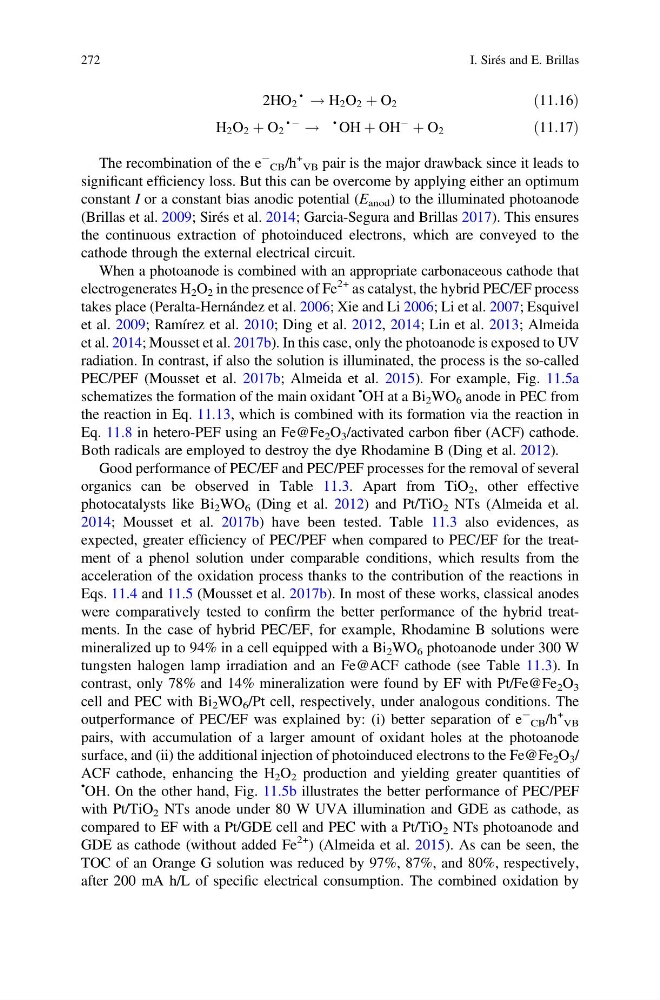
2HO 2
•
! H 2 O 2 þ O 2
ð11:16Þ
H 2 O 2 þ O 2
• À
!
• OH þ OH
À
þ O 2
ð11:17Þ
The recombination of the e
À
CB /h
+
VB pair is the major drawback since it leads to
significant efficiency loss. But this can be overcome by applying either an optimum
constant I or a constant bias anodic potential (E anod ) to the illuminated photoanode
(Brillas et al. 2009; Sirés et al. 2014; Garcia-Segura and Brillas 2017). This ensures
the continuous extraction of photoinduced electrons, which are conveyed to the
cathode through the external electrical circuit.
When a photoanode is combined with an appropriate carbonaceous cathode that
electrogenerates H 2 O 2 in the presence of Fe
2+ as catalyst, the hybrid PEC/EF process
takes place (Peralta-Hernández et al. 2006; Xie and Li 2006; Li et al. 2007; Esquivel
et al. 2009; Ramírez et al. 2010; Ding et al. 2012, 2014; Lin et al. 2013; Almeida
et al. 2014; Mousset et al. 2017b). In this case, only the photoanode is exposed to UV
radiation. In contrast, if also the solution is illuminated, the process is the so-called
PEC/PEF (Mousset et al. 2017b; Almeida et al. 2015). For example, Fig. 11.5a
schematizes the formation of the main oxidant
•
OH at a Bi 2 WO 6 anode in PEC from
the reaction in Eq. 11.13, which is combined with its formation via the reaction in
Eq. 11.8 in hetero-PEF using an Fe@Fe 2 O 3 /activated carbon fiber (ACF) cathode.
Both radicals are employed to destroy the dye Rhodamine B (Ding et al. 2012).
Good performance of PEC/EF and PEC/PEF processes for the removal of several
organics can be observed in Table 11.3. Apart from TiO 2 , other effective
photocatalysts like Bi 2 WO 6 (Ding et al. 2012) and Pt/TiO 2 NTs (Almeida et al.
2014; Mousset et al. 2017b) have been tested. Table 11.3 also evidences, as
expected, greater efficiency of PEC/PEF when compared to PEC/EF for the treatment of a phenol solution under comparable conditions, which results from the
acceleration of the oxidation process thanks to the contribution of the reactions in
Eqs. 11.4 and 11.5 (Mousset et al. 2017b). In most of these works, classical anodes
were comparatively tested to confirm the better performance of the hybrid treatments. In the case of hybrid PEC/EF, for example, Rhodamine B solutions were
mineralized up to 94% in a cell equipped with a Bi 2 WO 6 photoanode under 300 W
tungsten halogen lamp irradiation and an Fe@ACF cathode (see Table 11.3). In
contrast, only 78% and 14% mineralization were found by EF with Pt/Fe@Fe 2 O 3
cell and PEC with Bi 2 WO 6 /Pt cell, respectively, under analogous conditions. The
outperformance of PEC/EF was explained by: (i) better separation of e
À
CB /h
+
VB
pairs, with accumulation of a larger amount of oxidant holes at the photoanode
surface, and (ii) the additional injection of photoinduced electrons to the Fe@Fe 2 O 3 /
ACF cathode, enhancing the H 2 O 2 production and yielding greater quantities of
•
OH. On the other hand, Fig. 11.5b illustrates the better performance of PEC/PEF
with Pt/TiO 2 NTs anode under 80 W UVA illumination and GDE as cathode, as
compared to EF with a Pt/GDE cell and PEC with a Pt/TiO 2 NTs photoanode and
GDE as cathode (without added Fe
2+ ) (Almeida et al. 2015). As can be seen, the
TOC of an Orange G solution was reduced by 97%, 87%, and 80%, respectively,
after 200 mA h/L of specific electrical consumption. The combined oxidation by
272
I. Sirés and E. Brillas
•
! H 2 O 2 þ O 2
ð11:16Þ
H 2 O 2 þ O 2
• À
!
• OH þ OH
À
þ O 2
ð11:17Þ
The recombination of the e
À
CB /h
+
VB pair is the major drawback since it leads to
significant efficiency loss. But this can be overcome by applying either an optimum
constant I or a constant bias anodic potential (E anod ) to the illuminated photoanode
(Brillas et al. 2009; Sirés et al. 2014; Garcia-Segura and Brillas 2017). This ensures
the continuous extraction of photoinduced electrons, which are conveyed to the
cathode through the external electrical circuit.
When a photoanode is combined with an appropriate carbonaceous cathode that
electrogenerates H 2 O 2 in the presence of Fe
2+ as catalyst, the hybrid PEC/EF process
takes place (Peralta-Hernández et al. 2006; Xie and Li 2006; Li et al. 2007; Esquivel
et al. 2009; Ramírez et al. 2010; Ding et al. 2012, 2014; Lin et al. 2013; Almeida
et al. 2014; Mousset et al. 2017b). In this case, only the photoanode is exposed to UV
radiation. In contrast, if also the solution is illuminated, the process is the so-called
PEC/PEF (Mousset et al. 2017b; Almeida et al. 2015). For example, Fig. 11.5a
schematizes the formation of the main oxidant
•
OH at a Bi 2 WO 6 anode in PEC from
the reaction in Eq. 11.13, which is combined with its formation via the reaction in
Eq. 11.8 in hetero-PEF using an Fe@Fe 2 O 3 /activated carbon fiber (ACF) cathode.
Both radicals are employed to destroy the dye Rhodamine B (Ding et al. 2012).
Good performance of PEC/EF and PEC/PEF processes for the removal of several
organics can be observed in Table 11.3. Apart from TiO 2 , other effective
photocatalysts like Bi 2 WO 6 (Ding et al. 2012) and Pt/TiO 2 NTs (Almeida et al.
2014; Mousset et al. 2017b) have been tested. Table 11.3 also evidences, as
expected, greater efficiency of PEC/PEF when compared to PEC/EF for the treatment of a phenol solution under comparable conditions, which results from the
acceleration of the oxidation process thanks to the contribution of the reactions in
Eqs. 11.4 and 11.5 (Mousset et al. 2017b). In most of these works, classical anodes
were comparatively tested to confirm the better performance of the hybrid treatments. In the case of hybrid PEC/EF, for example, Rhodamine B solutions were
mineralized up to 94% in a cell equipped with a Bi 2 WO 6 photoanode under 300 W
tungsten halogen lamp irradiation and an Fe@ACF cathode (see Table 11.3). In
contrast, only 78% and 14% mineralization were found by EF with Pt/Fe@Fe 2 O 3
cell and PEC with Bi 2 WO 6 /Pt cell, respectively, under analogous conditions. The
outperformance of PEC/EF was explained by: (i) better separation of e
À
CB /h
+
VB
pairs, with accumulation of a larger amount of oxidant holes at the photoanode
surface, and (ii) the additional injection of photoinduced electrons to the Fe@Fe 2 O 3 /
ACF cathode, enhancing the H 2 O 2 production and yielding greater quantities of
•
OH. On the other hand, Fig. 11.5b illustrates the better performance of PEC/PEF
with Pt/TiO 2 NTs anode under 80 W UVA illumination and GDE as cathode, as
compared to EF with a Pt/GDE cell and PEC with a Pt/TiO 2 NTs photoanode and
GDE as cathode (without added Fe
2+ ) (Almeida et al. 2015). As can be seen, the
TOC of an Orange G solution was reduced by 97%, 87%, and 80%, respectively,
after 200 mA h/L of specific electrical consumption. The combined oxidation by
272
I. Sirés and E. Brillas