

Fe
III
=Co
III
‐OH þ H 2 O 2 ! Fe
II
=Co
II
‐OH þ HO 2
•
þ H
þ
ð11:10Þ
Fe
II
=Co
II
‐OH þ H 2 O 2 ! Fe
III
=Co
III
‐OH þ
• OH þ OH
À
ð11:11Þ
11.3 Nanomaterials as Anodes
The EF and PEF treatments are usually carried out in cells equipped with conventional anodes like plates, rods/bars, or meshes. Alternatively, they can be performed
with nanostructured anodes that can act as photoanodes or more efficient
electrocatalysts. In the former case, hybrid processes with photoelectrocatalysis
(PEC) have been devised. This section is focused on the preparation and application
of such materials.
11.3.1 TiO 2 -Based Photoanodes
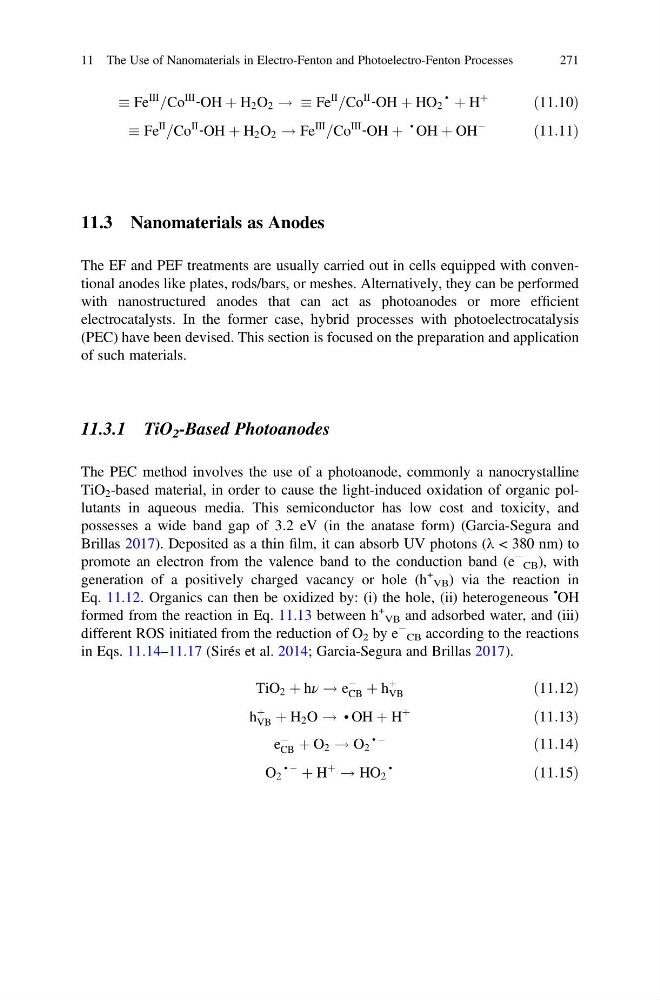
The PEC method involves the use of a photoanode, commonly a nanocrystalline
TiO 2 -based material, in order to cause the light-induced oxidation of organic pollutants in aqueous media. This semiconductor has low cost and toxicity, and
possesses a wide band gap of 3.2 eV (in the anatase form) (Garcia-Segura and
Brillas 2017). Deposited as a thin film, it can absorb UV photons (λ < 380 nm) to
promote an electron from the valence band to the conduction band (e
À
CB ), with
generation of a positively charged vacancy or hole (h
+
VB ) via the reaction in
Eq. 11.12. Organics can then be oxidized by: (i) the hole, (ii) heterogeneous
•
OH
formed from the reaction in Eq. 11.13 between h
+
VB and adsorbed water, and (iii)
different ROS initiated from the reduction of O 2 by e
À
CB according to the reactions
in Eqs. 11.14–11.17 (Sirés et al. 2014; Garcia-Segura and Brillas 2017).
TiO 2 þ hν ! e
À
CB þ h
þ
VB
ð11:12Þ
h
þ
VB þ H 2 O ! • OH þ H
þ
ð11:13Þ
e
À
CB þ O 2 ! O 2
• À
ð11:14Þ
O 2
• À
þ H
þ
! HO 2
•
ð11:15Þ
11 The Use of Nanomaterials in Electro-Fenton and Photoelectro-Fenton Processes
271
III
=Co
III
‐OH þ H 2 O 2 ! Fe
II
=Co
II
‐OH þ HO 2
•
þ H
þ
ð11:10Þ
Fe
II
=Co
II
‐OH þ H 2 O 2 ! Fe
III
=Co
III
‐OH þ
• OH þ OH
À
ð11:11Þ
11.3 Nanomaterials as Anodes
The EF and PEF treatments are usually carried out in cells equipped with conventional anodes like plates, rods/bars, or meshes. Alternatively, they can be performed
with nanostructured anodes that can act as photoanodes or more efficient
electrocatalysts. In the former case, hybrid processes with photoelectrocatalysis
(PEC) have been devised. This section is focused on the preparation and application
of such materials.
11.3.1 TiO 2 -Based Photoanodes
The PEC method involves the use of a photoanode, commonly a nanocrystalline
TiO 2 -based material, in order to cause the light-induced oxidation of organic pollutants in aqueous media. This semiconductor has low cost and toxicity, and
possesses a wide band gap of 3.2 eV (in the anatase form) (Garcia-Segura and
Brillas 2017). Deposited as a thin film, it can absorb UV photons (λ < 380 nm) to
promote an electron from the valence band to the conduction band (e
À
CB ), with
generation of a positively charged vacancy or hole (h
+
VB ) via the reaction in
Eq. 11.12. Organics can then be oxidized by: (i) the hole, (ii) heterogeneous
•
OH
formed from the reaction in Eq. 11.13 between h
+
VB and adsorbed water, and (iii)
different ROS initiated from the reduction of O 2 by e
À
CB according to the reactions
in Eqs. 11.14–11.17 (Sirés et al. 2014; Garcia-Segura and Brillas 2017).
TiO 2 þ hν ! e
À
CB þ h
þ
VB
ð11:12Þ
h
þ
VB þ H 2 O ! • OH þ H
þ
ð11:13Þ
e
À
CB þ O 2 ! O 2
• À
ð11:14Þ
O 2
• À
þ H
þ
! HO 2
•
ð11:15Þ
11 The Use of Nanomaterials in Electro-Fenton and Photoelectro-Fenton Processes
271