

•
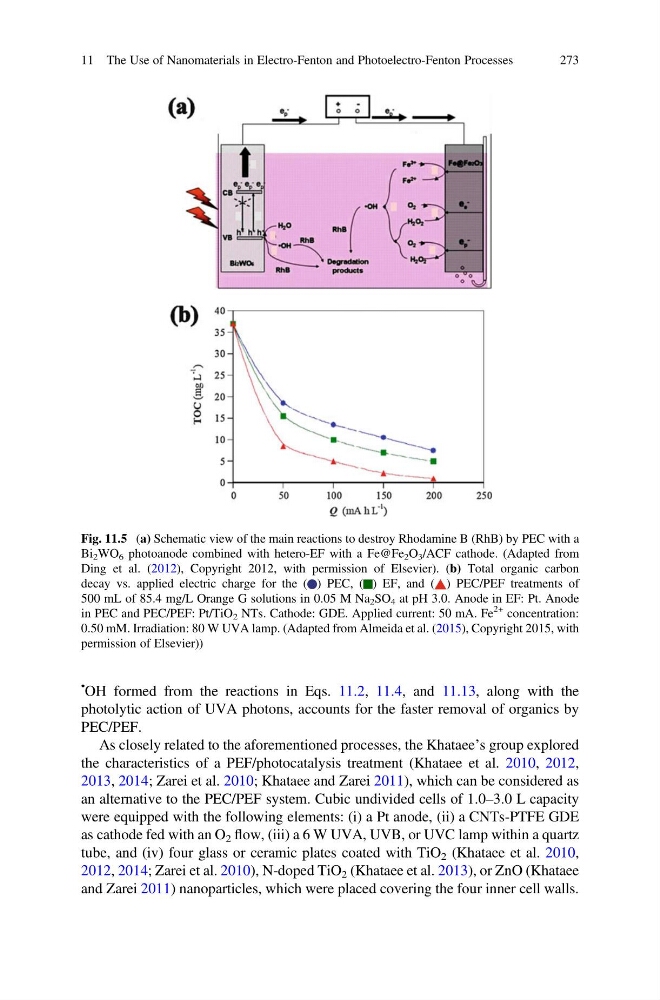
OH formed from the reactions in Eqs. 11.2, 11.4, and 11.13, along with the
photolytic action of UVA photons, accounts for the faster removal of organics by
PEC/PEF.
As closely related to the aforementioned processes, the Khataee’s group explored
the characteristics of a PEF/photocatalysis treatment (Khataee et al. 2010, 2012,
2013, 2014; Zarei et al. 2010; Khataee and Zarei 2011), which can be considered as
an alternative to the PEC/PEF system. Cubic undivided cells of 1.0–3.0 L capacity
were equipped with the following elements: (i) a Pt anode, (ii) a CNTs-PTFE GDE
as cathode fed with an O 2 flow, (iii) a 6 W UVA, UVB, or UVC lamp within a quartz
tube, and (iv) four glass or ceramic plates coated with TiO 2 (Khataee et al. 2010,
2012, 2014; Zarei et al. 2010), N-doped TiO 2 (Khataee et al. 2013), or ZnO (Khataee
and Zarei 2011) nanoparticles, which were placed covering the four inner cell walls.
Fig. 11.5 (a) Schematic view of the main reactions to destroy Rhodamine B (RhB) by PEC with a
Bi 2 WO 6 photoanode combined with hetero-EF with a Fe@Fe 2 O 3 /ACF cathode. (Adapted from
Ding et al. (2012), Copyright 2012, with permission of Elsevier). (b) Total organic carbon
decay vs. applied electric charge for the ( ) PEC, ( ) EF, and ( ) PEC/PEF treatments of
500 mL of 85.4 mg/L Orange G solutions in 0.05 M Na 2 SO 4 at pH 3.0. Anode in EF: Pt. Anode
in PEC and PEC/PEF: Pt/TiO 2 NTs. Cathode: GDE. Applied current: 50 mA. Fe
2+ concentration:
0.50 mM. Irradiation: 80 W UVA lamp. (Adapted from Almeida et al. (2015), Copyright 2015, with
permission of Elsevier))
11 The Use of Nanomaterials in Electro-Fenton and Photoelectro-Fenton Processes
273
OH formed from the reactions in Eqs. 11.2, 11.4, and 11.13, along with the
photolytic action of UVA photons, accounts for the faster removal of organics by
PEC/PEF.
As closely related to the aforementioned processes, the Khataee’s group explored
the characteristics of a PEF/photocatalysis treatment (Khataee et al. 2010, 2012,
2013, 2014; Zarei et al. 2010; Khataee and Zarei 2011), which can be considered as
an alternative to the PEC/PEF system. Cubic undivided cells of 1.0–3.0 L capacity
were equipped with the following elements: (i) a Pt anode, (ii) a CNTs-PTFE GDE
as cathode fed with an O 2 flow, (iii) a 6 W UVA, UVB, or UVC lamp within a quartz
tube, and (iv) four glass or ceramic plates coated with TiO 2 (Khataee et al. 2010,
2012, 2014; Zarei et al. 2010), N-doped TiO 2 (Khataee et al. 2013), or ZnO (Khataee
and Zarei 2011) nanoparticles, which were placed covering the four inner cell walls.
Fig. 11.5 (a) Schematic view of the main reactions to destroy Rhodamine B (RhB) by PEC with a
Bi 2 WO 6 photoanode combined with hetero-EF with a Fe@Fe 2 O 3 /ACF cathode. (Adapted from
Ding et al. (2012), Copyright 2012, with permission of Elsevier). (b) Total organic carbon
decay vs. applied electric charge for the ( ) PEC, ( ) EF, and ( ) PEC/PEF treatments of
500 mL of 85.4 mg/L Orange G solutions in 0.05 M Na 2 SO 4 at pH 3.0. Anode in EF: Pt. Anode
in PEC and PEC/PEF: Pt/TiO 2 NTs. Cathode: GDE. Applied current: 50 mA. Fe
2+ concentration:
0.50 mM. Irradiation: 80 W UVA lamp. (Adapted from Almeida et al. (2015), Copyright 2015, with
permission of Elsevier))
11 The Use of Nanomaterials in Electro-Fenton and Photoelectro-Fenton Processes
273