

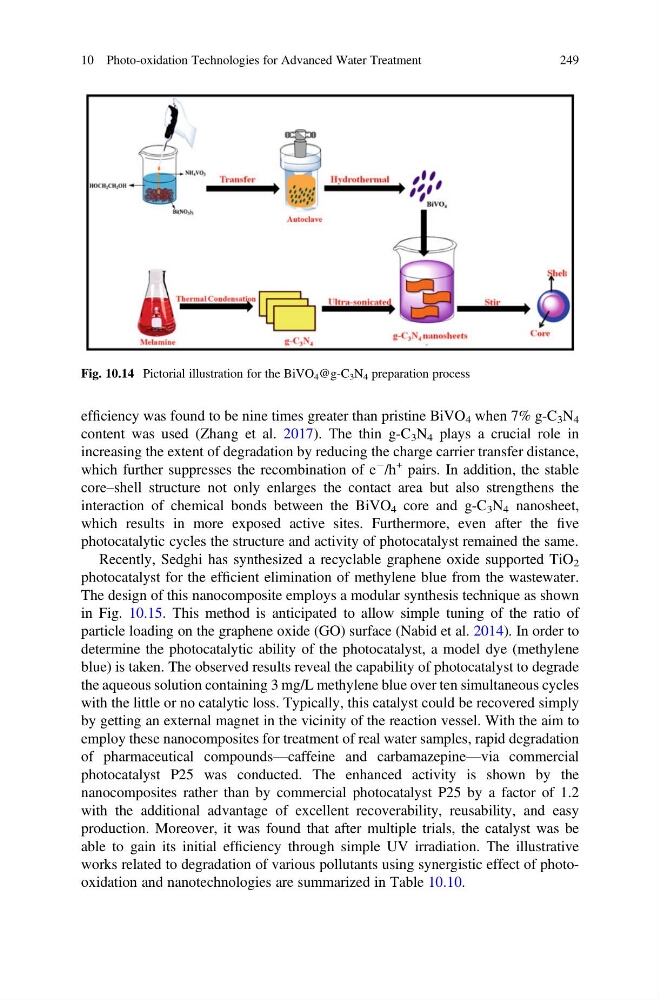
efficiency was found to be nine times greater than pristine BiVO 4 when 7% g-C 3 N 4
content was used (Zhang et al. 2017). The thin g-C 3 N 4 plays a crucial role in
increasing the extent of degradation by reducing the charge carrier transfer distance,
which further suppresses the recombination of e
À
/h
+ pairs. In addition, the stable
core–shell structure not only enlarges the contact area but also strengthens the
interaction of chemical bonds between the BiVO 4 core and g-C 3 N 4 nanosheet,
which results in more exposed active sites. Furthermore, even after the five
photocatalytic cycles the structure and activity of photocatalyst remained the same.
Recently, Sedghi has synthesized a recyclable graphene oxide supported TiO 2
photocatalyst for the efficient elimination of methylene blue from the wastewater.
The design of this nanocomposite employs a modular synthesis technique as shown
in Fig. 10.15. This method is anticipated to allow simple tuning of the ratio of
particle loading on the graphene oxide (GO) surface (Nabid et al. 2014). In order to
determine the photocatalytic ability of the photocatalyst, a model dye (methylene
blue) is taken. The observed results reveal the capability of photocatalyst to degrade
the aqueous solution containing 3 mg/L methylene blue over ten simultaneous cycles
with the little or no catalytic loss. Typically, this catalyst could be recovered simply
by getting an external magnet in the vicinity of the reaction vessel. With the aim to
employ these nanocomposites for treatment of real water samples, rapid degradation
of pharmaceutical compounds—caffeine and carbamazepine—via commercial
photocatalyst P25 was conducted. The enhanced activity is shown by the
nanocomposites rather than by commercial photocatalyst P25 by a factor of 1.2
with the additional advantage of excellent recoverability, reusability, and easy
production. Moreover, it was found that after multiple trials, the catalyst was be
able to gain its initial efficiency through simple UV irradiation. The illustrative
works related to degradation of various pollutants using synergistic effect of photooxidation and nanotechnologies are summarized in Table 10.10.
Fig. 10.14 Pictorial illustration for the BiVO 4 @g-C 3 N 4 preparation process
10 Photo-oxidation Technologies for Advanced Water Treatment
249
content was used (Zhang et al. 2017). The thin g-C 3 N 4 plays a crucial role in
increasing the extent of degradation by reducing the charge carrier transfer distance,
which further suppresses the recombination of e
À
/h
+ pairs. In addition, the stable
core–shell structure not only enlarges the contact area but also strengthens the
interaction of chemical bonds between the BiVO 4 core and g-C 3 N 4 nanosheet,
which results in more exposed active sites. Furthermore, even after the five
photocatalytic cycles the structure and activity of photocatalyst remained the same.
Recently, Sedghi has synthesized a recyclable graphene oxide supported TiO 2
photocatalyst for the efficient elimination of methylene blue from the wastewater.
The design of this nanocomposite employs a modular synthesis technique as shown
in Fig. 10.15. This method is anticipated to allow simple tuning of the ratio of
particle loading on the graphene oxide (GO) surface (Nabid et al. 2014). In order to
determine the photocatalytic ability of the photocatalyst, a model dye (methylene
blue) is taken. The observed results reveal the capability of photocatalyst to degrade
the aqueous solution containing 3 mg/L methylene blue over ten simultaneous cycles
with the little or no catalytic loss. Typically, this catalyst could be recovered simply
by getting an external magnet in the vicinity of the reaction vessel. With the aim to
employ these nanocomposites for treatment of real water samples, rapid degradation
of pharmaceutical compounds—caffeine and carbamazepine—via commercial
photocatalyst P25 was conducted. The enhanced activity is shown by the
nanocomposites rather than by commercial photocatalyst P25 by a factor of 1.2
with the additional advantage of excellent recoverability, reusability, and easy
production. Moreover, it was found that after multiple trials, the catalyst was be
able to gain its initial efficiency through simple UV irradiation. The illustrative
works related to degradation of various pollutants using synergistic effect of photooxidation and nanotechnologies are summarized in Table 10.10.
Fig. 10.14 Pictorial illustration for the BiVO 4 @g-C 3 N 4 preparation process
10 Photo-oxidation Technologies for Advanced Water Treatment
249