

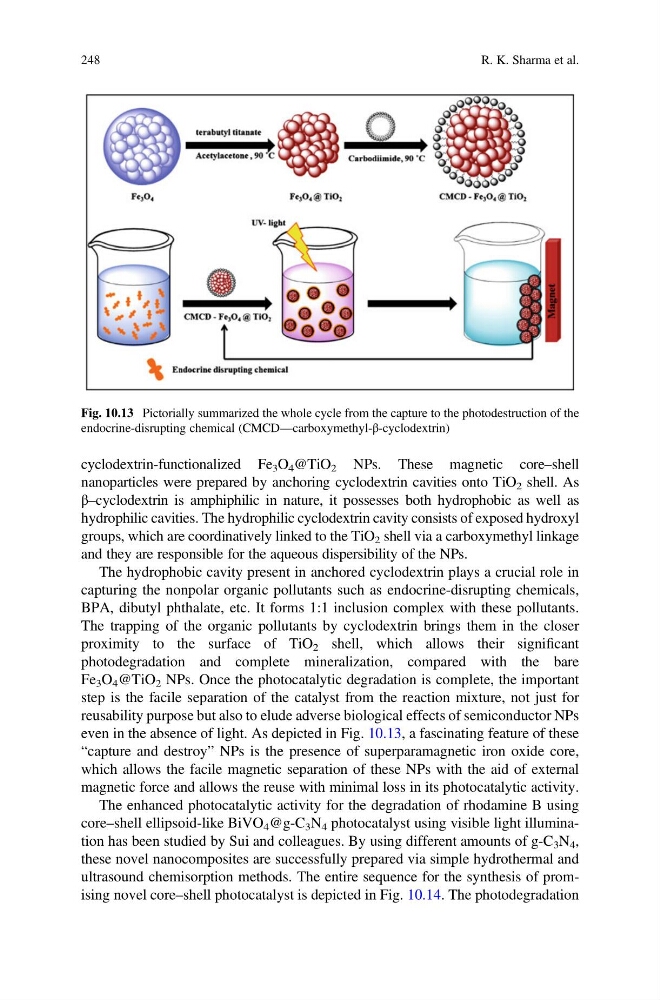
cyclodextrin-functionalized Fe 3 O 4 @TiO 2 NPs. These magnetic core–shell
nanoparticles were prepared by anchoring cyclodextrin cavities onto TiO 2 shell. As
β–cyclodextrin is amphiphilic in nature, it possesses both hydrophobic as well as
hydrophilic cavities. The hydrophilic cyclodextrin cavity consists of exposed hydroxyl
groups, which are coordinatively linked to the TiO 2 shell via a carboxymethyl linkage
and they are responsible for the aqueous dispersibility of the NPs.
The hydrophobic cavity present in anchored cyclodextrin plays a crucial role in
capturing the nonpolar organic pollutants such as endocrine-disrupting chemicals,
BPA, dibutyl phthalate, etc. It forms 1:1 inclusion complex with these pollutants.
The trapping of the organic pollutants by cyclodextrin brings them in the closer
proximity to the surface of TiO 2 shell, which allows their significant
photodegradation and complete mineralization, compared with the bare
Fe 3 O 4 @TiO 2 NPs. Once the photocatalytic degradation is complete, the important
step is the facile separation of the catalyst from the reaction mixture, not just for
reusability purpose but also to elude adverse biological effects of semiconductor NPs
even in the absence of light. As depicted in Fig. 10.13, a fascinating feature of these
“capture and destroy” NPs is the presence of superparamagnetic iron oxide core,
which allows the facile magnetic separation of these NPs with the aid of external
magnetic force and allows the reuse with minimal loss in its photocatalytic activity.
The enhanced photocatalytic activity for the degradation of rhodamine B using
core–shell ellipsoid-like BiVO 4 @g-C 3 N 4 photocatalyst using visible light illumination has been studied by Sui and colleagues. By using different amounts of g-C 3 N 4 ,
these novel nanocomposites are successfully prepared via simple hydrothermal and
ultrasound chemisorption methods. The entire sequence for the synthesis of promising novel core–shell photocatalyst is depicted in Fig. 10.14. The photodegradation
Fig. 10.13 Pictorially summarized the whole cycle from the capture to the photodestruction of the
endocrine-disrupting chemical (CMCD—carboxymethyl-β-cyclodextrin)
248
R. K. Sharma et al.
nanoparticles were prepared by anchoring cyclodextrin cavities onto TiO 2 shell. As
β–cyclodextrin is amphiphilic in nature, it possesses both hydrophobic as well as
hydrophilic cavities. The hydrophilic cyclodextrin cavity consists of exposed hydroxyl
groups, which are coordinatively linked to the TiO 2 shell via a carboxymethyl linkage
and they are responsible for the aqueous dispersibility of the NPs.
The hydrophobic cavity present in anchored cyclodextrin plays a crucial role in
capturing the nonpolar organic pollutants such as endocrine-disrupting chemicals,
BPA, dibutyl phthalate, etc. It forms 1:1 inclusion complex with these pollutants.
The trapping of the organic pollutants by cyclodextrin brings them in the closer
proximity to the surface of TiO 2 shell, which allows their significant
photodegradation and complete mineralization, compared with the bare
Fe 3 O 4 @TiO 2 NPs. Once the photocatalytic degradation is complete, the important
step is the facile separation of the catalyst from the reaction mixture, not just for
reusability purpose but also to elude adverse biological effects of semiconductor NPs
even in the absence of light. As depicted in Fig. 10.13, a fascinating feature of these
“capture and destroy” NPs is the presence of superparamagnetic iron oxide core,
which allows the facile magnetic separation of these NPs with the aid of external
magnetic force and allows the reuse with minimal loss in its photocatalytic activity.
The enhanced photocatalytic activity for the degradation of rhodamine B using
core–shell ellipsoid-like BiVO 4 @g-C 3 N 4 photocatalyst using visible light illumination has been studied by Sui and colleagues. By using different amounts of g-C 3 N 4 ,
these novel nanocomposites are successfully prepared via simple hydrothermal and
ultrasound chemisorption methods. The entire sequence for the synthesis of promising novel core–shell photocatalyst is depicted in Fig. 10.14. The photodegradation
Fig. 10.13 Pictorially summarized the whole cycle from the capture to the photodestruction of the
endocrine-disrupting chemical (CMCD—carboxymethyl-β-cyclodextrin)
248
R. K. Sharma et al.