

company has employed photo-oxidation technology for the removal of toxicity,
elimination of phenol-based active structures, and for increasing the bioavailability
of strong wastewater. This installed treatment system has increased the capacity of
wastewater from 54 m
3
/d to 100 m
3
/d. GSK even won an award (Singapore Environment Achievement Award) for all its environmental activities including the installation
of the photo-oxidation technology. The data from the treatment of wastewater at GSK
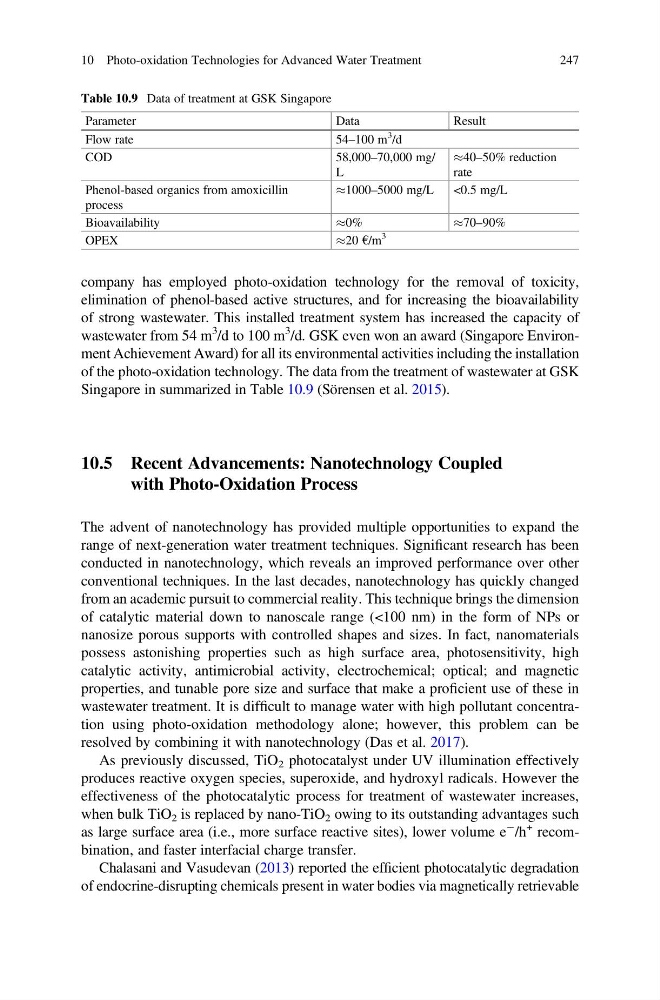
Singapore in summarized in Table 10.9 (Sörensen et al. 2015).
10.5 Recent Advancements: Nanotechnology Coupled
with Photo-Oxidation Process
The advent of nanotechnology has provided multiple opportunities to expand the
range of next-generation water treatment techniques. Significant research has been
conducted in nanotechnology, which reveals an improved performance over other
conventional techniques. In the last decades, nanotechnology has quickly changed
from an academic pursuit to commercial reality. This technique brings the dimension
of catalytic material down to nanoscale range (<100 nm) in the form of NPs or
nanosize porous supports with controlled shapes and sizes. In fact, nanomaterials
possess astonishing properties such as high surface area, photosensitivity, high
catalytic activity, antimicrobial activity, electrochemical; optical; and magnetic
properties, and tunable pore size and surface that make a proficient use of these in
wastewater treatment. It is difficult to manage water with high pollutant concentration using photo-oxidation methodology alone; however, this problem can be
resolved by combining it with nanotechnology (Das et al. 2017).
As previously discussed, TiO 2 photocatalyst under UV illumination effectively
produces reactive oxygen species, superoxide, and hydroxyl radicals. However the
effectiveness of the photocatalytic process for treatment of wastewater increases,
when bulk TiO 2 is replaced by nano-TiO 2 owing to its outstanding advantages such
as large surface area (i.e., more surface reactive sites), lower volume e
À
/h
+ recombination, and faster interfacial charge transfer.
Chalasani and Vasudevan (2013) reported the efficient photocatalytic degradation
of endocrine-disrupting chemicals present in water bodies via magnetically retrievable
Table 10.9 Data of treatment at GSK Singapore
Parameter
Data
Result
Flow rate
54–100 m
3
/d
COD
58,000–70,000 mg/
L
%40–50% reduction
rate
Phenol-based organics from amoxicillin
process
%1000–5000 mg/L
<0.5 mg/L
Bioavailability
%0%
%70–90%
OPEX
%20 €/m
3
10 Photo-oxidation Technologies for Advanced Water Treatment
247
elimination of phenol-based active structures, and for increasing the bioavailability
of strong wastewater. This installed treatment system has increased the capacity of
wastewater from 54 m
3
/d to 100 m
3
/d. GSK even won an award (Singapore Environment Achievement Award) for all its environmental activities including the installation
of the photo-oxidation technology. The data from the treatment of wastewater at GSK
Singapore in summarized in Table 10.9 (Sörensen et al. 2015).
10.5 Recent Advancements: Nanotechnology Coupled
with Photo-Oxidation Process
The advent of nanotechnology has provided multiple opportunities to expand the
range of next-generation water treatment techniques. Significant research has been
conducted in nanotechnology, which reveals an improved performance over other
conventional techniques. In the last decades, nanotechnology has quickly changed
from an academic pursuit to commercial reality. This technique brings the dimension
of catalytic material down to nanoscale range (<100 nm) in the form of NPs or
nanosize porous supports with controlled shapes and sizes. In fact, nanomaterials
possess astonishing properties such as high surface area, photosensitivity, high
catalytic activity, antimicrobial activity, electrochemical; optical; and magnetic
properties, and tunable pore size and surface that make a proficient use of these in
wastewater treatment. It is difficult to manage water with high pollutant concentration using photo-oxidation methodology alone; however, this problem can be
resolved by combining it with nanotechnology (Das et al. 2017).
As previously discussed, TiO 2 photocatalyst under UV illumination effectively
produces reactive oxygen species, superoxide, and hydroxyl radicals. However the
effectiveness of the photocatalytic process for treatment of wastewater increases,
when bulk TiO 2 is replaced by nano-TiO 2 owing to its outstanding advantages such
as large surface area (i.e., more surface reactive sites), lower volume e
À
/h
+ recombination, and faster interfacial charge transfer.
Chalasani and Vasudevan (2013) reported the efficient photocatalytic degradation
of endocrine-disrupting chemicals present in water bodies via magnetically retrievable
Table 10.9 Data of treatment at GSK Singapore
Parameter
Data
Result
Flow rate
54–100 m
3
/d
COD
58,000–70,000 mg/
L
%40–50% reduction
rate
Phenol-based organics from amoxicillin
process
%1000–5000 mg/L
<0.5 mg/L
Bioavailability
%0%
%70–90%
OPEX
%20 €/m
3
10 Photo-oxidation Technologies for Advanced Water Treatment
247