

extraction step, EDTA still could not be removed completely. Therefore, this
company directed its effort towards developing a highly selective treatment for the
elimination of this single substance only. Finally, they developed a highly selective
UV treatment that was able to reduce the concentration of EDTA without any
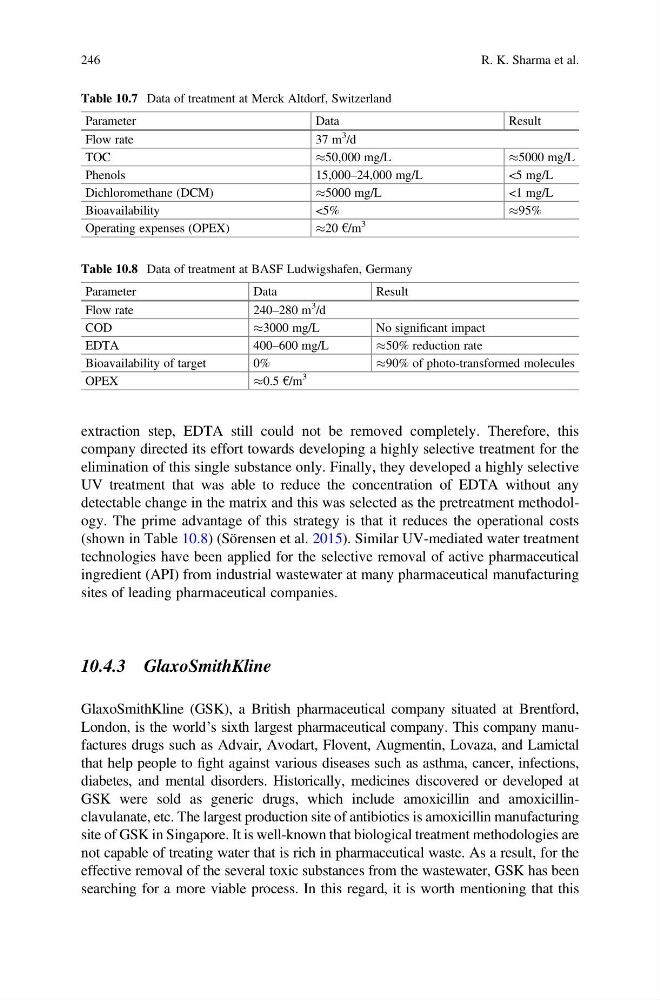
detectable change in the matrix and this was selected as the pretreatment methodology. The prime advantage of this strategy is that it reduces the operational costs
(shown in Table 10.8) (Sörensen et al. 2015). Similar UV-mediated water treatment
technologies have been applied for the selective removal of active pharmaceutical
ingredient (API) from industrial wastewater at many pharmaceutical manufacturing
sites of leading pharmaceutical companies.
10.4.3 GlaxoSmithKline
GlaxoSmithKline (GSK), a British pharmaceutical company situated at Brentford,
London, is the world’s sixth largest pharmaceutical company. This company manufactures drugs such as Advair, Avodart, Flovent, Augmentin, Lovaza, and Lamictal
that help people to fight against various diseases such as asthma, cancer, infections,
diabetes, and mental disorders. Historically, medicines discovered or developed at
GSK were sold as generic drugs, which include amoxicillin and amoxicillinclavulanate, etc. The largest production site of antibiotics is amoxicillin manufacturing
site of GSK in Singapore. It is well-known that biological treatment methodologies are
not capable of treating water that is rich in pharmaceutical waste. As a result, for the
effective removal of the several toxic substances from the wastewater, GSK has been
searching for a more viable process. In this regard, it is worth mentioning that this
Table 10.7 Data of treatment at Merck Altdorf, Switzerland
Parameter
Data
Result
Flow rate
37 m
3
/d
TOC
%50,000 mg/L
%5000 mg/L
Phenols
15,000–24,000 mg/L
<5 mg/L
Dichloromethane (DCM)
%5000 mg/L
<1 mg/L
Bioavailability
<5%
%95%
Operating expenses (OPEX)
%20 €/m
3
Table 10.8 Data of treatment at BASF Ludwigshafen, Germany
Parameter
Data
Result
Flow rate
240–280 m
3
/d
COD
%3000 mg/L
No significant impact
EDTA
400–600 mg/L
%50% reduction rate
Bioavailability of target
0%
%90% of photo-transformed molecules
OPEX
%0.5 €/m
3
246
R. K. Sharma et al.
company directed its effort towards developing a highly selective treatment for the
elimination of this single substance only. Finally, they developed a highly selective
UV treatment that was able to reduce the concentration of EDTA without any
detectable change in the matrix and this was selected as the pretreatment methodology. The prime advantage of this strategy is that it reduces the operational costs
(shown in Table 10.8) (Sörensen et al. 2015). Similar UV-mediated water treatment
technologies have been applied for the selective removal of active pharmaceutical
ingredient (API) from industrial wastewater at many pharmaceutical manufacturing
sites of leading pharmaceutical companies.
10.4.3 GlaxoSmithKline
GlaxoSmithKline (GSK), a British pharmaceutical company situated at Brentford,
London, is the world’s sixth largest pharmaceutical company. This company manufactures drugs such as Advair, Avodart, Flovent, Augmentin, Lovaza, and Lamictal
that help people to fight against various diseases such as asthma, cancer, infections,
diabetes, and mental disorders. Historically, medicines discovered or developed at
GSK were sold as generic drugs, which include amoxicillin and amoxicillinclavulanate, etc. The largest production site of antibiotics is amoxicillin manufacturing
site of GSK in Singapore. It is well-known that biological treatment methodologies are
not capable of treating water that is rich in pharmaceutical waste. As a result, for the
effective removal of the several toxic substances from the wastewater, GSK has been
searching for a more viable process. In this regard, it is worth mentioning that this
Table 10.7 Data of treatment at Merck Altdorf, Switzerland
Parameter
Data
Result
Flow rate
37 m
3
/d
TOC
%50,000 mg/L
%5000 mg/L
Phenols
15,000–24,000 mg/L
<5 mg/L
Dichloromethane (DCM)
%5000 mg/L
<1 mg/L
Bioavailability
<5%
%95%
Operating expenses (OPEX)
%20 €/m
3
Table 10.8 Data of treatment at BASF Ludwigshafen, Germany
Parameter
Data
Result
Flow rate
240–280 m
3
/d
COD
%3000 mg/L
No significant impact
EDTA
400–600 mg/L
%50% reduction rate
Bioavailability of target
0%
%90% of photo-transformed molecules
OPEX
%0.5 €/m
3
246
R. K. Sharma et al.