

high mass transfer rates. Another important parameter for practical applicability
during this process is the high oxygen uptake at gas-liquid interface. Therefore,
designing a suitable reactor for effective treatment of wastewater has remained a
challenging task for the researchers in today’s global scenario. The ensuing section
throws light on some of the photoreactors that have been employed for water
treatment.
10.3.1 UV/H 2 O 2 Photoreactor
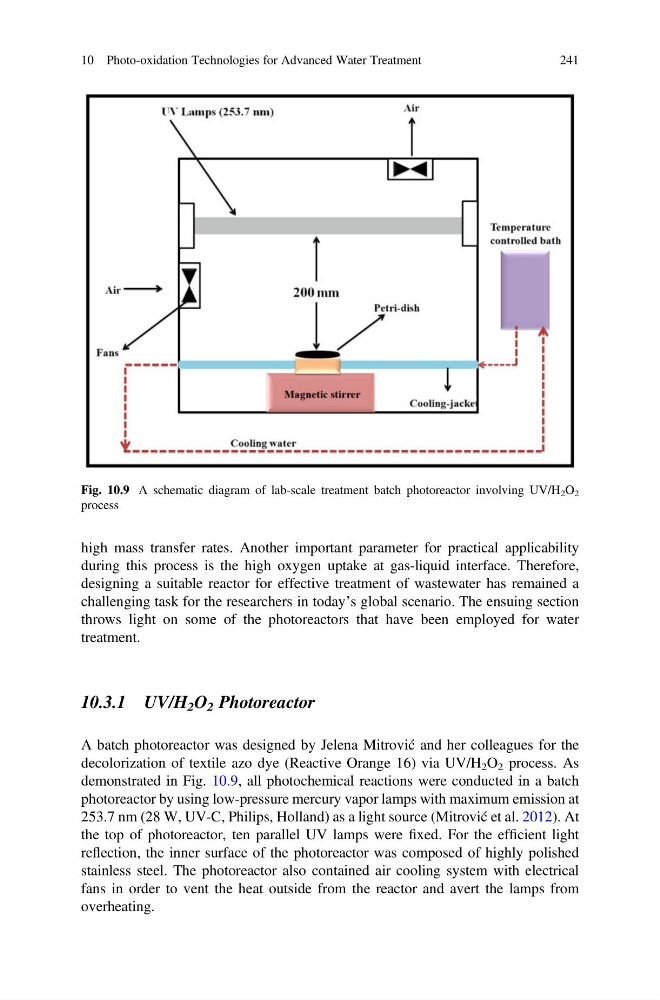
A batch photoreactor was designed by Jelena Mitrović and her colleagues for the
decolorization of textile azo dye (Reactive Orange 16) via UV/H 2 O 2 process. As
demonstrated in Fig. 10.9, all photochemical reactions were conducted in a batch
photoreactor by using low-pressure mercury vapor lamps with maximum emission at
253.7 nm (28 W, UV-C, Philips, Holland) as a light source (Mitrović et al. 2012). At
the top of photoreactor, ten parallel UV lamps were fixed. For the efficient light
reflection, the inner surface of the photoreactor was composed of highly polished
stainless steel. The photoreactor also contained air cooling system with electrical
fans in order to vent the heat outside from the reactor and avert the lamps from
overheating.
Fig. 10.9 A schematic diagram of lab-scale treatment batch photoreactor involving UV/H 2 O 2
process
10 Photo-oxidation Technologies for Advanced Water Treatment
241
during this process is the high oxygen uptake at gas-liquid interface. Therefore,
designing a suitable reactor for effective treatment of wastewater has remained a
challenging task for the researchers in today’s global scenario. The ensuing section
throws light on some of the photoreactors that have been employed for water
treatment.
10.3.1 UV/H 2 O 2 Photoreactor
A batch photoreactor was designed by Jelena Mitrović and her colleagues for the
decolorization of textile azo dye (Reactive Orange 16) via UV/H 2 O 2 process. As
demonstrated in Fig. 10.9, all photochemical reactions were conducted in a batch
photoreactor by using low-pressure mercury vapor lamps with maximum emission at
253.7 nm (28 W, UV-C, Philips, Holland) as a light source (Mitrović et al. 2012). At
the top of photoreactor, ten parallel UV lamps were fixed. For the efficient light
reflection, the inner surface of the photoreactor was composed of highly polished
stainless steel. The photoreactor also contained air cooling system with electrical
fans in order to vent the heat outside from the reactor and avert the lamps from
overheating.
Fig. 10.9 A schematic diagram of lab-scale treatment batch photoreactor involving UV/H 2 O 2
process
10 Photo-oxidation Technologies for Advanced Water Treatment
241