

10.3 Use of Photoreactors in Water Treatment
In recent decades, the photochemical oxidation of pollutants in wastewater has
become an attractive technology for the water treatment. For the specific concentration range of hazardous contaminants, this method is suggested because artificial
source requires high delivery of energy. The key parameters that play a crucial role
in water treatment efficiencies are (1) selection of light source, (2) oxidation system,
and (3) determination of optimal conditions. Sufficient UV penetration into the
radiated liquid is crucial for the efficient degradation of pollutants in waste water.
The significant interaction between the pollutant and photocatalyst is crucial for the
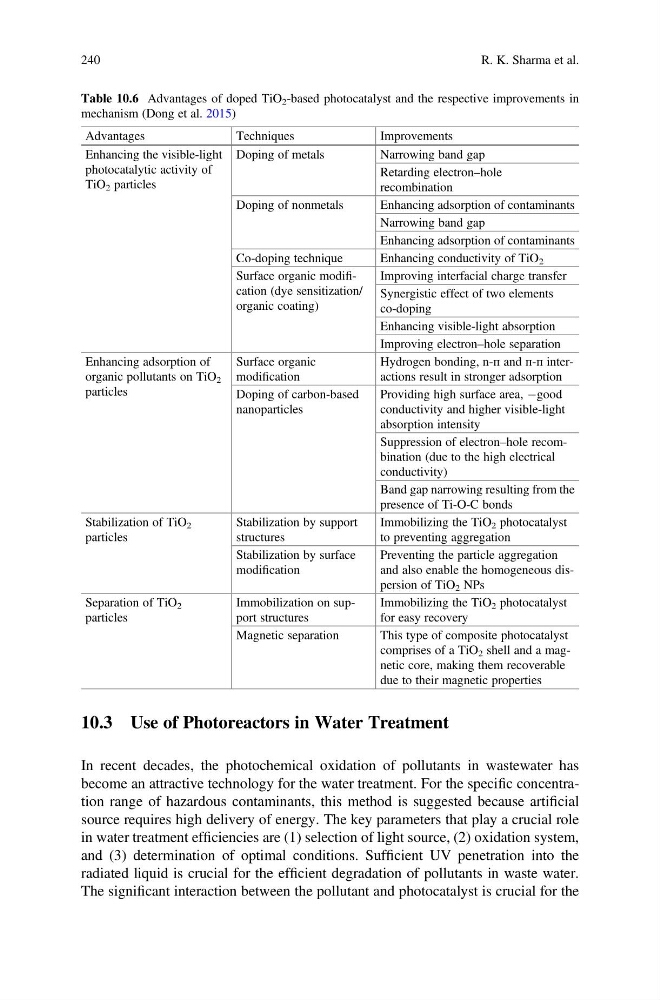
Table 10.6 Advantages of doped TiO 2 -based photocatalyst and the respective improvements in
mechanism (Dong et al. 2015)
Advantages
Techniques
Improvements
Enhancing the visible-light
photocatalytic activity of
TiO 2 particles
Doping of metals
Narrowing band gap
Retarding electron–hole
recombination
Doping of nonmetals
Enhancing adsorption of contaminants
Narrowing band gap
Enhancing adsorption of contaminants
Co-doping technique
Enhancing conductivity of TiO 2
Surface organic modification (dye sensitization/
organic coating)
Improving interfacial charge transfer
Synergistic effect of two elements
co-doping
Enhancing visible-light absorption
Improving electron–hole separation
Enhancing adsorption of
organic pollutants on TiO 2
particles
Surface organic
modification
Hydrogen bonding, n-п and п-п interactions result in stronger adsorption
Doping of carbon-based
nanoparticles
Providing high surface area, Àgood
conductivity and higher visible-light
absorption intensity
Suppression of electron–hole recombination (due to the high electrical
conductivity)
Band gap narrowing resulting from the
presence of Ti-O-C bonds
Stabilization of TiO 2
particles
Stabilization by support
structures
Immobilizing the TiO 2 photocatalyst
to preventing aggregation
Stabilization by surface
modification
Preventing the particle aggregation
and also enable the homogeneous dispersion of TiO 2 NPs
Separation of TiO 2
particles
Immobilization on support structures
Immobilizing the TiO 2 photocatalyst
for easy recovery
Magnetic separation
This type of composite photocatalyst
comprises of a TiO 2 shell and a magnetic core, making them recoverable
due to their magnetic properties
240
R. K. Sharma et al.
In recent decades, the photochemical oxidation of pollutants in wastewater has
become an attractive technology for the water treatment. For the specific concentration range of hazardous contaminants, this method is suggested because artificial
source requires high delivery of energy. The key parameters that play a crucial role
in water treatment efficiencies are (1) selection of light source, (2) oxidation system,
and (3) determination of optimal conditions. Sufficient UV penetration into the
radiated liquid is crucial for the efficient degradation of pollutants in waste water.
The significant interaction between the pollutant and photocatalyst is crucial for the
Table 10.6 Advantages of doped TiO 2 -based photocatalyst and the respective improvements in
mechanism (Dong et al. 2015)
Advantages
Techniques
Improvements
Enhancing the visible-light
photocatalytic activity of
TiO 2 particles
Doping of metals
Narrowing band gap
Retarding electron–hole
recombination
Doping of nonmetals
Enhancing adsorption of contaminants
Narrowing band gap
Enhancing adsorption of contaminants
Co-doping technique
Enhancing conductivity of TiO 2
Surface organic modification (dye sensitization/
organic coating)
Improving interfacial charge transfer
Synergistic effect of two elements
co-doping
Enhancing visible-light absorption
Improving electron–hole separation
Enhancing adsorption of
organic pollutants on TiO 2
particles
Surface organic
modification
Hydrogen bonding, n-п and п-п interactions result in stronger adsorption
Doping of carbon-based
nanoparticles
Providing high surface area, Àgood
conductivity and higher visible-light
absorption intensity
Suppression of electron–hole recombination (due to the high electrical
conductivity)
Band gap narrowing resulting from the
presence of Ti-O-C bonds
Stabilization of TiO 2
particles
Stabilization by support
structures
Immobilizing the TiO 2 photocatalyst
to preventing aggregation
Stabilization by surface
modification
Preventing the particle aggregation
and also enable the homogeneous dispersion of TiO 2 NPs
Separation of TiO 2
particles
Immobilization on support structures
Immobilizing the TiO 2 photocatalyst
for easy recovery
Magnetic separation
This type of composite photocatalyst
comprises of a TiO 2 shell and a magnetic core, making them recoverable
due to their magnetic properties
240
R. K. Sharma et al.