

In addition, for the controlled release of UV light, the lamps were placed at a
distance of 220 mm above from the working solution. The UV radiation intensity
was measured by a UV radiometer solar meter model 8.0 (UVC) (Solartech, USA).
Further, to study the effect of the important parameters on the decolorization rate of
dye, some of the experiments were carried out by using the lowest UV light intensity.
10.3.2 Photoreactor for Photolytic Ozonation
Zheng et al. (2015) designed a combined microbubble ozonation/UV irradiation
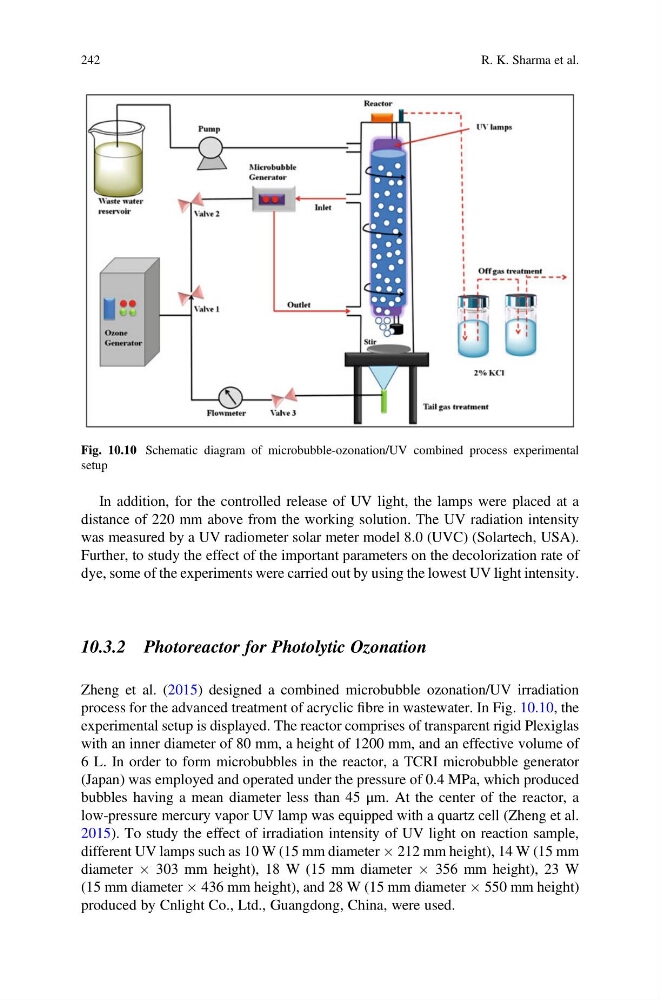
process for the advanced treatment of acryclic fibre in wastewater. In Fig. 10.10, the
experimental setup is displayed. The reactor comprises of transparent rigid Plexiglas
with an inner diameter of 80 mm, a height of 1200 mm, and an effective volume of
6 L. In order to form microbubbles in the reactor, a TCRI microbubble generator
(Japan) was employed and operated under the pressure of 0.4 MPa, which produced
bubbles having a mean diameter less than 45 μm. At the center of the reactor, a
low-pressure mercury vapor UV lamp was equipped with a quartz cell (Zheng et al.
2015). To study the effect of irradiation intensity of UV light on reaction sample,
different UV lamps such as 10 W (15 mm diameter  212 mm height), 14 W (15 mm
diameter  303 mm height), 18 W (15 mm diameter  356 mm height), 23 W
(15 mm diameter  436 mm height), and 28 W (15 mm diameter  550 mm height)
produced by Cnlight Co., Ltd., Guangdong, China, were used.
Fig. 10.10 Schematic diagram of microbubble-ozonation/UV combined process experimental
setup
242
R. K. Sharma et al.
distance of 220 mm above from the working solution. The UV radiation intensity
was measured by a UV radiometer solar meter model 8.0 (UVC) (Solartech, USA).
Further, to study the effect of the important parameters on the decolorization rate of
dye, some of the experiments were carried out by using the lowest UV light intensity.
10.3.2 Photoreactor for Photolytic Ozonation
Zheng et al. (2015) designed a combined microbubble ozonation/UV irradiation
process for the advanced treatment of acryclic fibre in wastewater. In Fig. 10.10, the
experimental setup is displayed. The reactor comprises of transparent rigid Plexiglas
with an inner diameter of 80 mm, a height of 1200 mm, and an effective volume of
6 L. In order to form microbubbles in the reactor, a TCRI microbubble generator
(Japan) was employed and operated under the pressure of 0.4 MPa, which produced
bubbles having a mean diameter less than 45 μm. At the center of the reactor, a
low-pressure mercury vapor UV lamp was equipped with a quartz cell (Zheng et al.
2015). To study the effect of irradiation intensity of UV light on reaction sample,
different UV lamps such as 10 W (15 mm diameter  212 mm height), 14 W (15 mm
diameter  303 mm height), 18 W (15 mm diameter  356 mm height), 23 W
(15 mm diameter  436 mm height), and 28 W (15 mm diameter  550 mm height)
produced by Cnlight Co., Ltd., Guangdong, China, were used.
Fig. 10.10 Schematic diagram of microbubble-ozonation/UV combined process experimental
setup
242
R. K. Sharma et al.