

Organic pollutants þ
• OH ! Degraded products
ð10:41Þ
Organic pollutants þ h
þ
VB ! Oxidation products
ð10:42Þ
Organic pollutants þ e
À
CB ! Reduction products
ð10:43Þ
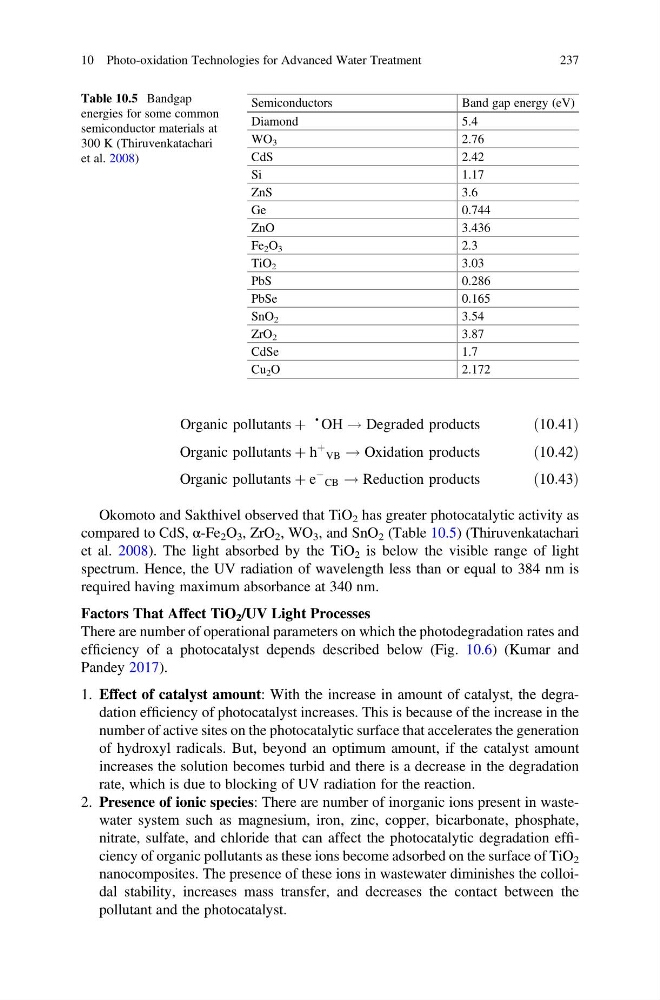
Okomoto and Sakthivel observed that TiO 2 has greater photocatalytic activity as
compared to CdS, α-Fe 2 O 3 , ZrO 2 , WO 3 , and SnO 2 (Table 10.5) (Thiruvenkatachari
et al. 2008). The light absorbed by the TiO 2 is below the visible range of light
spectrum. Hence, the UV radiation of wavelength less than or equal to 384 nm is
required having maximum absorbance at 340 nm.
Factors That Affect TiO 2 /UV Light Processes
There are number of operational parameters on which the photodegradation rates and
efficiency of a photocatalyst depends described below (Fig. 10.6) (Kumar and
Pandey 2017).
1. Effect of catalyst amount: With the increase in amount of catalyst, the degradation efficiency of photocatalyst increases. This is because of the increase in the
number of active sites on the photocatalytic surface that accelerates the generation
of hydroxyl radicals. But, beyond an optimum amount, if the catalyst amount
increases the solution becomes turbid and there is a decrease in the degradation
rate, which is due to blocking of UV radiation for the reaction.
2. Presence of ionic species: There are number of inorganic ions present in wastewater system such as magnesium, iron, zinc, copper, bicarbonate, phosphate,
nitrate, sulfate, and chloride that can affect the photocatalytic degradation efficiency of organic pollutants as these ions become adsorbed on the surface of TiO 2
nanocomposites. The presence of these ions in wastewater diminishes the colloidal stability, increases mass transfer, and decreases the contact between the
pollutant and the photocatalyst.
Table 10.5 Bandgap
energies for some common
semiconductor materials at
300 K (Thiruvenkatachari
et al. 2008)
Semiconductors
Band gap energy (eV)
Diamond
5.4
WO 3
2.76
CdS
2.42
Si
1.17
ZnS
3.6
Ge
0.744
ZnO
3.436
Fe 2 O 3
2.3
TiO 2
3.03
PbS
0.286
PbSe
0.165
SnO 2
3.54
ZrO 2
3.87
CdSe
1.7
Cu 2 O
2.172
10 Photo-oxidation Technologies for Advanced Water Treatment
237
• OH ! Degraded products
ð10:41Þ
Organic pollutants þ h
þ
VB ! Oxidation products
ð10:42Þ
Organic pollutants þ e
À
CB ! Reduction products
ð10:43Þ
Okomoto and Sakthivel observed that TiO 2 has greater photocatalytic activity as
compared to CdS, α-Fe 2 O 3 , ZrO 2 , WO 3 , and SnO 2 (Table 10.5) (Thiruvenkatachari
et al. 2008). The light absorbed by the TiO 2 is below the visible range of light
spectrum. Hence, the UV radiation of wavelength less than or equal to 384 nm is
required having maximum absorbance at 340 nm.
Factors That Affect TiO 2 /UV Light Processes
There are number of operational parameters on which the photodegradation rates and
efficiency of a photocatalyst depends described below (Fig. 10.6) (Kumar and
Pandey 2017).
1. Effect of catalyst amount: With the increase in amount of catalyst, the degradation efficiency of photocatalyst increases. This is because of the increase in the
number of active sites on the photocatalytic surface that accelerates the generation
of hydroxyl radicals. But, beyond an optimum amount, if the catalyst amount
increases the solution becomes turbid and there is a decrease in the degradation
rate, which is due to blocking of UV radiation for the reaction.
2. Presence of ionic species: There are number of inorganic ions present in wastewater system such as magnesium, iron, zinc, copper, bicarbonate, phosphate,
nitrate, sulfate, and chloride that can affect the photocatalytic degradation efficiency of organic pollutants as these ions become adsorbed on the surface of TiO 2
nanocomposites. The presence of these ions in wastewater diminishes the colloidal stability, increases mass transfer, and decreases the contact between the
pollutant and the photocatalyst.
Table 10.5 Bandgap
energies for some common
semiconductor materials at
300 K (Thiruvenkatachari
et al. 2008)
Semiconductors
Band gap energy (eV)
Diamond
5.4
WO 3
2.76
CdS
2.42
Si
1.17
ZnS
3.6
Ge
0.744
ZnO
3.436
Fe 2 O 3
2.3
TiO 2
3.03
PbS
0.286
PbSe
0.165
SnO 2
3.54
ZrO 2
3.87
CdSe
1.7
Cu 2 O
2.172
10 Photo-oxidation Technologies for Advanced Water Treatment
237