

H 2 O. Up to date, the TiO 2 /UV light process is believed to be appropriate for
wastewater treatment at ambient conditions as it shows no mass transfer limitations
and effective use of solar irradiation. Moreover, TiO 2 is extensively used as a
photocatalyst owing to its high photostability, nontoxicity, chemical and biological
inertness, cost-effectiveness, and ready availability. Since the band gap energy of
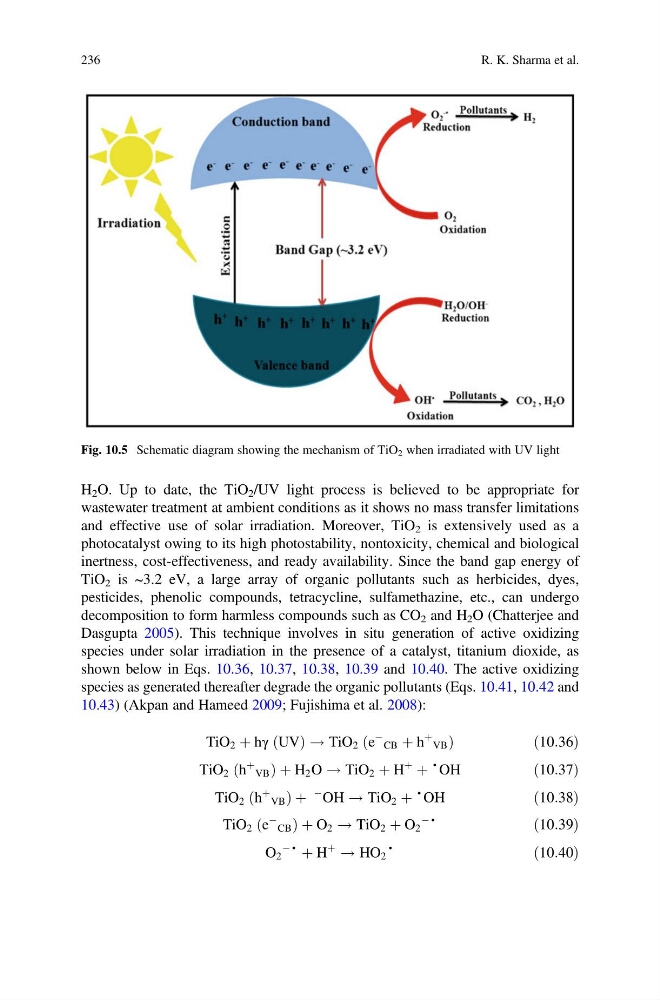
TiO 2 is ~3.2 eV, a large array of organic pollutants such as herbicides, dyes,
pesticides, phenolic compounds, tetracycline, sulfamethazine, etc., can undergo
decomposition to form harmless compounds such as CO 2 and H 2 O (Chatterjee and
Dasgupta 2005). This technique involves in situ generation of active oxidizing
species under solar irradiation in the presence of a catalyst, titanium dioxide, as
shown below in Eqs. 10.36, 10.37, 10.38, 10.39 and 10.40. The active oxidizing
species as generated thereafter degrade the organic pollutants (Eqs. 10.41, 10.42 and
10.43) (Akpan and Hameed 2009; Fujishima et al. 2008):
TiO 2 þ hγ UV
ð Þ ! TiO 2 e
À
CB þ h
þ
VB
ð
Þ
ð 10:36Þ
TiO 2 h
þ
VB
ð
ÞþH 2 O ! TiO 2 þ H
þ
þ
• OH
ð10:37Þ
TiO 2 h
þ
VB
ð
Þþ
À OH ! TiO 2 þ
• OH
ð10:38Þ
TiO 2 e
À
CB
ð
ÞþO 2 ! TiO 2 þ O 2
À •
ð10:39Þ
O 2
À •
þ H
þ
! HO 2
•
ð10:40Þ
Fig. 10.5 Schematic diagram showing the mechanism of TiO 2 when irradiated with UV light
236
R. K. Sharma et al.
wastewater treatment at ambient conditions as it shows no mass transfer limitations
and effective use of solar irradiation. Moreover, TiO 2 is extensively used as a
photocatalyst owing to its high photostability, nontoxicity, chemical and biological
inertness, cost-effectiveness, and ready availability. Since the band gap energy of
TiO 2 is ~3.2 eV, a large array of organic pollutants such as herbicides, dyes,
pesticides, phenolic compounds, tetracycline, sulfamethazine, etc., can undergo
decomposition to form harmless compounds such as CO 2 and H 2 O (Chatterjee and
Dasgupta 2005). This technique involves in situ generation of active oxidizing
species under solar irradiation in the presence of a catalyst, titanium dioxide, as
shown below in Eqs. 10.36, 10.37, 10.38, 10.39 and 10.40. The active oxidizing
species as generated thereafter degrade the organic pollutants (Eqs. 10.41, 10.42 and
10.43) (Akpan and Hameed 2009; Fujishima et al. 2008):
TiO 2 þ hγ UV
ð Þ ! TiO 2 e
À
CB þ h
þ
VB
ð
Þ
ð 10:36Þ
TiO 2 h
þ
VB
ð
ÞþH 2 O ! TiO 2 þ H
þ
þ
• OH
ð10:37Þ
TiO 2 h
þ
VB
ð
Þþ
À OH ! TiO 2 þ
• OH
ð10:38Þ
TiO 2 e
À
CB
ð
ÞþO 2 ! TiO 2 þ O 2
À •
ð10:39Þ
O 2
À •
þ H
þ
! HO 2
•
ð10:40Þ
Fig. 10.5 Schematic diagram showing the mechanism of TiO 2 when irradiated with UV light
236
R. K. Sharma et al.