

reveal 96% decolorization and 89% dechlorination of wastewater. In another study,
wastewater samples collected from pulp industries containing lignin sugars were
decomposed by photo-Fenton process. Some other descriptive works related to
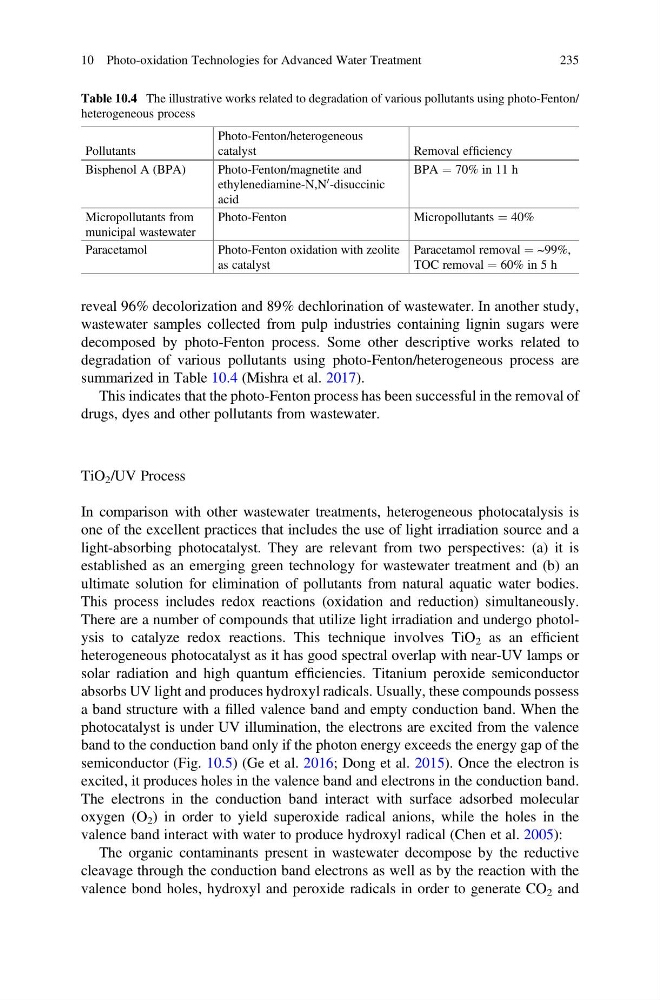
degradation of various pollutants using photo-Fenton/heterogeneous process are
summarized in Table 10.4 (Mishra et al. 2017).
This indicates that the photo-Fenton process has been successful in the removal of
drugs, dyes and other pollutants from wastewater.
TiO 2 /UV Process
In comparison with other wastewater treatments, heterogeneous photocatalysis is
one of the excellent practices that includes the use of light irradiation source and a
light-absorbing photocatalyst. They are relevant from two perspectives: (a) it is
established as an emerging green technology for wastewater treatment and (b) an
ultimate solution for elimination of pollutants from natural aquatic water bodies.
This process includes redox reactions (oxidation and reduction) simultaneously.
There are a number of compounds that utilize light irradiation and undergo photolysis to catalyze redox reactions. This technique involves TiO 2 as an efficient
heterogeneous photocatalyst as it has good spectral overlap with near-UV lamps or
solar radiation and high quantum efficiencies. Titanium peroxide semiconductor
absorbs UV light and produces hydroxyl radicals. Usually, these compounds possess
a band structure with a filled valence band and empty conduction band. When the
photocatalyst is under UV illumination, the electrons are excited from the valence
band to the conduction band only if the photon energy exceeds the energy gap of the
semiconductor (Fig. 10.5) (Ge et al. 2016; Dong et al. 2015). Once the electron is
excited, it produces holes in the valence band and electrons in the conduction band.
The electrons in the conduction band interact with surface adsorbed molecular
oxygen (O 2 ) in order to yield superoxide radical anions, while the holes in the
valence band interact with water to produce hydroxyl radical (Chen et al. 2005):
The organic contaminants present in wastewater decompose by the reductive
cleavage through the conduction band electrons as well as by the reaction with the
valence bond holes, hydroxyl and peroxide radicals in order to generate CO 2 and
Table 10.4 The illustrative works related to degradation of various pollutants using photo-Fenton/
heterogeneous process
Pollutants
Photo-Fenton/heterogeneous
catalyst
Removal efficiency
Bisphenol A (BPA)
Photo-Fenton/magnetite and
ethylenediamine-N,N
0 -disuccinic
acid
BPA ¼ 70% in 11 h
Micropollutants from
municipal wastewater
Photo-Fenton
Micropollutants ¼ 40%
Paracetamol
Photo-Fenton oxidation with zeolite
as catalyst
Paracetamol removal ¼ ~99%,
TOC removal ¼ 60% in 5 h
10 Photo-oxidation Technologies for Advanced Water Treatment
235
wastewater samples collected from pulp industries containing lignin sugars were
decomposed by photo-Fenton process. Some other descriptive works related to
degradation of various pollutants using photo-Fenton/heterogeneous process are
summarized in Table 10.4 (Mishra et al. 2017).
This indicates that the photo-Fenton process has been successful in the removal of
drugs, dyes and other pollutants from wastewater.
TiO 2 /UV Process
In comparison with other wastewater treatments, heterogeneous photocatalysis is
one of the excellent practices that includes the use of light irradiation source and a
light-absorbing photocatalyst. They are relevant from two perspectives: (a) it is
established as an emerging green technology for wastewater treatment and (b) an
ultimate solution for elimination of pollutants from natural aquatic water bodies.
This process includes redox reactions (oxidation and reduction) simultaneously.
There are a number of compounds that utilize light irradiation and undergo photolysis to catalyze redox reactions. This technique involves TiO 2 as an efficient
heterogeneous photocatalyst as it has good spectral overlap with near-UV lamps or
solar radiation and high quantum efficiencies. Titanium peroxide semiconductor
absorbs UV light and produces hydroxyl radicals. Usually, these compounds possess
a band structure with a filled valence band and empty conduction band. When the
photocatalyst is under UV illumination, the electrons are excited from the valence
band to the conduction band only if the photon energy exceeds the energy gap of the
semiconductor (Fig. 10.5) (Ge et al. 2016; Dong et al. 2015). Once the electron is
excited, it produces holes in the valence band and electrons in the conduction band.
The electrons in the conduction band interact with surface adsorbed molecular
oxygen (O 2 ) in order to yield superoxide radical anions, while the holes in the
valence band interact with water to produce hydroxyl radical (Chen et al. 2005):
The organic contaminants present in wastewater decompose by the reductive
cleavage through the conduction band electrons as well as by the reaction with the
valence bond holes, hydroxyl and peroxide radicals in order to generate CO 2 and
Table 10.4 The illustrative works related to degradation of various pollutants using photo-Fenton/
heterogeneous process
Pollutants
Photo-Fenton/heterogeneous
catalyst
Removal efficiency
Bisphenol A (BPA)
Photo-Fenton/magnetite and
ethylenediamine-N,N
0 -disuccinic
acid
BPA ¼ 70% in 11 h
Micropollutants from
municipal wastewater
Photo-Fenton
Micropollutants ¼ 40%
Paracetamol
Photo-Fenton oxidation with zeolite
as catalyst
Paracetamol removal ¼ ~99%,
TOC removal ¼ 60% in 5 h
10 Photo-oxidation Technologies for Advanced Water Treatment
235