

Fe
III OH
ð Þ
2þ þ hν !
• OH þ Fe
2þ
ð10:31Þ
H 2 O 2 þ hν ! 2
• OH
ð10:32Þ
The hydroxyl radicals formed in the photo-Fenton process are highly reactive
oxidants and initiate a radical chain oxidative decomposition of organic substances
(RH) in water, which may lead to a total mineralization of the organic pollutants:
RH þ
• OH ! H 2 O þ
• R
ð10:33Þ
• R þ H 2 O 2 ! ROH þ
• OH
ð10:34Þ
• R þ O 2 ! ROO
•
ð10:35Þ
The generated organic radical reacts instantaneously with dissolved oxygen to
yield a peroxyl radical, thus initiating subsequent oxidation by chain reactions. As a
result, the photo-Fenton process has been reported to be more efficient than Fenton
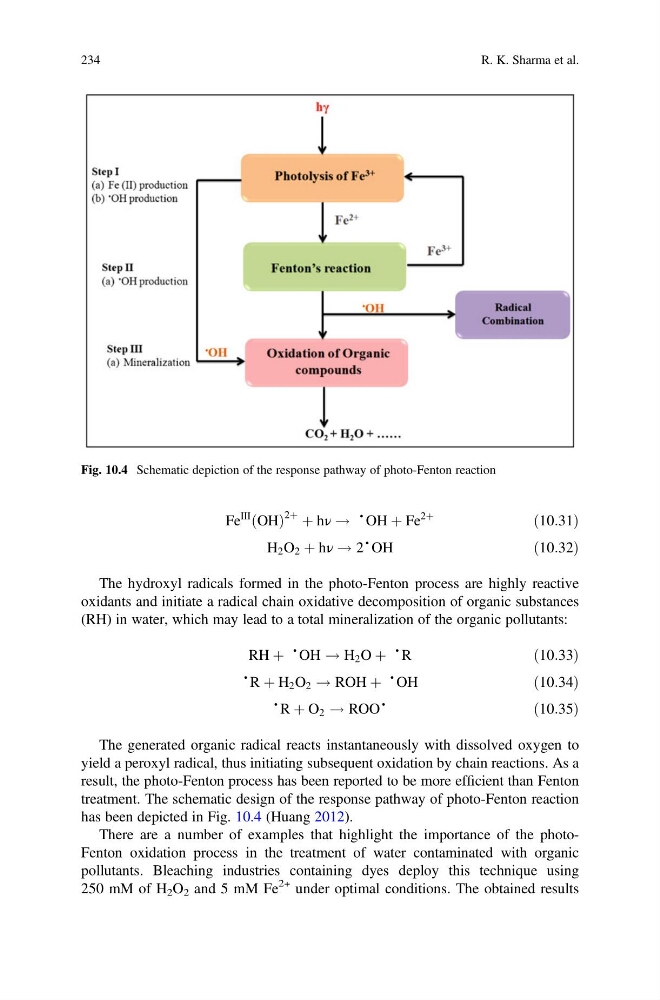
treatment. The schematic design of the response pathway of photo-Fenton reaction
has been depicted in Fig. 10.4 (Huang 2012).
There are a number of examples that highlight the importance of the photoFenton oxidation process in the treatment of water contaminated with organic
pollutants. Bleaching industries containing dyes deploy this technique using
250 mM of H 2 O 2 and 5 mM Fe
2+ under optimal conditions. The obtained results
Fig. 10.4 Schematic depiction of the response pathway of photo-Fenton reaction
234
R. K. Sharma et al.
III OH
ð Þ
2þ þ hν !
• OH þ Fe
2þ
ð10:31Þ
H 2 O 2 þ hν ! 2
• OH
ð10:32Þ
The hydroxyl radicals formed in the photo-Fenton process are highly reactive
oxidants and initiate a radical chain oxidative decomposition of organic substances
(RH) in water, which may lead to a total mineralization of the organic pollutants:
RH þ
• OH ! H 2 O þ
• R
ð10:33Þ
• R þ H 2 O 2 ! ROH þ
• OH
ð10:34Þ
• R þ O 2 ! ROO
•
ð10:35Þ
The generated organic radical reacts instantaneously with dissolved oxygen to
yield a peroxyl radical, thus initiating subsequent oxidation by chain reactions. As a
result, the photo-Fenton process has been reported to be more efficient than Fenton
treatment. The schematic design of the response pathway of photo-Fenton reaction
has been depicted in Fig. 10.4 (Huang 2012).
There are a number of examples that highlight the importance of the photoFenton oxidation process in the treatment of water contaminated with organic
pollutants. Bleaching industries containing dyes deploy this technique using
250 mM of H 2 O 2 and 5 mM Fe
2+ under optimal conditions. The obtained results
Fig. 10.4 Schematic depiction of the response pathway of photo-Fenton reaction
234
R. K. Sharma et al.