

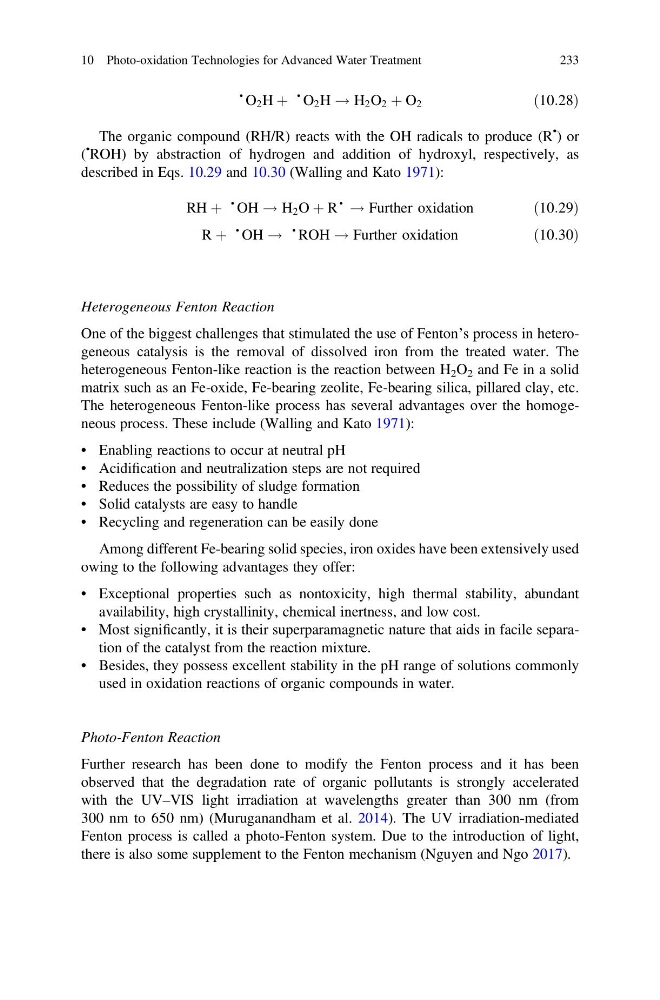
• O 2 H þ
• O 2 H ! H 2 O 2 þ O 2
ð10:28Þ
The organic compound (RH/R) reacts with the OH radicals to produce (R
•
) or
(
•
ROH) by abstraction of hydrogen and addition of hydroxyl, respectively, as
described in Eqs. 10.29 and 10.30 (Walling and Kato 1971):
RH þ
• OH ! H 2 O þ R
•
! Further oxidation
ð10:29Þ
R þ
• OH !
• ROH ! Further oxidation
ð10:30Þ
Heterogeneous Fenton Reaction
One of the biggest challenges that stimulated the use of Fenton’s process in heterogeneous catalysis is the removal of dissolved iron from the treated water. The
heterogeneous Fenton-like reaction is the reaction between H 2 O 2 and Fe in a solid
matrix such as an Fe-oxide, Fe-bearing zeolite, Fe-bearing silica, pillared clay, etc.
The heterogeneous Fenton-like process has several advantages over the homogeneous process. These include (Walling and Kato 1971):
• Enabling reactions to occur at neutral pH
• Acidification and neutralization steps are not required
• Reduces the possibility of sludge formation
• Solid catalysts are easy to handle
• Recycling and regeneration can be easily done
Among different Fe-bearing solid species, iron oxides have been extensively used
owing to the following advantages they offer:
• Exceptional properties such as nontoxicity, high thermal stability, abundant
availability, high crystallinity, chemical inertness, and low cost.
• Most significantly, it is their superparamagnetic nature that aids in facile separation of the catalyst from the reaction mixture.
• Besides, they possess excellent stability in the pH range of solutions commonly
used in oxidation reactions of organic compounds in water.
Photo-Fenton Reaction
Further research has been done to modify the Fenton process and it has been
observed that the degradation rate of organic pollutants is strongly accelerated
with the UV–VIS light irradiation at wavelengths greater than 300 nm (from
300 nm to 650 nm) (Muruganandham et al. 2014). The UV irradiation-mediated
Fenton process is called a photo-Fenton system. Due to the introduction of light,
there is also some supplement to the Fenton mechanism (Nguyen and Ngo 2017).
10 Photo-oxidation Technologies for Advanced Water Treatment
233
• O 2 H ! H 2 O 2 þ O 2
ð10:28Þ
The organic compound (RH/R) reacts with the OH radicals to produce (R
•
) or
(
•
ROH) by abstraction of hydrogen and addition of hydroxyl, respectively, as
described in Eqs. 10.29 and 10.30 (Walling and Kato 1971):
RH þ
• OH ! H 2 O þ R
•
! Further oxidation
ð10:29Þ
R þ
• OH !
• ROH ! Further oxidation
ð10:30Þ
Heterogeneous Fenton Reaction
One of the biggest challenges that stimulated the use of Fenton’s process in heterogeneous catalysis is the removal of dissolved iron from the treated water. The
heterogeneous Fenton-like reaction is the reaction between H 2 O 2 and Fe in a solid
matrix such as an Fe-oxide, Fe-bearing zeolite, Fe-bearing silica, pillared clay, etc.
The heterogeneous Fenton-like process has several advantages over the homogeneous process. These include (Walling and Kato 1971):
• Enabling reactions to occur at neutral pH
• Acidification and neutralization steps are not required
• Reduces the possibility of sludge formation
• Solid catalysts are easy to handle
• Recycling and regeneration can be easily done
Among different Fe-bearing solid species, iron oxides have been extensively used
owing to the following advantages they offer:
• Exceptional properties such as nontoxicity, high thermal stability, abundant
availability, high crystallinity, chemical inertness, and low cost.
• Most significantly, it is their superparamagnetic nature that aids in facile separation of the catalyst from the reaction mixture.
• Besides, they possess excellent stability in the pH range of solutions commonly
used in oxidation reactions of organic compounds in water.
Photo-Fenton Reaction
Further research has been done to modify the Fenton process and it has been
observed that the degradation rate of organic pollutants is strongly accelerated
with the UV–VIS light irradiation at wavelengths greater than 300 nm (from
300 nm to 650 nm) (Muruganandham et al. 2014). The UV irradiation-mediated
Fenton process is called a photo-Fenton system. Due to the introduction of light,
there is also some supplement to the Fenton mechanism (Nguyen and Ngo 2017).
10 Photo-oxidation Technologies for Advanced Water Treatment
233