

Weiss (1934) also proposed that there is a formation of
•
OH due to the Fenton
reaction, where iron salt works as a catalyst. Nowadays, Fenton’s process is an
attractive technique for oxidation as it can generate
•
OH without the use of special
apparatus or chemicals under ambient temperature and pressure. Besides, it is an
effortless technique that is environmentally safe and involves the use of cheap
precursors like iron salt, H 2 O 2 . The generation of
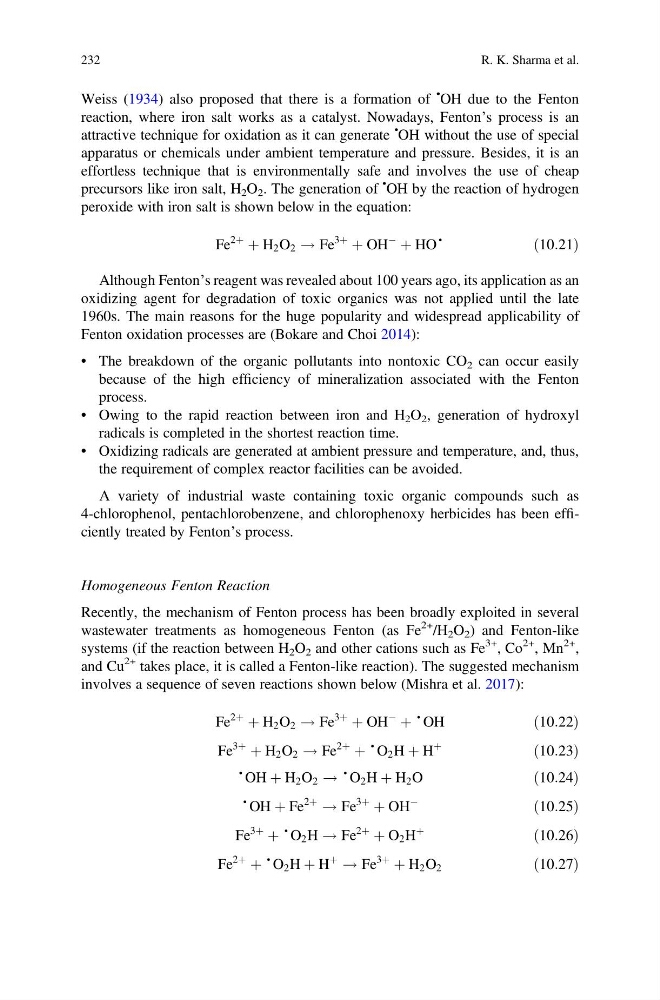
• OH by the reaction of hydrogen
peroxide with iron salt is shown below in the equation:
Fe
2þ
þ H 2 O 2 ! Fe
3þ
þ OH
À
þ HO
•
ð10:21Þ
Although Fenton’s reagent was revealed about 100 years ago, its application as an
oxidizing agent for degradation of toxic organics was not applied until the late
1960s. The main reasons for the huge popularity and widespread applicability of
Fenton oxidation processes are (Bokare and Choi 2014):
• The breakdown of the organic pollutants into nontoxic CO 2 can occur easily
because of the high efficiency of mineralization associated with the Fenton
process.
• Owing to the rapid reaction between iron and H 2 O 2 , generation of hydroxyl
radicals is completed in the shortest reaction time.
• Oxidizing radicals are generated at ambient pressure and temperature, and, thus,
the requirement of complex reactor facilities can be avoided.
A variety of industrial waste containing toxic organic compounds such as
4-chlorophenol, pentachlorobenzene, and chlorophenoxy herbicides has been efficiently treated by Fenton’s process.
Homogeneous Fenton Reaction
Recently, the mechanism of Fenton process has been broadly exploited in several
wastewater treatments as homogeneous Fenton (as Fe
2+ /H 2 O 2 ) and Fenton-like
systems (if the reaction between H 2 O 2 and other cations such as Fe
3+ , Co
2+ , Mn
2+ ,
and Cu
2+ takes place, it is called a Fenton-like reaction). The suggested mechanism
involves a sequence of seven reactions shown below (Mishra et al. 2017):
Fe
2þ
þ H 2 O 2 ! Fe
3þ
þ OH
À
þ
• OH
ð10:22Þ
Fe
3þ
þ H 2 O 2 ! Fe
2þ
þ
• O 2 H þ H
þ
ð10:23Þ
• OH þ H 2 O 2 !
• O 2 H þ H 2 O
ð10:24Þ
• OH þ Fe
2þ
! Fe
3þ
þ OH
À
ð10:25Þ
Fe
3þ
þ
• O 2 H ! Fe
2þ
þ O 2 H
þ
ð10:26Þ
Fe
2þ
þ
• O 2 H þ H
þ
! Fe
3þ
þ H 2 O 2
ð10:27Þ
232
R. K. Sharma et al.
•
OH due to the Fenton
reaction, where iron salt works as a catalyst. Nowadays, Fenton’s process is an
attractive technique for oxidation as it can generate
•
OH without the use of special
apparatus or chemicals under ambient temperature and pressure. Besides, it is an
effortless technique that is environmentally safe and involves the use of cheap
precursors like iron salt, H 2 O 2 . The generation of
• OH by the reaction of hydrogen
peroxide with iron salt is shown below in the equation:
Fe
2þ
þ H 2 O 2 ! Fe
3þ
þ OH
À
þ HO
•
ð10:21Þ
Although Fenton’s reagent was revealed about 100 years ago, its application as an
oxidizing agent for degradation of toxic organics was not applied until the late
1960s. The main reasons for the huge popularity and widespread applicability of
Fenton oxidation processes are (Bokare and Choi 2014):
• The breakdown of the organic pollutants into nontoxic CO 2 can occur easily
because of the high efficiency of mineralization associated with the Fenton
process.
• Owing to the rapid reaction between iron and H 2 O 2 , generation of hydroxyl
radicals is completed in the shortest reaction time.
• Oxidizing radicals are generated at ambient pressure and temperature, and, thus,
the requirement of complex reactor facilities can be avoided.
A variety of industrial waste containing toxic organic compounds such as
4-chlorophenol, pentachlorobenzene, and chlorophenoxy herbicides has been efficiently treated by Fenton’s process.
Homogeneous Fenton Reaction
Recently, the mechanism of Fenton process has been broadly exploited in several
wastewater treatments as homogeneous Fenton (as Fe
2+ /H 2 O 2 ) and Fenton-like
systems (if the reaction between H 2 O 2 and other cations such as Fe
3+ , Co
2+ , Mn
2+ ,
and Cu
2+ takes place, it is called a Fenton-like reaction). The suggested mechanism
involves a sequence of seven reactions shown below (Mishra et al. 2017):
Fe
2þ
þ H 2 O 2 ! Fe
3þ
þ OH
À
þ
• OH
ð10:22Þ
Fe
3þ
þ H 2 O 2 ! Fe
2þ
þ
• O 2 H þ H
þ
ð10:23Þ
• OH þ H 2 O 2 !
• O 2 H þ H 2 O
ð10:24Þ
• OH þ Fe
2þ
! Fe
3þ
þ OH
À
ð10:25Þ
Fe
3þ
þ
• O 2 H ! Fe
2þ
þ O 2 H
þ
ð10:26Þ
Fe
2þ
þ
• O 2 H þ H
þ
! Fe
3þ
þ H 2 O 2
ð10:27Þ
232
R. K. Sharma et al.