

Ozone Dosage
For the effective degradation of contaminants, optimum dosage of ozone is necessary. This can be accomplished by the effective transfer of ozone gas, which helps to
maintain the high dissolved ozone rate into the solution.
UV Illumination Level
For proper UV irradiation and mixing of ozone in the system, an effective O 3 /UV
system with pressurized injection secondary mix UV/O 3 reactor needs to be
designed. Such system generates microbubbles with the constant renewal of gas to
liquid—mixing zone. This enhances the gas solubility for the better utilization of UV
irradiation.
pH of the System
With the increase in the pH (>8) of the system, ozone becomes readily converted to
hydroxyl radicals, which increase the oxidation rate of contaminants such as pesticides and cyanide.
In order to achieve the maximum degradation efficiency, the equilibrium between
the pH level, UV photolysis, and ozone dosage must be considered in system design.
In fact, UV/O 3 technology has been extensively used to manage contamination in
wastewater obtained from textiles, petroleum refineries, electroplating waste, electronic chip manufacturing, etc., because it not only leads to the efficient degradation
of pollutants but also successfully reduces the total organic carbon (TOC) and COD.
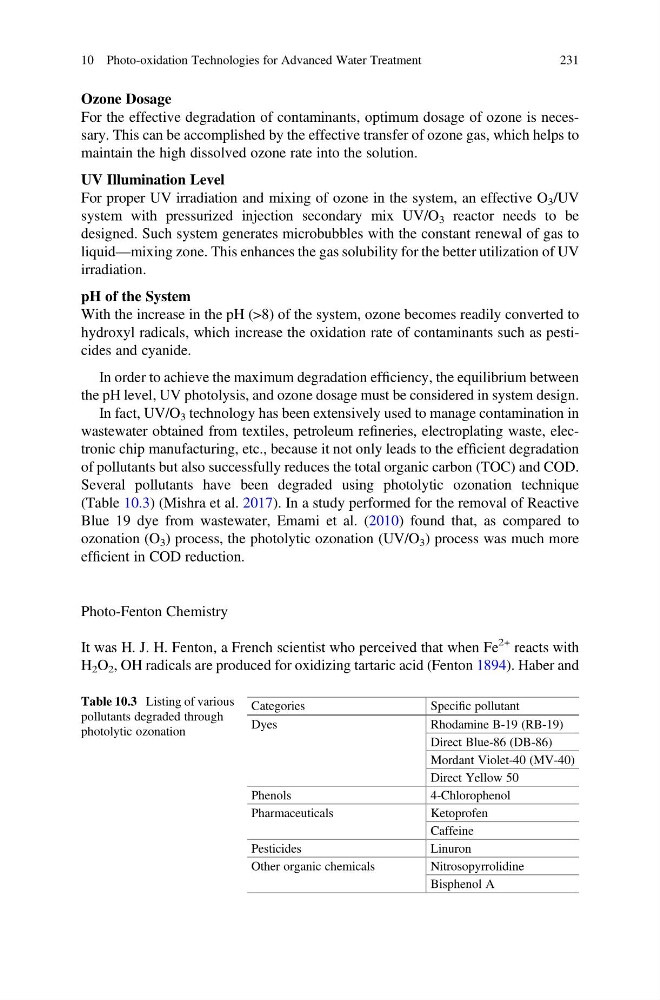
Several pollutants have been degraded using photolytic ozonation technique
(Table 10.3) (Mishra et al. 2017). In a study performed for the removal of Reactive
Blue 19 dye from wastewater, Emami et al. (2010) found that, as compared to
ozonation (O 3 ) process, the photolytic ozonation (UV/O 3 ) process was much more
efficient in COD reduction.
Photo-Fenton Chemistry
It was H. J. H. Fenton, a French scientist who perceived that when Fe
2+ reacts with
H 2 O 2 , OH radicals are produced for oxidizing tartaric acid (Fenton 1894). Haber and
Table 10.3 Listing of various
pollutants degraded through
photolytic ozonation
Categories
Specific pollutant
Dyes
Rhodamine B-19 (RB-19)
Direct Blue-86 (DB-86)
Mordant Violet-40 (MV-40)
Direct Yellow 50
Phenols
4-Chlorophenol
Pharmaceuticals
Ketoprofen
Caffeine
Pesticides
Linuron
Other organic chemicals
Nitrosopyrrolidine
Bisphenol A
10 Photo-oxidation Technologies for Advanced Water Treatment
231
For the effective degradation of contaminants, optimum dosage of ozone is necessary. This can be accomplished by the effective transfer of ozone gas, which helps to
maintain the high dissolved ozone rate into the solution.
UV Illumination Level
For proper UV irradiation and mixing of ozone in the system, an effective O 3 /UV
system with pressurized injection secondary mix UV/O 3 reactor needs to be
designed. Such system generates microbubbles with the constant renewal of gas to
liquid—mixing zone. This enhances the gas solubility for the better utilization of UV
irradiation.
pH of the System
With the increase in the pH (>8) of the system, ozone becomes readily converted to
hydroxyl radicals, which increase the oxidation rate of contaminants such as pesticides and cyanide.
In order to achieve the maximum degradation efficiency, the equilibrium between
the pH level, UV photolysis, and ozone dosage must be considered in system design.
In fact, UV/O 3 technology has been extensively used to manage contamination in
wastewater obtained from textiles, petroleum refineries, electroplating waste, electronic chip manufacturing, etc., because it not only leads to the efficient degradation
of pollutants but also successfully reduces the total organic carbon (TOC) and COD.
Several pollutants have been degraded using photolytic ozonation technique
(Table 10.3) (Mishra et al. 2017). In a study performed for the removal of Reactive
Blue 19 dye from wastewater, Emami et al. (2010) found that, as compared to
ozonation (O 3 ) process, the photolytic ozonation (UV/O 3 ) process was much more
efficient in COD reduction.
Photo-Fenton Chemistry
It was H. J. H. Fenton, a French scientist who perceived that when Fe
2+ reacts with
H 2 O 2 , OH radicals are produced for oxidizing tartaric acid (Fenton 1894). Haber and
Table 10.3 Listing of various
pollutants degraded through
photolytic ozonation
Categories
Specific pollutant
Dyes
Rhodamine B-19 (RB-19)
Direct Blue-86 (DB-86)
Mordant Violet-40 (MV-40)
Direct Yellow 50
Phenols
4-Chlorophenol
Pharmaceuticals
Ketoprofen
Caffeine
Pesticides
Linuron
Other organic chemicals
Nitrosopyrrolidine
Bisphenol A
10 Photo-oxidation Technologies for Advanced Water Treatment
231