

Limitations of This Technique (Mishra et al. 2017)
• Compounds like benzenes, geosmin, and 2-methylisoborneol (MIB), trihalomethanes (THMs), etc., do not become efficiently oxidized by ozone
• Removal of ammonia by this process is slow as it exhibits low oxidation potential
• Cryptosporidium parvum cyst requires high amount of ozone and detrimental
by-products are formed during this process in drinking water
• If bromide is present in wastewater, it reacts with O 3 and
• OH to form bromate,
which is a potential carcinogen
• Complete mineralization of the pollutant into carbon dioxide, which makes
ozonation hardly possible
• High production cost
• Relatively low solubility and stability in water
• Selectively reacts with organic compounds at acidic pH
By introducing the UV radiation (λ ¼ 254 nm) in the ozonation process, the
removal efficiency of contaminants in water is enhanced. This process is also known
as photolytic ozonation.
Advantages of the UV/O 3 Technique (Krishnan et al. 2017)
• The efficiency of the combined UV/O 3 process is typically higher than the
additive efficiencies of UV alone and ozone.
• Compared with the H 2 O 2 /UV process, the combined O 3 /UV process is more
efficient in generating hydroxyl radicals using LP UV lamps.
• This process is more stochiometrically efficient than other processes in generating
OH radicals.
• This process is capable of degradation of stubborn organic compounds that resist
degradation.
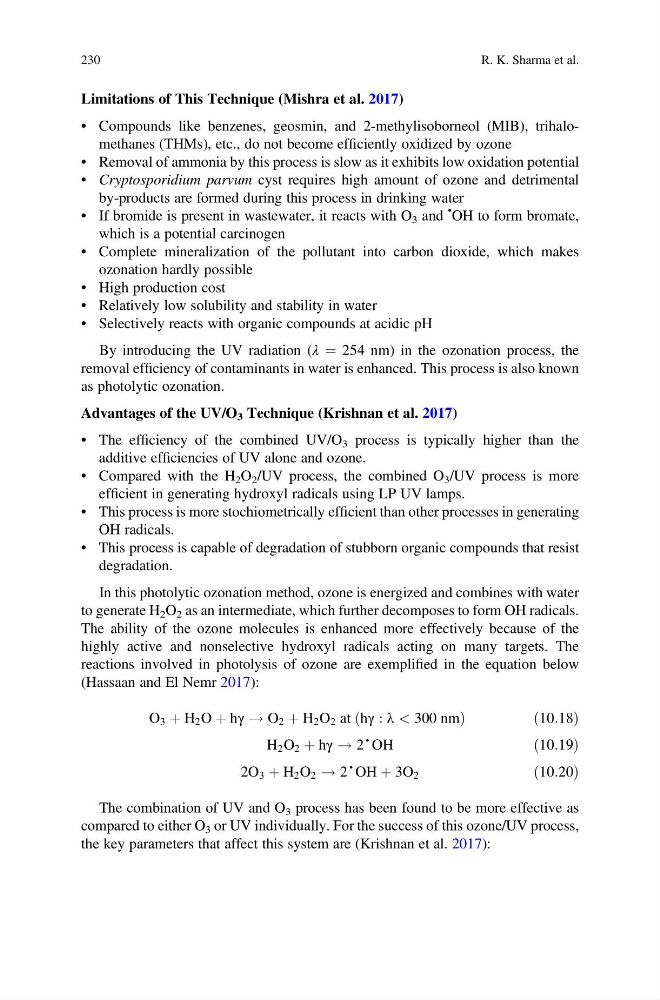
In this photolytic ozonation method, ozone is energized and combines with water
to generate H 2 O 2 as an intermediate, which further decomposes to form OH radicals.
The ability of the ozone molecules is enhanced more effectively because of the
highly active and nonselective hydroxyl radicals acting on many targets. The
reactions involved in photolysis of ozone are exemplified in the equation below
(Hassaan and El Nemr 2017):
O 3 þ H 2 O þ hγ ! O 2 þ H 2 O 2 at hγ : λ < 300 nm
ð
Þ
ð 10:18Þ
H 2 O 2 þ hγ ! 2
• OH
ð10:19Þ
2O 3 þ H 2 O 2 ! 2
• OH þ 3O 2
ð10:20Þ
The combination of UV and O 3 process has been found to be more effective as
compared to either O 3 or UV individually. For the success of this ozone/UV process,
the key parameters that affect this system are (Krishnan et al. 2017):
230
R. K. Sharma et al.
• Compounds like benzenes, geosmin, and 2-methylisoborneol (MIB), trihalomethanes (THMs), etc., do not become efficiently oxidized by ozone
• Removal of ammonia by this process is slow as it exhibits low oxidation potential
• Cryptosporidium parvum cyst requires high amount of ozone and detrimental
by-products are formed during this process in drinking water
• If bromide is present in wastewater, it reacts with O 3 and
• OH to form bromate,
which is a potential carcinogen
• Complete mineralization of the pollutant into carbon dioxide, which makes
ozonation hardly possible
• High production cost
• Relatively low solubility and stability in water
• Selectively reacts with organic compounds at acidic pH
By introducing the UV radiation (λ ¼ 254 nm) in the ozonation process, the
removal efficiency of contaminants in water is enhanced. This process is also known
as photolytic ozonation.
Advantages of the UV/O 3 Technique (Krishnan et al. 2017)
• The efficiency of the combined UV/O 3 process is typically higher than the
additive efficiencies of UV alone and ozone.
• Compared with the H 2 O 2 /UV process, the combined O 3 /UV process is more
efficient in generating hydroxyl radicals using LP UV lamps.
• This process is more stochiometrically efficient than other processes in generating
OH radicals.
• This process is capable of degradation of stubborn organic compounds that resist
degradation.
In this photolytic ozonation method, ozone is energized and combines with water
to generate H 2 O 2 as an intermediate, which further decomposes to form OH radicals.
The ability of the ozone molecules is enhanced more effectively because of the
highly active and nonselective hydroxyl radicals acting on many targets. The
reactions involved in photolysis of ozone are exemplified in the equation below
(Hassaan and El Nemr 2017):
O 3 þ H 2 O þ hγ ! O 2 þ H 2 O 2 at hγ : λ < 300 nm
ð
Þ
ð 10:18Þ
H 2 O 2 þ hγ ! 2
• OH
ð10:19Þ
2O 3 þ H 2 O 2 ! 2
• OH þ 3O 2
ð10:20Þ
The combination of UV and O 3 process has been found to be more effective as
compared to either O 3 or UV individually. For the success of this ozone/UV process,
the key parameters that affect this system are (Krishnan et al. 2017):
230
R. K. Sharma et al.