

Initially, in water the concentration of ozone decreases rapidly and first-order
kinetics is followed, whereas second-order kinetics is followed in the second phase
of ozone decrease through oxidation (von Gunten 2003; Stettler et al. 1998; Exner
1988). Being an extremely strong oxidant, ozone (E
0 ¼ 2.07 V) reacts rapidly with
most of organic compounds. The oxidation of organic pollutants is enhanced by
ozone when electron-donating groups like –CH 3 , ÀO, ÀOCH 3 are present, whereas
it gets reduced as a result of the presence of electron-withdrawing groups like ÀCl,
ÀNO 2 (von Gunten 2003). There is a decrease in the oxidation potential with
protonation of species due to the decrease in the nucleophilicity. The decolorization
using ozone as an oxidant is fast because ozone molecule attacks the unsaturated
groups present in chromophores. On the other hand, the saturated compounds exhibit
low reactivity because they get accumulated during the ozonation process. The
presence of sulfide and amino groups in the organic compounds shows high ozone
reactivity. The half-life of dissolved ozone varies from seconds to hours depending
upon the pH of water, alkalinity, and waste organic matter content.
This technique is extensively used in European countries, e.g., Switzerland and
Germany in wastewater treatment plants (Badia-Fabregat et al. 2017). There are
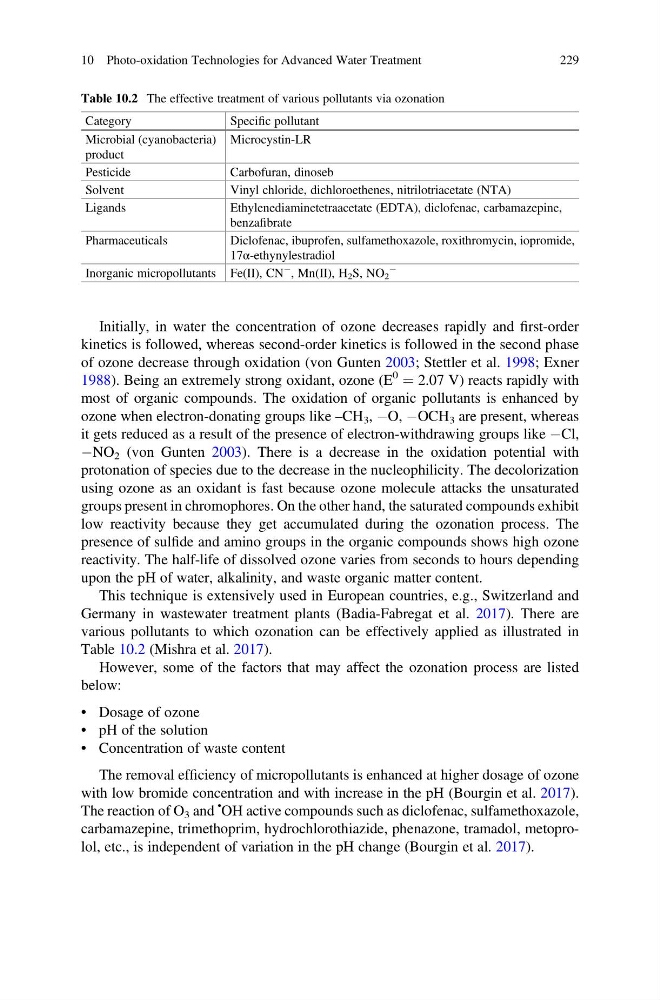
various pollutants to which ozonation can be effectively applied as illustrated in
Table 10.2 (Mishra et al. 2017).
However, some of the factors that may affect the ozonation process are listed
below:
• Dosage of ozone
• pH of the solution
• Concentration of waste content
The removal efficiency of micropollutants is enhanced at higher dosage of ozone
with low bromide concentration and with increase in the pH (Bourgin et al. 2017).
The reaction of O 3 and
•
OH active compounds such as diclofenac, sulfamethoxazole,
carbamazepine, trimethoprim, hydrochlorothiazide, phenazone, tramadol, metoprolol, etc., is independent of variation in the pH change (Bourgin et al. 2017).
Table 10.2 The effective treatment of various pollutants via ozonation
Category
Specific pollutant
Microbial (cyanobacteria)
product
Microcystin-LR
Pesticide
Carbofuran, dinoseb
Solvent
Vinyl chloride, dichloroethenes, nitrilotriacetate (NTA)
Ligands
Ethylenediaminetetraacetate (EDTA), diclofenac, carbamazepine,
benzafibrate
Pharmaceuticals
Diclofenac, ibuprofen, sulfamethoxazole, roxithromycin, iopromide,
17α-ethynylestradiol
Inorganic micropollutants Fe(II), CN
À
, Mn(II), H 2 S, NO 2
À
10 Photo-oxidation Technologies for Advanced Water Treatment
229
kinetics is followed, whereas second-order kinetics is followed in the second phase
of ozone decrease through oxidation (von Gunten 2003; Stettler et al. 1998; Exner
1988). Being an extremely strong oxidant, ozone (E
0 ¼ 2.07 V) reacts rapidly with
most of organic compounds. The oxidation of organic pollutants is enhanced by
ozone when electron-donating groups like –CH 3 , ÀO, ÀOCH 3 are present, whereas
it gets reduced as a result of the presence of electron-withdrawing groups like ÀCl,
ÀNO 2 (von Gunten 2003). There is a decrease in the oxidation potential with
protonation of species due to the decrease in the nucleophilicity. The decolorization
using ozone as an oxidant is fast because ozone molecule attacks the unsaturated
groups present in chromophores. On the other hand, the saturated compounds exhibit
low reactivity because they get accumulated during the ozonation process. The
presence of sulfide and amino groups in the organic compounds shows high ozone
reactivity. The half-life of dissolved ozone varies from seconds to hours depending
upon the pH of water, alkalinity, and waste organic matter content.
This technique is extensively used in European countries, e.g., Switzerland and
Germany in wastewater treatment plants (Badia-Fabregat et al. 2017). There are
various pollutants to which ozonation can be effectively applied as illustrated in
Table 10.2 (Mishra et al. 2017).
However, some of the factors that may affect the ozonation process are listed
below:
• Dosage of ozone
• pH of the solution
• Concentration of waste content
The removal efficiency of micropollutants is enhanced at higher dosage of ozone
with low bromide concentration and with increase in the pH (Bourgin et al. 2017).
The reaction of O 3 and
•
OH active compounds such as diclofenac, sulfamethoxazole,
carbamazepine, trimethoprim, hydrochlorothiazide, phenazone, tramadol, metoprolol, etc., is independent of variation in the pH change (Bourgin et al. 2017).
Table 10.2 The effective treatment of various pollutants via ozonation
Category
Specific pollutant
Microbial (cyanobacteria)
product
Microcystin-LR
Pesticide
Carbofuran, dinoseb
Solvent
Vinyl chloride, dichloroethenes, nitrilotriacetate (NTA)
Ligands
Ethylenediaminetetraacetate (EDTA), diclofenac, carbamazepine,
benzafibrate
Pharmaceuticals
Diclofenac, ibuprofen, sulfamethoxazole, roxithromycin, iopromide,
17α-ethynylestradiol
Inorganic micropollutants Fe(II), CN
À
, Mn(II), H 2 S, NO 2
À
10 Photo-oxidation Technologies for Advanced Water Treatment
229