

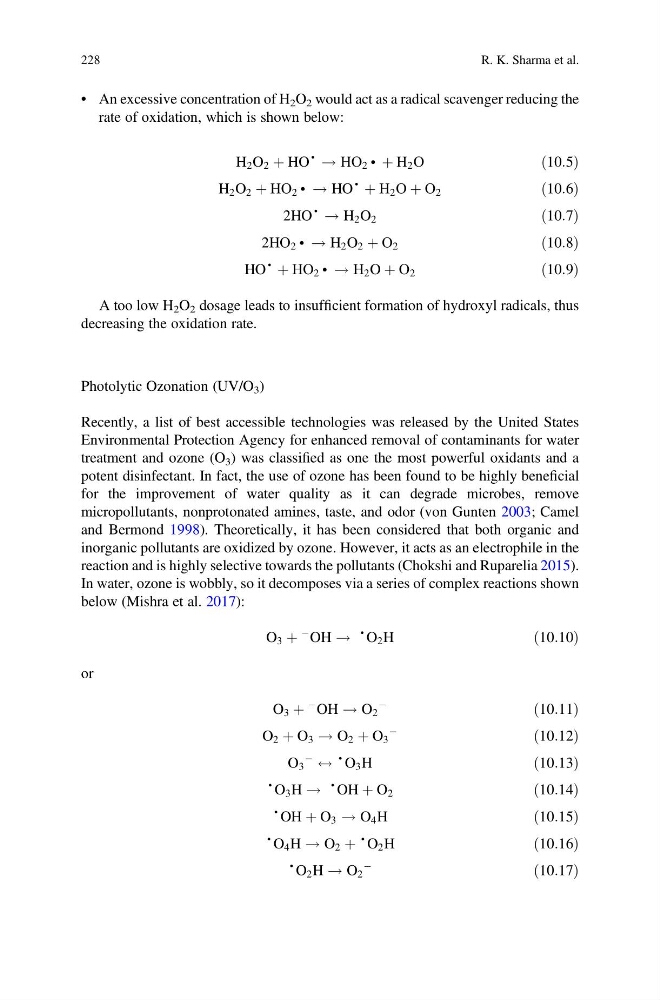
• An excessive concentration of H 2 O 2 would act as a radical scavenger reducing the
rate of oxidation, which is shown below:
H 2 O 2 þ HO
•
! ΗΟ 2 • þ Η 2 Ο
ð10:5Þ
H 2 O 2 þ ΗΟ 2 • ! HO
•
þ Η 2 Ο þ Ο 2
ð10:6Þ
2HO
•
! H 2 O 2
ð10:7Þ
2ΗΟ 2 • ! H 2 O 2 þ Ο 2
ð10:8Þ
HO
•
þ ΗΟ 2 • ! H 2 O þ Ο 2
ð10:9Þ
A too low H 2 O 2 dosage leads to insufficient formation of hydroxyl radicals, thus
decreasing the oxidation rate.
Photolytic Ozonation (UV/O 3 )
Recently, a list of best accessible technologies was released by the United States
Environmental Protection Agency for enhanced removal of contaminants for water
treatment and ozone (O 3 ) was classified as one the most powerful oxidants and a
potent disinfectant. In fact, the use of ozone has been found to be highly beneficial
for the improvement of water quality as it can degrade microbes, remove
micropollutants, nonprotonated amines, taste, and odor (von Gunten 2003; Camel
and Bermond 1998). Theoretically, it has been considered that both organic and
inorganic pollutants are oxidized by ozone. However, it acts as an electrophile in the
reaction and is highly selective towards the pollutants (Chokshi and Ruparelia 2015).
In water, ozone is wobbly, so it decomposes via a series of complex reactions shown
below (Mishra et al. 2017):
O 3 þ
À OH !
• O 2 H
ð10:10Þ
or
O 3 þ
À OH ! O 2
À
ð10:11Þ
O 2 þ O 3 ! O 2 þ O 3
À
ð10:12Þ
O 3
À
$
• O 3 H
ð10:13Þ
• O 3 H !
• OH þ O 2
ð10:14Þ
• OH þ O 3 ! O 4 H
ð10:15Þ
• O 4 H ! O 2 þ
• O 2 H
ð10:16Þ
• O 2 H ! O 2
À
ð10:17Þ
228
R. K. Sharma et al.
rate of oxidation, which is shown below:
H 2 O 2 þ HO
•
! ΗΟ 2 • þ Η 2 Ο
ð10:5Þ
H 2 O 2 þ ΗΟ 2 • ! HO
•
þ Η 2 Ο þ Ο 2
ð10:6Þ
2HO
•
! H 2 O 2
ð10:7Þ
2ΗΟ 2 • ! H 2 O 2 þ Ο 2
ð10:8Þ
HO
•
þ ΗΟ 2 • ! H 2 O þ Ο 2
ð10:9Þ
A too low H 2 O 2 dosage leads to insufficient formation of hydroxyl radicals, thus
decreasing the oxidation rate.
Photolytic Ozonation (UV/O 3 )
Recently, a list of best accessible technologies was released by the United States
Environmental Protection Agency for enhanced removal of contaminants for water
treatment and ozone (O 3 ) was classified as one the most powerful oxidants and a
potent disinfectant. In fact, the use of ozone has been found to be highly beneficial
for the improvement of water quality as it can degrade microbes, remove
micropollutants, nonprotonated amines, taste, and odor (von Gunten 2003; Camel
and Bermond 1998). Theoretically, it has been considered that both organic and
inorganic pollutants are oxidized by ozone. However, it acts as an electrophile in the
reaction and is highly selective towards the pollutants (Chokshi and Ruparelia 2015).
In water, ozone is wobbly, so it decomposes via a series of complex reactions shown
below (Mishra et al. 2017):
O 3 þ
À OH !
• O 2 H
ð10:10Þ
or
O 3 þ
À OH ! O 2
À
ð10:11Þ
O 2 þ O 3 ! O 2 þ O 3
À
ð10:12Þ
O 3
À
$
• O 3 H
ð10:13Þ
• O 3 H !
• OH þ O 2
ð10:14Þ
• OH þ O 3 ! O 4 H
ð10:15Þ
• O 4 H ! O 2 þ
• O 2 H
ð10:16Þ
• O 2 H ! O 2
À
ð10:17Þ
228
R. K. Sharma et al.