

3. Initial organic load: The presence of high concentration of pollutants in wastewater leads to the saturation of TiO 2 surface, which results in the reduction of
photocatalyst activity.
4. Effect of reaction temperature: In general, the photocatalytic activity of catalyst
increases with the increase in the reaction temperature (>80
C). This is because
high temperature favors the recombination of charge carriers and avoids the
adsorption of organic compounds on TiO 2 surface. On the other hand, the
reaction temperature below 80
C promotes the adsorption and a further decrease
in the temperature to 0
C leads to an increase in apparent activation energy.
Hence, for significant photodegradation of organic pollutants, temperature
20–80
C has been considered as an optimum temperature range.
5. UV irradiation time: The intensity of UV light and the time of irradiation both
significantly affect photodegradation of organic pollutants. It has been observed
from the results that at lower light intensity, the rate would increase linearly with
the increase in the intensity of light and follows first-order kinetics; at higher
intensities of light, the rate is independent of light intensity.
6. Effect of pH: One of the main factors, which affects the photodegradation of
wastewater contaminant, is the pH of the solution. The acidic and alkaline
conditions can protonate as well as deprotonate the surface of titania, respectively, which will consequently either increase or decrease the rate of reaction
depending on the nature of the pollutant.
In order to examine the photocatalytic efficiency of titanium dioxide, it was used
for the treatment of diluted (1/100) olive mill wastewater. After a 24 h treatment, it
was observed that the COD, colouration at 330 nm and level of phenols could
decrease to 22%, 57% and 94% respectively (El Hajjouji et al. 2008).
Figure 10.7 displays some of the disadvantages of the TiO 2 /UV process (Dong
et al. 2015; Bagheri et al. 2017). As photocatalytic degradation mainly occurs on the
surface of TiO 2 , TiO 2 has poor affinity towards the organic contaminants because of
which the adsorption of pollutants onto the surface of TiO 2 is slow, which leads to
the reduction of photocatalytic degradation rates. Furthermore, owing to the
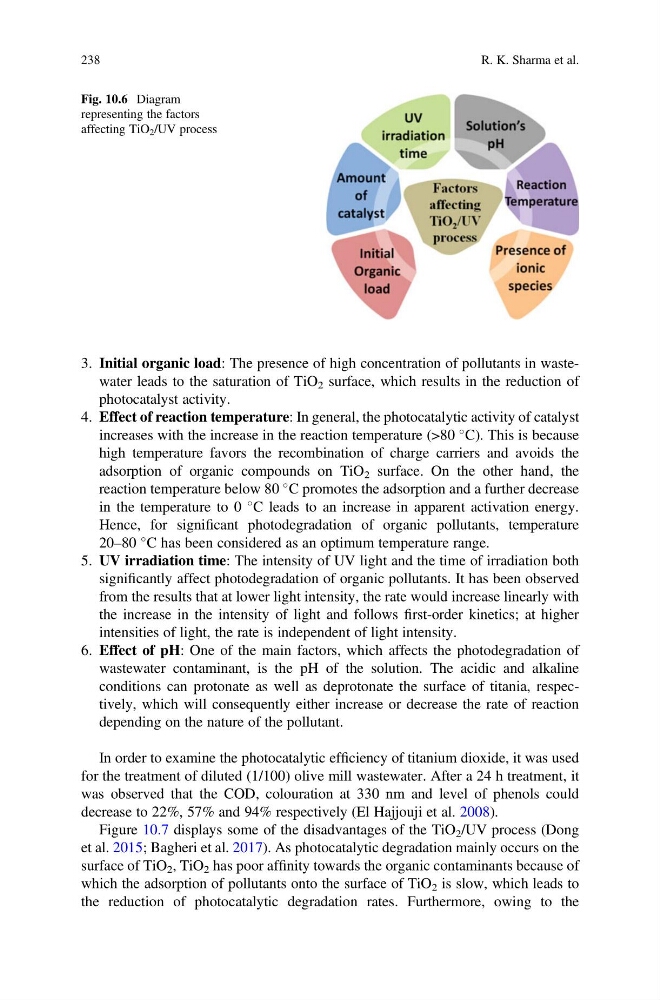
Fig. 10.6 Diagram
representing the factors
affecting TiO 2 /UV process
238
R. K. Sharma et al.
photocatalyst activity.
4. Effect of reaction temperature: In general, the photocatalytic activity of catalyst
increases with the increase in the reaction temperature (>80
C). This is because
high temperature favors the recombination of charge carriers and avoids the
adsorption of organic compounds on TiO 2 surface. On the other hand, the
reaction temperature below 80
C promotes the adsorption and a further decrease
in the temperature to 0
C leads to an increase in apparent activation energy.
Hence, for significant photodegradation of organic pollutants, temperature
20–80
C has been considered as an optimum temperature range.
5. UV irradiation time: The intensity of UV light and the time of irradiation both
significantly affect photodegradation of organic pollutants. It has been observed
from the results that at lower light intensity, the rate would increase linearly with
the increase in the intensity of light and follows first-order kinetics; at higher
intensities of light, the rate is independent of light intensity.
6. Effect of pH: One of the main factors, which affects the photodegradation of
wastewater contaminant, is the pH of the solution. The acidic and alkaline
conditions can protonate as well as deprotonate the surface of titania, respectively, which will consequently either increase or decrease the rate of reaction
depending on the nature of the pollutant.
In order to examine the photocatalytic efficiency of titanium dioxide, it was used
for the treatment of diluted (1/100) olive mill wastewater. After a 24 h treatment, it
was observed that the COD, colouration at 330 nm and level of phenols could
decrease to 22%, 57% and 94% respectively (El Hajjouji et al. 2008).
Figure 10.7 displays some of the disadvantages of the TiO 2 /UV process (Dong
et al. 2015; Bagheri et al. 2017). As photocatalytic degradation mainly occurs on the
surface of TiO 2 , TiO 2 has poor affinity towards the organic contaminants because of
which the adsorption of pollutants onto the surface of TiO 2 is slow, which leads to
the reduction of photocatalytic degradation rates. Furthermore, owing to the
Fig. 10.6 Diagram
representing the factors
affecting TiO 2 /UV process
238
R. K. Sharma et al.