

Further, removal of a wide range of heavy metals by ferrate(VI) has been studied.
A thorough study by Prucek et al. (2015) showed that metal ions, such as Cd(II), Ni
(II), Co(II), Cu(II), and Al(III), can be removed from water very effectively
(Fig. 8.9). At an Fe/metal ion weight ratio of 1/0 or less, complete removal of Co
(II), Cu(II), and Al(III) ions was observed. The ratio of 2/0 was required to remove
Ni(II) ions completely from water. In the case of Cd(II) ions, the removal was $70%
even at an Fe/Cd(II) weight ratio of 15/1. These results were obtained at neutral or
slightly acidic pH values. An increase in the pH enhanced the removal efficiency of
heavy metal ions, whereas the removal efficiency of Al(III) decreased with increasing pH, which can be explained in terms of a more pronounced transformation of Al
(III) ions to soluble Al(OH) 4 . The mechanisms of metal ions removal were confirmed by the combination of XPS and Mössbauer spectroscopy techniques. The
removal mechanism includes different processes for each particular metal. In the
case of copper, cobalt, and nickel, ions are readily removed predominantly through
the simultaneous formation of particular metal ferrite and γ-Fe 2 O 3 /γ-FeOOH core/
shell nanoparticles embedding a part of heavy metals in their crystal lattice (i.e.,
octahedral sites); only a minor part of these elements is adsorbed on the surfaces of
γ-Fe 2 O 3 /γ-FeOOH core/shell nanoparticles. Aluminum is partially incorporated in
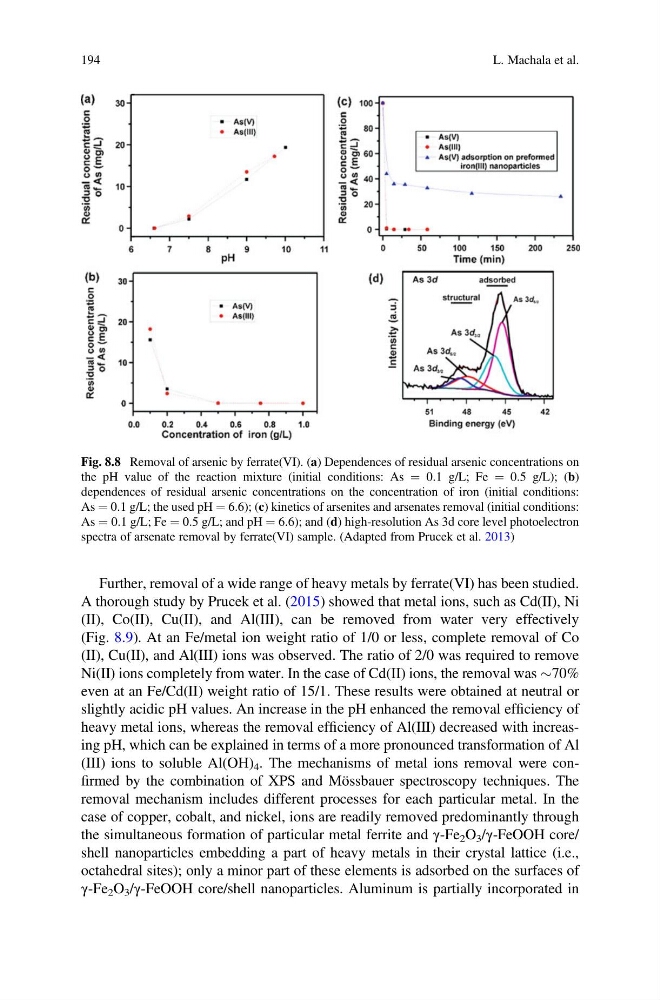
Fig. 8.8 Removal of arsenic by ferrate(VI). (a) Dependences of residual arsenic concentrations on
the pH value of the reaction mixture (initial conditions: As ¼ 0.1 g/L; Fe ¼ 0.5 g/L); (b)
dependences of residual arsenic concentrations on the concentration of iron (initial conditions:
As ¼ 0.1 g/L; the used pH ¼ 6.6); (c) kinetics of arsenites and arsenates removal (initial conditions:
As ¼ 0.1 g/L; Fe ¼ 0.5 g/L; and pH ¼ 6.6); and (d) high-resolution As 3d core level photoelectron
spectra of arsenate removal by ferrate(VI) sample. (Adapted from Prucek et al. 2013)
194
L. Machala et al.
A thorough study by Prucek et al. (2015) showed that metal ions, such as Cd(II), Ni
(II), Co(II), Cu(II), and Al(III), can be removed from water very effectively
(Fig. 8.9). At an Fe/metal ion weight ratio of 1/0 or less, complete removal of Co
(II), Cu(II), and Al(III) ions was observed. The ratio of 2/0 was required to remove
Ni(II) ions completely from water. In the case of Cd(II) ions, the removal was $70%
even at an Fe/Cd(II) weight ratio of 15/1. These results were obtained at neutral or
slightly acidic pH values. An increase in the pH enhanced the removal efficiency of
heavy metal ions, whereas the removal efficiency of Al(III) decreased with increasing pH, which can be explained in terms of a more pronounced transformation of Al
(III) ions to soluble Al(OH) 4 . The mechanisms of metal ions removal were confirmed by the combination of XPS and Mössbauer spectroscopy techniques. The
removal mechanism includes different processes for each particular metal. In the
case of copper, cobalt, and nickel, ions are readily removed predominantly through
the simultaneous formation of particular metal ferrite and γ-Fe 2 O 3 /γ-FeOOH core/
shell nanoparticles embedding a part of heavy metals in their crystal lattice (i.e.,
octahedral sites); only a minor part of these elements is adsorbed on the surfaces of
γ-Fe 2 O 3 /γ-FeOOH core/shell nanoparticles. Aluminum is partially incorporated in
Fig. 8.8 Removal of arsenic by ferrate(VI). (a) Dependences of residual arsenic concentrations on
the pH value of the reaction mixture (initial conditions: As ¼ 0.1 g/L; Fe ¼ 0.5 g/L); (b)
dependences of residual arsenic concentrations on the concentration of iron (initial conditions:
As ¼ 0.1 g/L; the used pH ¼ 6.6); (c) kinetics of arsenites and arsenates removal (initial conditions:
As ¼ 0.1 g/L; Fe ¼ 0.5 g/L; and pH ¼ 6.6); and (d) high-resolution As 3d core level photoelectron
spectra of arsenate removal by ferrate(VI) sample. (Adapted from Prucek et al. 2013)
194
L. Machala et al.