

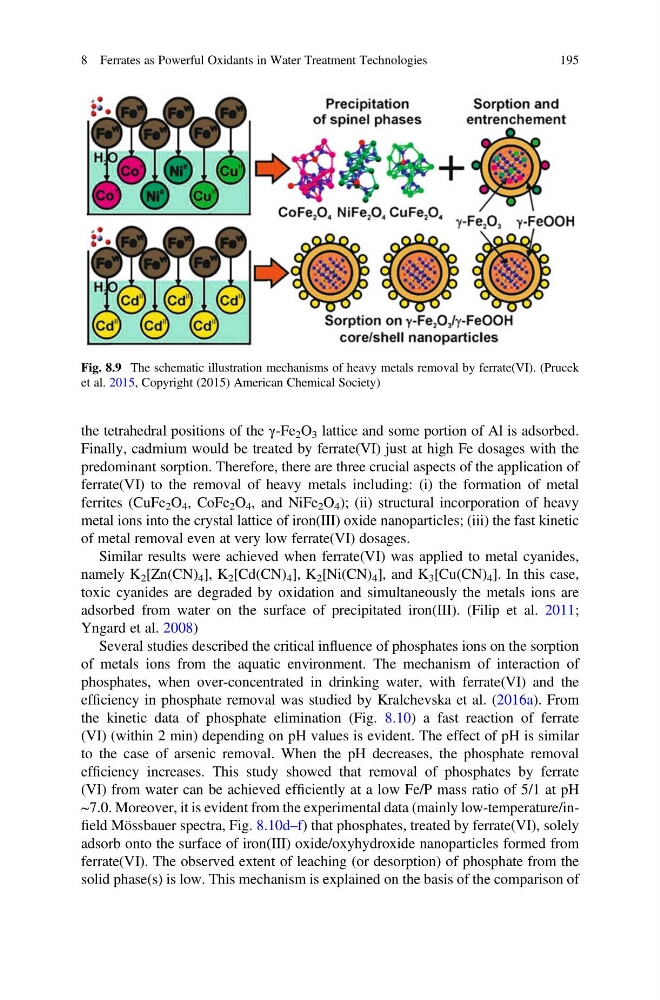
the tetrahedral positions of the γ-Fe 2 O 3 lattice and some portion of Al is adsorbed.
Finally, cadmium would be treated by ferrate(VI) just at high Fe dosages with the
predominant sorption. Therefore, there are three crucial aspects of the application of
ferrate(VI) to the removal of heavy metals including: (i) the formation of metal
ferrites (CuFe 2 O 4 , CoFe 2 O 4 , and NiFe 2 O 4 ); (ii) structural incorporation of heavy
metal ions into the crystal lattice of iron(III) oxide nanoparticles; (iii) the fast kinetic
of metal removal even at very low ferrate(VI) dosages.
Similar results were achieved when ferrate(VI) was applied to metal cyanides,
namely K 2 [Zn(CN) 4 ], K 2 [Cd(CN) 4 ], K 2 [Ni(CN) 4 ], and K 3 [Cu(CN) 4 ]. In this case,
toxic cyanides are degraded by oxidation and simultaneously the metals ions are
adsorbed from water on the surface of precipitated iron(III). (Filip et al. 2011;
Yngard et al. 2008)
Several studies described the critical influence of phosphates ions on the sorption
of metals ions from the aquatic environment. The mechanism of interaction of
phosphates, when over-concentrated in drinking water, with ferrate(VI) and the
efficiency in phosphate removal was studied by Kralchevska et al. (2016a). From
the kinetic data of phosphate elimination (Fig. 8.10) a fast reaction of ferrate
(VI) (within 2 min) depending on pH values is evident. The effect of pH is similar
to the case of arsenic removal. When the pH decreases, the phosphate removal
efficiency increases. This study showed that removal of phosphates by ferrate
(VI) from water can be achieved efficiently at a low Fe/P mass ratio of 5/1 at pH
~7.0. Moreover, it is evident from the experimental data (mainly low-temperature/infield Mössbauer spectra, Fig. 8.10d–f) that phosphates, treated by ferrate(VI), solely
adsorb onto the surface of iron(III) oxide/oxyhydroxide nanoparticles formed from
ferrate(VI). The observed extent of leaching (or desorption) of phosphate from the
solid phase(s) is low. This mechanism is explained on the basis of the comparison of
Fig. 8.9 The schematic illustration mechanisms of heavy metals removal by ferrate(VI). (Prucek
et al. 2015, Copyright (2015) American Chemical Society)
8 Ferrates as Powerful Oxidants in Water Treatment Technologies
195
Finally, cadmium would be treated by ferrate(VI) just at high Fe dosages with the
predominant sorption. Therefore, there are three crucial aspects of the application of
ferrate(VI) to the removal of heavy metals including: (i) the formation of metal
ferrites (CuFe 2 O 4 , CoFe 2 O 4 , and NiFe 2 O 4 ); (ii) structural incorporation of heavy
metal ions into the crystal lattice of iron(III) oxide nanoparticles; (iii) the fast kinetic
of metal removal even at very low ferrate(VI) dosages.
Similar results were achieved when ferrate(VI) was applied to metal cyanides,
namely K 2 [Zn(CN) 4 ], K 2 [Cd(CN) 4 ], K 2 [Ni(CN) 4 ], and K 3 [Cu(CN) 4 ]. In this case,
toxic cyanides are degraded by oxidation and simultaneously the metals ions are
adsorbed from water on the surface of precipitated iron(III). (Filip et al. 2011;
Yngard et al. 2008)
Several studies described the critical influence of phosphates ions on the sorption
of metals ions from the aquatic environment. The mechanism of interaction of
phosphates, when over-concentrated in drinking water, with ferrate(VI) and the
efficiency in phosphate removal was studied by Kralchevska et al. (2016a). From
the kinetic data of phosphate elimination (Fig. 8.10) a fast reaction of ferrate
(VI) (within 2 min) depending on pH values is evident. The effect of pH is similar
to the case of arsenic removal. When the pH decreases, the phosphate removal
efficiency increases. This study showed that removal of phosphates by ferrate
(VI) from water can be achieved efficiently at a low Fe/P mass ratio of 5/1 at pH
~7.0. Moreover, it is evident from the experimental data (mainly low-temperature/infield Mössbauer spectra, Fig. 8.10d–f) that phosphates, treated by ferrate(VI), solely
adsorb onto the surface of iron(III) oxide/oxyhydroxide nanoparticles formed from
ferrate(VI). The observed extent of leaching (or desorption) of phosphate from the
solid phase(s) is low. This mechanism is explained on the basis of the comparison of
Fig. 8.9 The schematic illustration mechanisms of heavy metals removal by ferrate(VI). (Prucek
et al. 2015, Copyright (2015) American Chemical Society)
8 Ferrates as Powerful Oxidants in Water Treatment Technologies
195