

metal ions, such as As(III), Pb(II), Cr(III), or Hg(II) via co-precipitation and/or
oxidation (Jiang et al. 2006). Moreover, ferrate(VI) has proven its ability to remove
some natural or artificial radionuclides (
238
U,
226 Ra,
232 Th,
137 Cs,
90 Sr,
239 Pu, etc.)
from various environmental samples (mines, waters) by their sorption in aqueous
environment with concomitant co-precipitation with iron(III) oxy-hydroxy species
followed by sedimentation. Interestingly, potassium ferrate effectively acted as a
scavenger to remove a mixture of alpha- and beta-emitting radionuclides (
137 Cs(I),
90 Sr(II),
152 Eu(III),
243 Am(III),
239
Pu(IV),
237 Np(V),
239 Np(V), and
238 + 233
U(VI))
from water samples under laboratory conditions (Petrov et al. 2016; Rai et al. 2018).
Considering the high toxicity of arsenic compounds, many studies focused on
their removal by ferrates (Jain et al. 2009; Lee et al. 2003). For instance Prucek et al.
(2013) explained kinetics and mechanisms of arsenite and arsenate removing by
ferrate(VI) (Fig. 8.8). A well-known fact is that sorption of metal ions is dependent
on the pH value. This effect is connected with speciation of ions and surface charge.
In the case of arsenic, decreasing the pH value sharply improved efficiency of arsenic
removal. In these experiments, the sorption kinetics of arsenic removal was very fast
and sorption equilibrium was reached approximately within 2 min. Ferrate
(VI) removed almost all arsenic at an Fe/As weight ratio of 2/1 (at pH 6.6). The
very important conclusion is that ferrate(VI) has the same efficiency in arsenite and
arsenate removals. This is due to strong oxidizing properties of ferrate(VI) that
oxidized arsenite to arsenate. The oxidation of arsenite was confirmed using X-ray
photoelectron spectroscopy—XPS (Fig. 8.8d). On the basis of XPS results (i.e., As
3d high resolution spectra), only As(V) was detected. Therefore, arsenite can be
effectively removed from water by ferrate(VI) even though this form of arsenic is
difficult to remove from water by other processes. The combination of XPS and
Mössbauer spectroscopy enables to reveal the mechanisms of As removal, which
include two crucial aspects. Arsenic is partially incorporated into the crystal structure
of solid precipitate of iron(III), which leads to an increase in the removal efficiency.
Thus, arsenic is strongly bound to sorbent and is partially protected against leaching
back into the environment. The remaining arsenic is adsorbed onto the surface of
iron(III) oxide nanoparticles. Additionally, most of the formed phases are magnetically active; they can be separated easily from the medium by the application of an
external magnetic field.
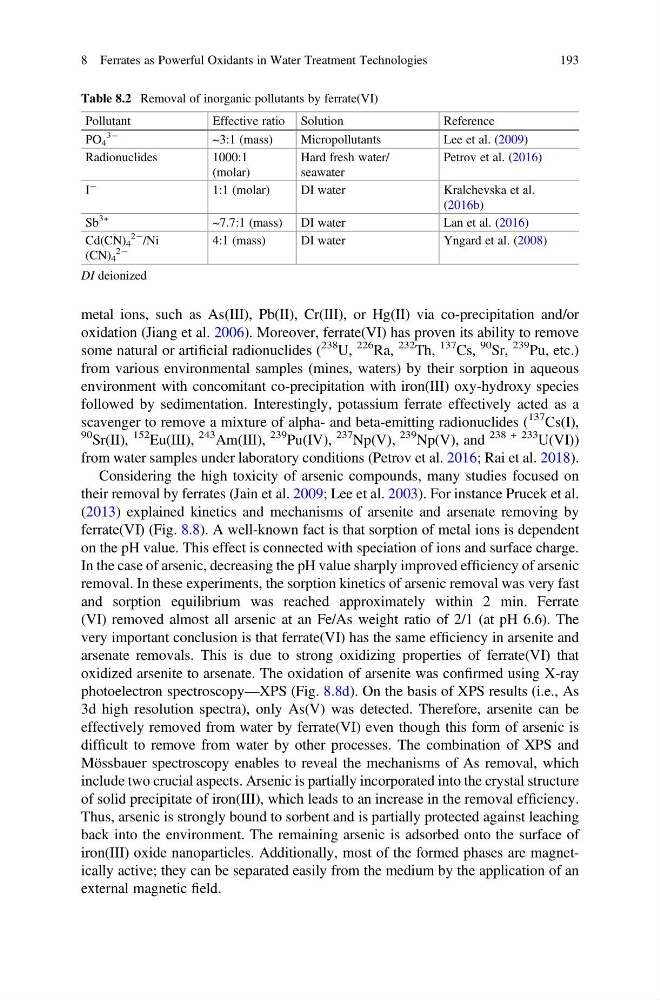
Table 8.2 Removal of inorganic pollutants by ferrate(VI)
Pollutant
Effective ratio Solution
Reference
PO 4
3À
~3:1 (mass)
Micropollutants
Lee et al. (2009)
Radionuclides
1000:1
(molar)
Hard fresh water/
seawater
Petrov et al. (2016)
I
À
1:1 (molar)
DI water
Kralchevska et al.
(2016b)
Sb
3+
~7.7:1 (mass) DI water
Lan et al. (2016)
Cd(CN) 4
2À
/Ni
(CN) 4
2À
4:1 (mass)
DI water
Yngard et al. (2008)
DI deionized
8 Ferrates as Powerful Oxidants in Water Treatment Technologies
193
oxidation (Jiang et al. 2006). Moreover, ferrate(VI) has proven its ability to remove
some natural or artificial radionuclides (
238
U,
226 Ra,
232 Th,
137 Cs,
90 Sr,
239 Pu, etc.)
from various environmental samples (mines, waters) by their sorption in aqueous
environment with concomitant co-precipitation with iron(III) oxy-hydroxy species
followed by sedimentation. Interestingly, potassium ferrate effectively acted as a
scavenger to remove a mixture of alpha- and beta-emitting radionuclides (
137 Cs(I),
90 Sr(II),
152 Eu(III),
243 Am(III),
239
Pu(IV),
237 Np(V),
239 Np(V), and
238 + 233
U(VI))
from water samples under laboratory conditions (Petrov et al. 2016; Rai et al. 2018).
Considering the high toxicity of arsenic compounds, many studies focused on
their removal by ferrates (Jain et al. 2009; Lee et al. 2003). For instance Prucek et al.
(2013) explained kinetics and mechanisms of arsenite and arsenate removing by
ferrate(VI) (Fig. 8.8). A well-known fact is that sorption of metal ions is dependent
on the pH value. This effect is connected with speciation of ions and surface charge.
In the case of arsenic, decreasing the pH value sharply improved efficiency of arsenic
removal. In these experiments, the sorption kinetics of arsenic removal was very fast
and sorption equilibrium was reached approximately within 2 min. Ferrate
(VI) removed almost all arsenic at an Fe/As weight ratio of 2/1 (at pH 6.6). The
very important conclusion is that ferrate(VI) has the same efficiency in arsenite and
arsenate removals. This is due to strong oxidizing properties of ferrate(VI) that
oxidized arsenite to arsenate. The oxidation of arsenite was confirmed using X-ray
photoelectron spectroscopy—XPS (Fig. 8.8d). On the basis of XPS results (i.e., As
3d high resolution spectra), only As(V) was detected. Therefore, arsenite can be
effectively removed from water by ferrate(VI) even though this form of arsenic is
difficult to remove from water by other processes. The combination of XPS and
Mössbauer spectroscopy enables to reveal the mechanisms of As removal, which
include two crucial aspects. Arsenic is partially incorporated into the crystal structure
of solid precipitate of iron(III), which leads to an increase in the removal efficiency.
Thus, arsenic is strongly bound to sorbent and is partially protected against leaching
back into the environment. The remaining arsenic is adsorbed onto the surface of
iron(III) oxide nanoparticles. Additionally, most of the formed phases are magnetically active; they can be separated easily from the medium by the application of an
external magnetic field.
Table 8.2 Removal of inorganic pollutants by ferrate(VI)
Pollutant
Effective ratio Solution
Reference
PO 4
3À
~3:1 (mass)
Micropollutants
Lee et al. (2009)
Radionuclides
1000:1
(molar)
Hard fresh water/
seawater
Petrov et al. (2016)
I
À
1:1 (molar)
DI water
Kralchevska et al.
(2016b)
Sb
3+
~7.7:1 (mass) DI water
Lan et al. (2016)
Cd(CN) 4
2À
/Ni
(CN) 4
2À
4:1 (mass)
DI water
Yngard et al. (2008)
DI deionized
8 Ferrates as Powerful Oxidants in Water Treatment Technologies
193