

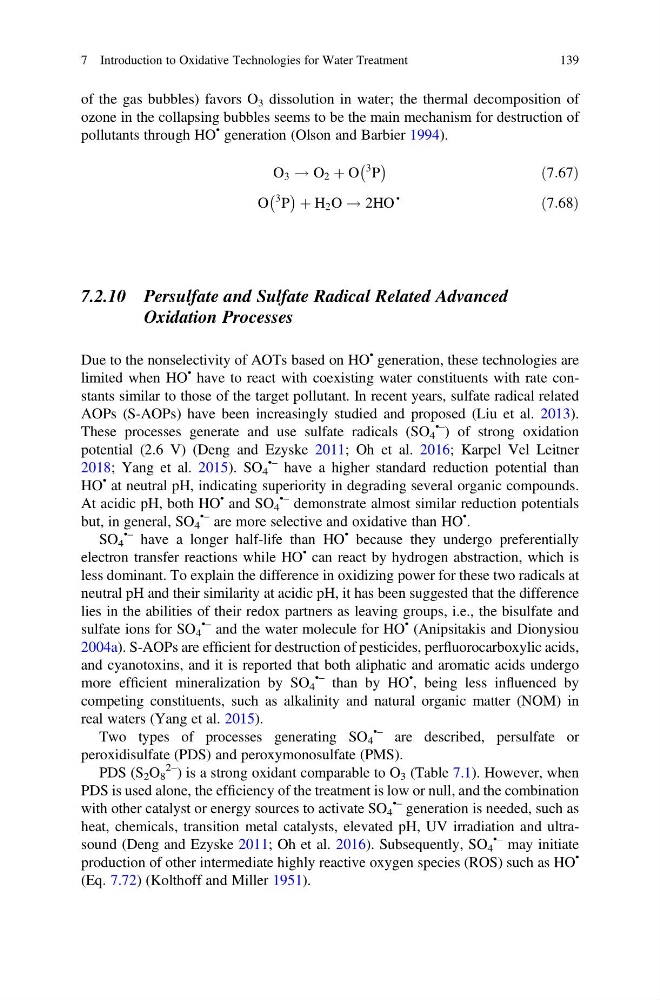
of the gas bubbles) favors O 3 dissolution in water; the thermal decomposition of
ozone in the collapsing bubbles seems to be the main mechanism for destruction of
pollutants through HO
• generation (Olson and Barbier 1994).
O 3 ! O 2 þ O
3 P
À Á
ð7:67Þ
O
3 P
À Á þ H 2 O ! 2HO
•
ð7:68Þ
7.2.10 Persulfate and Sulfate Radical Related Advanced
Oxidation Processes
Due to the nonselectivity of AOTs based on HO
• generation, these technologies are
limited when HO
• have to react with coexisting water constituents with rate constants similar to those of the target pollutant. In recent years, sulfate radical related
AOPs (S-AOPs) have been increasingly studied and proposed (Liu et al. 2013).
These processes generate and use sulfate radicals (SO 4
•–
) of strong oxidation
potential (2.6 V) (Deng and Ezyske 2011; Oh et al. 2016; Karpel Vel Leitner
2018; Yang et al. 2015). SO 4
•– have a higher standard reduction potential than
HO
• at neutral pH, indicating superiority in degrading several organic compounds.
At acidic pH, both HO
• and SO 4
•– demonstrate almost similar reduction potentials
but, in general, SO 4
•– are more selective and oxidative than HO
•
.
SO 4
•– have a longer half-life than HO
• because they undergo preferentially
electron transfer reactions while HO
• can react by hydrogen abstraction, which is
less dominant. To explain the difference in oxidizing power for these two radicals at
neutral pH and their similarity at acidic pH, it has been suggested that the difference
lies in the abilities of their redox partners as leaving groups, i.e., the bisulfate and
sulfate ions for SO 4
•– and the water molecule for HO
• (Anipsitakis and Dionysiou
2004a). S-AOPs are efficient for destruction of pesticides, perfluorocarboxylic acids,
and cyanotoxins, and it is reported that both aliphatic and aromatic acids undergo
more efficient mineralization by SO 4
•– than by HO
•
, being less influenced by
competing constituents, such as alkalinity and natural organic matter (NOM) in
real waters (Yang et al. 2015).
Two types of processes generating SO 4
•– are described, persulfate or
peroxidisulfate (PDS) and peroxymonosulfate (PMS).
PDS (S 2 O 8
2– ) is a strong oxidant comparable to O 3 (Table 7.1). However, when
PDS is used alone, the efficiency of the treatment is low or null, and the combination
with other catalyst or energy sources to activate SO 4
•– generation is needed, such as
heat, chemicals, transition metal catalysts, elevated pH, UV irradiation and ultrasound (Deng and Ezyske 2011; Oh et al. 2016). Subsequently, SO 4
•– may initiate
production of other intermediate highly reactive oxygen species (ROS) such as HO
•
(Eq. 7.72) (Kolthoff and Miller 1951).
7 Introduction to Oxidative Technologies for Water Treatment
139
ozone in the collapsing bubbles seems to be the main mechanism for destruction of
pollutants through HO
• generation (Olson and Barbier 1994).
O 3 ! O 2 þ O
3 P
À Á
ð7:67Þ
O
3 P
À Á þ H 2 O ! 2HO
•
ð7:68Þ
7.2.10 Persulfate and Sulfate Radical Related Advanced
Oxidation Processes
Due to the nonselectivity of AOTs based on HO
• generation, these technologies are
limited when HO
• have to react with coexisting water constituents with rate constants similar to those of the target pollutant. In recent years, sulfate radical related
AOPs (S-AOPs) have been increasingly studied and proposed (Liu et al. 2013).
These processes generate and use sulfate radicals (SO 4
•–
) of strong oxidation
potential (2.6 V) (Deng and Ezyske 2011; Oh et al. 2016; Karpel Vel Leitner
2018; Yang et al. 2015). SO 4
•– have a higher standard reduction potential than
HO
• at neutral pH, indicating superiority in degrading several organic compounds.
At acidic pH, both HO
• and SO 4
•– demonstrate almost similar reduction potentials
but, in general, SO 4
•– are more selective and oxidative than HO
•
.
SO 4
•– have a longer half-life than HO
• because they undergo preferentially
electron transfer reactions while HO
• can react by hydrogen abstraction, which is
less dominant. To explain the difference in oxidizing power for these two radicals at
neutral pH and their similarity at acidic pH, it has been suggested that the difference
lies in the abilities of their redox partners as leaving groups, i.e., the bisulfate and
sulfate ions for SO 4
•– and the water molecule for HO
• (Anipsitakis and Dionysiou
2004a). S-AOPs are efficient for destruction of pesticides, perfluorocarboxylic acids,
and cyanotoxins, and it is reported that both aliphatic and aromatic acids undergo
more efficient mineralization by SO 4
•– than by HO
•
, being less influenced by
competing constituents, such as alkalinity and natural organic matter (NOM) in
real waters (Yang et al. 2015).
Two types of processes generating SO 4
•– are described, persulfate or
peroxidisulfate (PDS) and peroxymonosulfate (PMS).
PDS (S 2 O 8
2– ) is a strong oxidant comparable to O 3 (Table 7.1). However, when
PDS is used alone, the efficiency of the treatment is low or null, and the combination
with other catalyst or energy sources to activate SO 4
•– generation is needed, such as
heat, chemicals, transition metal catalysts, elevated pH, UV irradiation and ultrasound (Deng and Ezyske 2011; Oh et al. 2016). Subsequently, SO 4
•– may initiate
production of other intermediate highly reactive oxygen species (ROS) such as HO
•
(Eq. 7.72) (Kolthoff and Miller 1951).
7 Introduction to Oxidative Technologies for Water Treatment
139