

volatile compounds because the combustion takes place directly inside the collapsing hot bubbles. It has been applied to abstract chlorine from chlorobenzene and odichlorobenzene, for decomposition of aliphatics and chlorinated aliphatics (CCl 4 ,
CHCl 3 ), for p-nitrophenol and TNT degradation, for decomposition and discoloration of azo dyes, for degradation of Triton X-100 and related surfactants, for total
decomposition of H 2 S, parathion, MTBE, etc. It can be improved by H 2 O 2 , O 3 , or Fe
(II) addition and by elimination of O 2 and operation in inert atmosphere (Ar) to
promote reductions (Meichtry et al. 2018).
The scale-up of ultrasound systems has been studied a great deal and there is
sufficient evidence that the application of the method is possible in the short term. It
is a very economical technology in comparison with other oxidizing technologies
(Pankaj 2010; Gogate and Pandit 2004b). Practical application of the ultrasonic
process for wastewater treatment is often limited by its low mineralization efficiency,
formation of intermediate products, setup costs, and noise in the operation. However,
the combination of ultrasound and Fenton reagent, i.e., sono-Fenton oxidation, has a
great potential for rapid destruction of refractory organics in a short span of time
through the mechanisms of thermal destruction and removal of free HO
• (Ma 2012).
The sono-Fenton process utilizes the advantages of these two methods to generate
more HO
•
. As cavitation operates also in terms of pyrolysis, this can help in
removing some compounds refractory to HO
•
. Moreover, the mass transfer resistances associated with the Fenton-based processes can be eliminated by the turbulent
conditions present in the reactor. The produced Fe
3+ can react with H 2 O 2 through
reaction 7.23, and the cycle continues but enhanced by ultrasound (Bagal and
Gogate 2014). However, from an engineering point of view, further investigation
is necessary for commercializing the sono-Fenton system (Ma 2012).
The synergistic effects of sonolysis combined with ozonation (sonozone process)
have been described for azobenzene and methyl orange oxidation (Destaillats et al.
2000a). This process notably increases the transformation rate. The increase in the
mass transfer coefficient of O 3 due to mechanical effects (better mixing and breaking
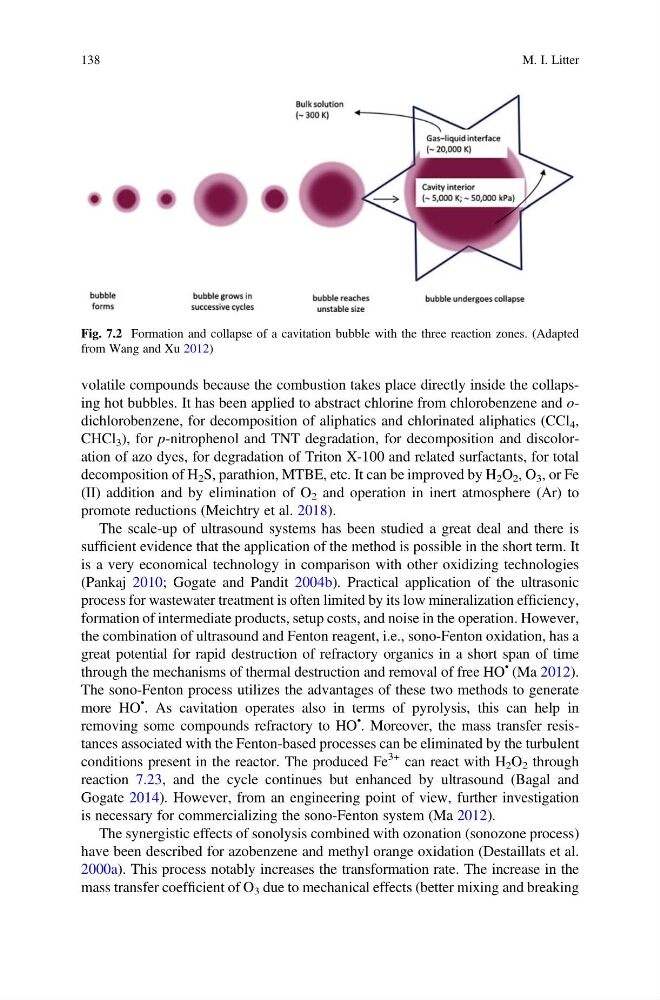
Fig. 7.2 Formation and collapse of a cavitation bubble with the three reaction zones. (Adapted
from Wang and Xu 2012)
138
M. I. Litter
CHCl 3 ), for p-nitrophenol and TNT degradation, for decomposition and discoloration of azo dyes, for degradation of Triton X-100 and related surfactants, for total
decomposition of H 2 S, parathion, MTBE, etc. It can be improved by H 2 O 2 , O 3 , or Fe
(II) addition and by elimination of O 2 and operation in inert atmosphere (Ar) to
promote reductions (Meichtry et al. 2018).
The scale-up of ultrasound systems has been studied a great deal and there is
sufficient evidence that the application of the method is possible in the short term. It
is a very economical technology in comparison with other oxidizing technologies
(Pankaj 2010; Gogate and Pandit 2004b). Practical application of the ultrasonic
process for wastewater treatment is often limited by its low mineralization efficiency,
formation of intermediate products, setup costs, and noise in the operation. However,
the combination of ultrasound and Fenton reagent, i.e., sono-Fenton oxidation, has a
great potential for rapid destruction of refractory organics in a short span of time
through the mechanisms of thermal destruction and removal of free HO
• (Ma 2012).
The sono-Fenton process utilizes the advantages of these two methods to generate
more HO
•
. As cavitation operates also in terms of pyrolysis, this can help in
removing some compounds refractory to HO
•
. Moreover, the mass transfer resistances associated with the Fenton-based processes can be eliminated by the turbulent
conditions present in the reactor. The produced Fe
3+ can react with H 2 O 2 through
reaction 7.23, and the cycle continues but enhanced by ultrasound (Bagal and
Gogate 2014). However, from an engineering point of view, further investigation
is necessary for commercializing the sono-Fenton system (Ma 2012).
The synergistic effects of sonolysis combined with ozonation (sonozone process)
have been described for azobenzene and methyl orange oxidation (Destaillats et al.
2000a). This process notably increases the transformation rate. The increase in the
mass transfer coefficient of O 3 due to mechanical effects (better mixing and breaking
Fig. 7.2 Formation and collapse of a cavitation bubble with the three reaction zones. (Adapted
from Wang and Xu 2012)
138
M. I. Litter