

temperatures and pressures (4000–10,000 K and 100,000–1,000,000 kPa in the
center of the collapsed bubbles) are reached (Huang et al. 1993; Domènech et al.
2004; Destaillats et al. 2000a, b, 2003; Gogate and Pandit 2004a; Henglein 1987;
Hoffmann et al. 1996; Adewuyi 2001; Sadjadi 2014; Pflieger et al. 2015; Pankaj
2010; Larpparisudthi et al. 2018). The degradation of the organic matter by sonolysis
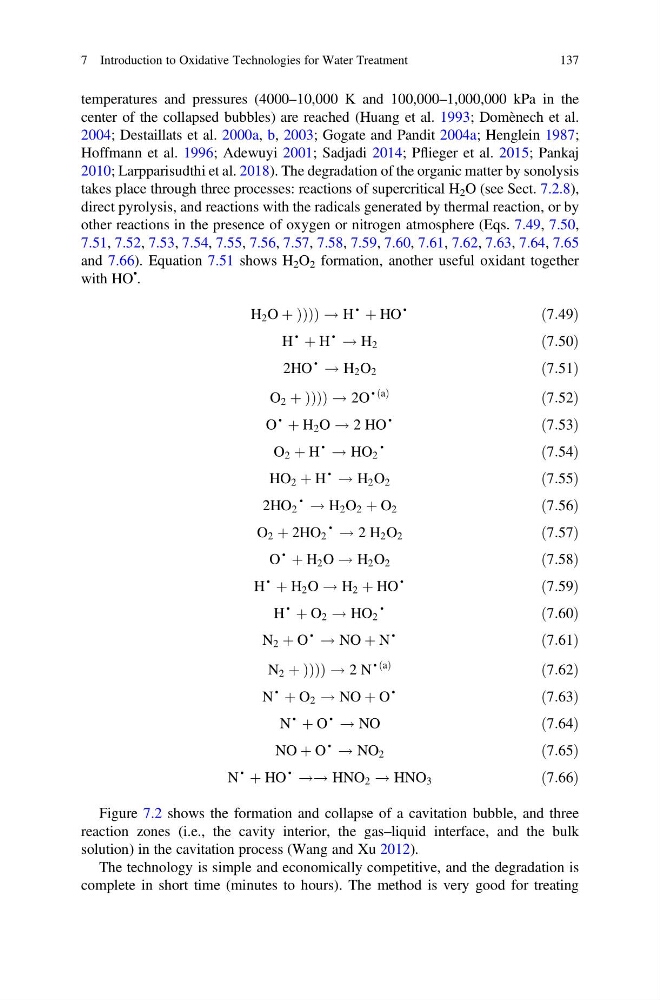
takes place through three processes: reactions of supercritical H 2 O (see Sect. 7.2.8),
direct pyrolysis, and reactions with the radicals generated by thermal reaction, or by
other reactions in the presence of oxygen or nitrogen atmosphere (Eqs. 7.49, 7.50,
7.51, 7.52, 7.53, 7.54, 7.55, 7.56, 7.57, 7.58, 7.59, 7.60, 7.61, 7.62, 7.63, 7.64, 7.65
and 7.66). Equation 7.51 shows H 2 O 2 formation, another useful oxidant together
with HO
• .
H 2 O þ ÞÞÞÞ ! H
•
þ HO
•
ð7:49Þ
H
•
þ H
•
! H 2
ð7:50Þ
2HO
•
! H 2 O 2
ð7:51Þ
O 2 þ ÞÞÞÞ ! 2O
• ðaÞ
ð7:52Þ
O
•
þ H 2 O ! 2 HO
•
ð7:53Þ
O 2 þ H
•
! HO 2
•
ð7:54Þ
HO 2 þ H
•
! H 2 O 2
ð7:55Þ
2HO 2
•
! H 2 O 2 þ O 2
ð7:56Þ
O 2 þ 2HO 2
•
! 2 H 2 O 2
ð7:57Þ
O
•
þ H 2 O ! H 2 O 2
ð7:58Þ
H
•
þ H 2 O ! H 2 þ HO
•
ð7:59Þ
H
•
þ O 2 ! HO 2
•
ð7:60Þ
N 2 þ O
•
! NO þ N
•
ð7:61Þ
N 2 þ ÞÞÞÞ ! 2 N
• ðaÞ
ð7:62Þ
N
•
þ O 2 ! NO þ O
•
ð7:63Þ
N
•
þ O
•
! NO
ð7:64Þ
NO þ O
•
! NO 2
ð7:65Þ
N
•
þ HO
•
!! HNO 2 ! HNO 3
ð7:66Þ
Figure 7.2 shows the formation and collapse of a cavitation bubble, and three
reaction zones (i.e., the cavity interior, the gas–liquid interface, and the bulk
solution) in the cavitation process (Wang and Xu 2012).
The technology is simple and economically competitive, and the degradation is
complete in short time (minutes to hours). The method is very good for treating
7 Introduction to Oxidative Technologies for Water Treatment
137
center of the collapsed bubbles) are reached (Huang et al. 1993; Domènech et al.
2004; Destaillats et al. 2000a, b, 2003; Gogate and Pandit 2004a; Henglein 1987;
Hoffmann et al. 1996; Adewuyi 2001; Sadjadi 2014; Pflieger et al. 2015; Pankaj
2010; Larpparisudthi et al. 2018). The degradation of the organic matter by sonolysis
takes place through three processes: reactions of supercritical H 2 O (see Sect. 7.2.8),
direct pyrolysis, and reactions with the radicals generated by thermal reaction, or by
other reactions in the presence of oxygen or nitrogen atmosphere (Eqs. 7.49, 7.50,
7.51, 7.52, 7.53, 7.54, 7.55, 7.56, 7.57, 7.58, 7.59, 7.60, 7.61, 7.62, 7.63, 7.64, 7.65
and 7.66). Equation 7.51 shows H 2 O 2 formation, another useful oxidant together
with HO
• .
H 2 O þ ÞÞÞÞ ! H
•
þ HO
•
ð7:49Þ
H
•
þ H
•
! H 2
ð7:50Þ
2HO
•
! H 2 O 2
ð7:51Þ
O 2 þ ÞÞÞÞ ! 2O
• ðaÞ
ð7:52Þ
O
•
þ H 2 O ! 2 HO
•
ð7:53Þ
O 2 þ H
•
! HO 2
•
ð7:54Þ
HO 2 þ H
•
! H 2 O 2
ð7:55Þ
2HO 2
•
! H 2 O 2 þ O 2
ð7:56Þ
O 2 þ 2HO 2
•
! 2 H 2 O 2
ð7:57Þ
O
•
þ H 2 O ! H 2 O 2
ð7:58Þ
H
•
þ H 2 O ! H 2 þ HO
•
ð7:59Þ
H
•
þ O 2 ! HO 2
•
ð7:60Þ
N 2 þ O
•
! NO þ N
•
ð7:61Þ
N 2 þ ÞÞÞÞ ! 2 N
• ðaÞ
ð7:62Þ
N
•
þ O 2 ! NO þ O
•
ð7:63Þ
N
•
þ O
•
! NO
ð7:64Þ
NO þ O
•
! NO 2
ð7:65Þ
N
•
þ HO
•
!! HNO 2 ! HNO 3
ð7:66Þ
Figure 7.2 shows the formation and collapse of a cavitation bubble, and three
reaction zones (i.e., the cavity interior, the gas–liquid interface, and the bulk
solution) in the cavitation process (Wang and Xu 2012).
The technology is simple and economically competitive, and the degradation is
complete in short time (minutes to hours). The method is very good for treating
7 Introduction to Oxidative Technologies for Water Treatment
137