

S 2 O 8
2À
þ heat ! 2SO 4
• À E a ¼ 33:4 kcal=mol
ð7:69Þ
S 2 O 8
2À
þ H 2 O ! 2HSO 4
À þ HO
•
ð7:70Þ
S 2 O 8
2À
þ 2OH À ! 2SO 4
2À
þ 2HO
•
ð7:71Þ
SO 4
• À þ H 2 O ! HO
•
þ HSO 4
À
ð7:72Þ
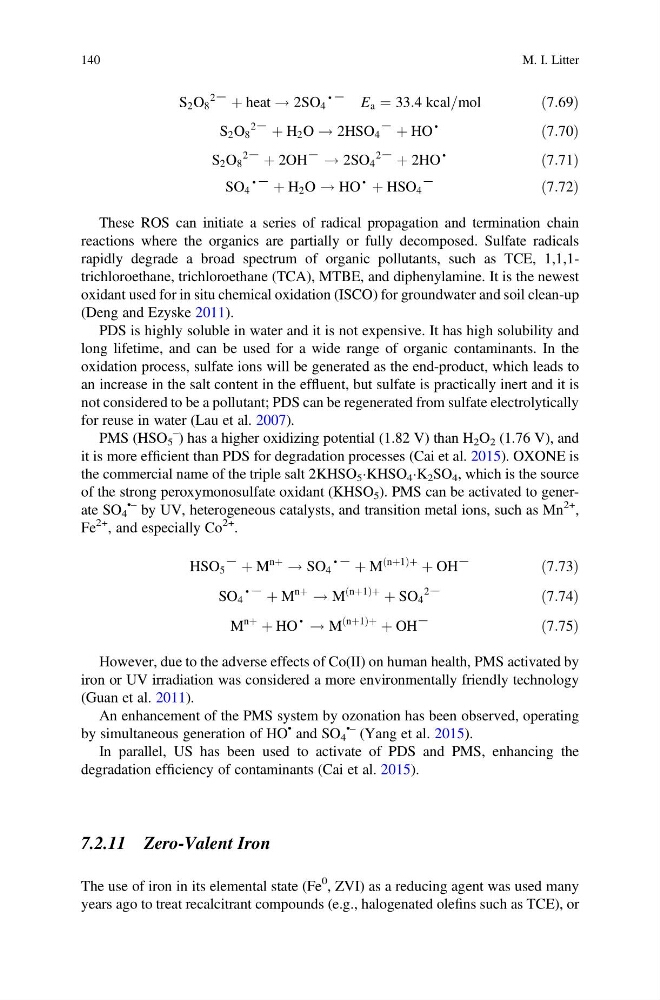
These ROS can initiate a series of radical propagation and termination chain
reactions where the organics are partially or fully decomposed. Sulfate radicals
rapidly degrade a broad spectrum of organic pollutants, such as TCE, 1,1,1trichloroethane, trichloroethane (TCA), MTBE, and diphenylamine. It is the newest
oxidant used for in situ chemical oxidation (ISCO) for groundwater and soil clean-up
(Deng and Ezyske 2011).
PDS is highly soluble in water and it is not expensive. It has high solubility and
long lifetime, and can be used for a wide range of organic contaminants. In the
oxidation process, sulfate ions will be generated as the end-product, which leads to
an increase in the salt content in the effluent, but sulfate is practically inert and it is
not considered to be a pollutant; PDS can be regenerated from sulfate electrolytically
for reuse in water (Lau et al. 2007).
PMS (HSO 5
– ) has a higher oxidizing potential (1.82 V) than H 2 O 2 (1.76 V), and
it is more efficient than PDS for degradation processes (Cai et al. 2015). OXONE is
the commercial name of the triple salt 2KHSO 5 ÁKHSO 4 ÁK 2 SO 4 , which is the source
of the strong peroxymonosulfate oxidant (KHSO 5 ). PMS can be activated to generate SO 4
•– by UV, heterogeneous catalysts, and transition metal ions, such as Mn
2+ ,
Fe
2+ , and especially Co
2+ .
HSO 5
À þ M
nþ
! SO 4
• À þ M
ðnþ1Þþ
þ OH À
ð7:73Þ
SO 4
• À þ M
nþ
! M
ðnþ1Þþ
þ SO 4
2À
ð7:74Þ
M
nþ
þ HO
•
! M
ðnþ1Þþ
þ OH À
ð7:75Þ
However, due to the adverse effects of Co(II) on human health, PMS activated by
iron or UV irradiation was considered a more environmentally friendly technology
(Guan et al. 2011).
An enhancement of the PMS system by ozonation has been observed, operating
by simultaneous generation of HO
• and SO 4
•– (Yang et al. 2015).
In parallel, US has been used to activate of PDS and PMS, enhancing the
degradation efficiency of contaminants (Cai et al. 2015).
7.2.11 Zero-Valent Iron
The use of iron in its elemental state (Fe
0 , ZVI) as a reducing agent was used many
years ago to treat recalcitrant compounds (e.g., halogenated olefins such as TCE), or
140
M. I. Litter
2À
þ heat ! 2SO 4
• À E a ¼ 33:4 kcal=mol
ð7:69Þ
S 2 O 8
2À
þ H 2 O ! 2HSO 4
À þ HO
•
ð7:70Þ
S 2 O 8
2À
þ 2OH À ! 2SO 4
2À
þ 2HO
•
ð7:71Þ
SO 4
• À þ H 2 O ! HO
•
þ HSO 4
À
ð7:72Þ
These ROS can initiate a series of radical propagation and termination chain
reactions where the organics are partially or fully decomposed. Sulfate radicals
rapidly degrade a broad spectrum of organic pollutants, such as TCE, 1,1,1trichloroethane, trichloroethane (TCA), MTBE, and diphenylamine. It is the newest
oxidant used for in situ chemical oxidation (ISCO) for groundwater and soil clean-up
(Deng and Ezyske 2011).
PDS is highly soluble in water and it is not expensive. It has high solubility and
long lifetime, and can be used for a wide range of organic contaminants. In the
oxidation process, sulfate ions will be generated as the end-product, which leads to
an increase in the salt content in the effluent, but sulfate is practically inert and it is
not considered to be a pollutant; PDS can be regenerated from sulfate electrolytically
for reuse in water (Lau et al. 2007).
PMS (HSO 5
– ) has a higher oxidizing potential (1.82 V) than H 2 O 2 (1.76 V), and
it is more efficient than PDS for degradation processes (Cai et al. 2015). OXONE is
the commercial name of the triple salt 2KHSO 5 ÁKHSO 4 ÁK 2 SO 4 , which is the source
of the strong peroxymonosulfate oxidant (KHSO 5 ). PMS can be activated to generate SO 4
•– by UV, heterogeneous catalysts, and transition metal ions, such as Mn
2+ ,
Fe
2+ , and especially Co
2+ .
HSO 5
À þ M
nþ
! SO 4
• À þ M
ðnþ1Þþ
þ OH À
ð7:73Þ
SO 4
• À þ M
nþ
! M
ðnþ1Þþ
þ SO 4
2À
ð7:74Þ
M
nþ
þ HO
•
! M
ðnþ1Þþ
þ OH À
ð7:75Þ
However, due to the adverse effects of Co(II) on human health, PMS activated by
iron or UV irradiation was considered a more environmentally friendly technology
(Guan et al. 2011).
An enhancement of the PMS system by ozonation has been observed, operating
by simultaneous generation of HO
• and SO 4
•– (Yang et al. 2015).
In parallel, US has been used to activate of PDS and PMS, enhancing the
degradation efficiency of contaminants (Cai et al. 2015).
7.2.11 Zero-Valent Iron
The use of iron in its elemental state (Fe
0 , ZVI) as a reducing agent was used many
years ago to treat recalcitrant compounds (e.g., halogenated olefins such as TCE), or
140
M. I. Litter