

application was successful in terms of DCE and VC reduction. At the end of the
monitoring period, the reduction of DCE accounted for 53% and VC for 47%.
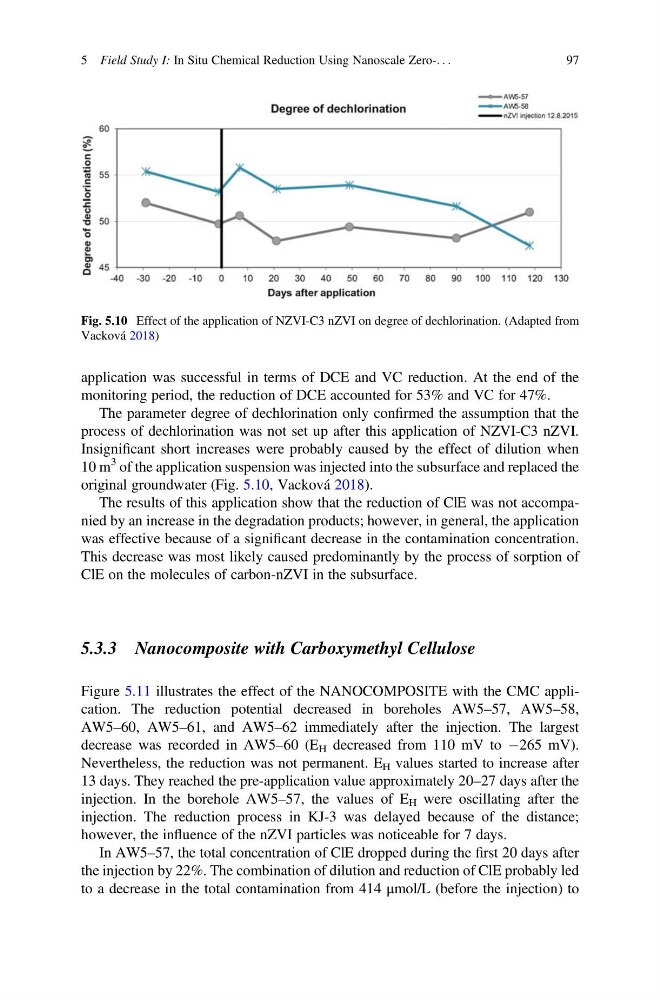
The parameter degree of dechlorination only confirmed the assumption that the
process of dechlorination was not set up after this application of NZVI-C3 nZVI.
Insignificant short increases were probably caused by the effect of dilution when
10 m
3 of the application suspension was injected into the subsurface and replaced the
original groundwater (Fig. 5.10, Vacková 2018).
The results of this application show that the reduction of ClE was not accompanied by an increase in the degradation products; however, in general, the application
was effective because of a significant decrease in the contamination concentration.
This decrease was most likely caused predominantly by the process of sorption of
ClE on the molecules of carbon-nZVI in the subsurface.
5.3.3 Nanocomposite with Carboxymethyl Cellulose
Figure 5.11 illustrates the effect of the NANOCOMPOSITE with the CMC application. The reduction potential decreased in boreholes AW5–57, AW5–58,
AW5–60, AW5–61, and AW5–62 immediately after the injection. The largest
decrease was recorded in AW5–60 (E H decreased from 110 mV to À265 mV).
Nevertheless, the reduction was not permanent. E H values started to increase after
13 days. They reached the pre-application value approximately 20–27 days after the
injection. In the borehole AW5–57, the values of E H were oscillating after the
injection. The reduction process in KJ-3 was delayed because of the distance;
however, the influence of the nZVI particles was noticeable for 7 days.
In AW5–57, the total concentration of ClE dropped during the first 20 days after
the injection by 22%. The combination of dilution and reduction of ClE probably led
to a decrease in the total contamination from 414 μmol/L (before the injection) to
Fig. 5.10 Effect of the application of NZVI-C3 nZVI on degree of dechlorination. (Adapted from
Vacková 2018)
5 Field Study I: In Situ Chemical Reduction Using Nanoscale Zero-. . .
97
monitoring period, the reduction of DCE accounted for 53% and VC for 47%.
The parameter degree of dechlorination only confirmed the assumption that the
process of dechlorination was not set up after this application of NZVI-C3 nZVI.
Insignificant short increases were probably caused by the effect of dilution when
10 m
3 of the application suspension was injected into the subsurface and replaced the
original groundwater (Fig. 5.10, Vacková 2018).
The results of this application show that the reduction of ClE was not accompanied by an increase in the degradation products; however, in general, the application
was effective because of a significant decrease in the contamination concentration.
This decrease was most likely caused predominantly by the process of sorption of
ClE on the molecules of carbon-nZVI in the subsurface.
5.3.3 Nanocomposite with Carboxymethyl Cellulose
Figure 5.11 illustrates the effect of the NANOCOMPOSITE with the CMC application. The reduction potential decreased in boreholes AW5–57, AW5–58,
AW5–60, AW5–61, and AW5–62 immediately after the injection. The largest
decrease was recorded in AW5–60 (E H decreased from 110 mV to À265 mV).
Nevertheless, the reduction was not permanent. E H values started to increase after
13 days. They reached the pre-application value approximately 20–27 days after the
injection. In the borehole AW5–57, the values of E H were oscillating after the
injection. The reduction process in KJ-3 was delayed because of the distance;
however, the influence of the nZVI particles was noticeable for 7 days.
In AW5–57, the total concentration of ClE dropped during the first 20 days after
the injection by 22%. The combination of dilution and reduction of ClE probably led
to a decrease in the total contamination from 414 μmol/L (before the injection) to
Fig. 5.10 Effect of the application of NZVI-C3 nZVI on degree of dechlorination. (Adapted from
Vacková 2018)
5 Field Study I: In Situ Chemical Reduction Using Nanoscale Zero-. . .
97