

To determine the reductive potential of NZVI-C3 particles, the reduction ratio
3 and 4 months after the injection was conclusive. The total concentration of ClE
decreased by 54% and 44%, respectively. The application showed very high and
long-term reductive influence on TCE, the concentration of which accounted only
for 29% TCE reduction 4 months after the nZVI injection, compared with its
pre-application concentration. In total, the TCE reduction of 71% was monitored
in AW5–57. Long-term reduction of DCE and VC was also observed. The samples
of groundwater from the time of 4 months after the NZVI-C3 nZVI injection showed
34% reduction of DCE and 60% reduction of VC.
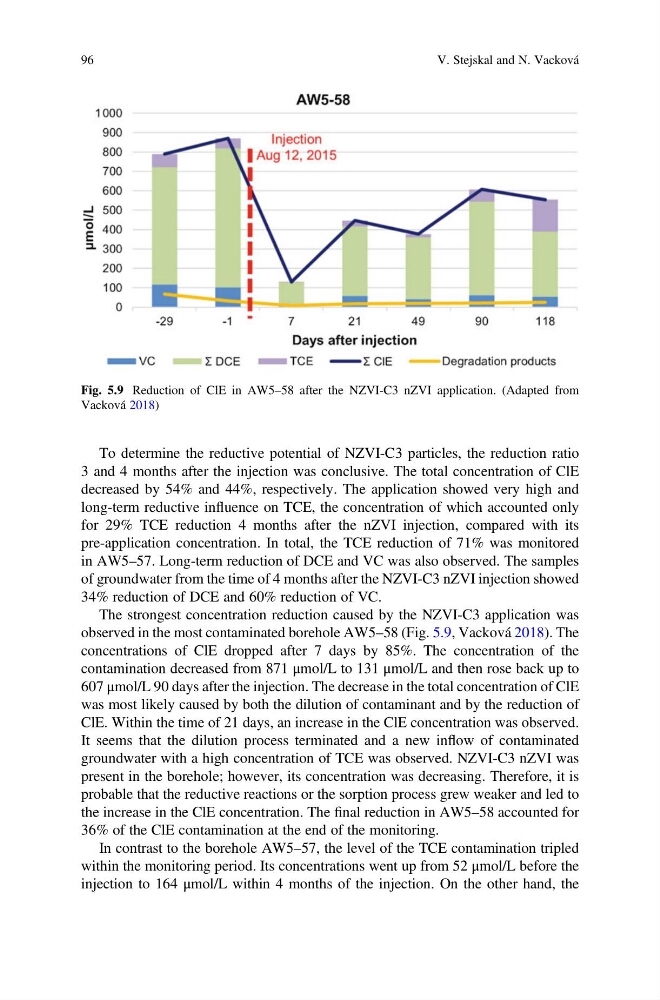
The strongest concentration reduction caused by the NZVI-C3 application was
observed in the most contaminated borehole AW5–58 (Fig. 5.9, Vacková 2018). The
concentrations of ClE dropped after 7 days by 85%. The concentration of the
contamination decreased from 871 μmol/L to 131 μmol/L and then rose back up to
607 μmol/L 90 days after the injection. The decrease in the total concentration of ClE
was most likely caused by both the dilution of contaminant and by the reduction of
ClE. Within the time of 21 days, an increase in the ClE concentration was observed.
It seems that the dilution process terminated and a new inflow of contaminated
groundwater with a high concentration of TCE was observed. NZVI-C3 nZVI was
present in the borehole; however, its concentration was decreasing. Therefore, it is
probable that the reductive reactions or the sorption process grew weaker and led to
the increase in the ClE concentration. The final reduction in AW5–58 accounted for
36% of the ClE contamination at the end of the monitoring.
In contrast to the borehole AW5–57, the level of the TCE contamination tripled
within the monitoring period. Its concentrations went up from 52 μmol/L before the
injection to 164 μmol/L within 4 months of the injection. On the other hand, the
Fig. 5.9 Reduction of ClE in AW5–58 after the NZVI-C3 nZVI application. (Adapted from
Vacková 2018)
96
V. Stejskal and N. Vacková
3 and 4 months after the injection was conclusive. The total concentration of ClE
decreased by 54% and 44%, respectively. The application showed very high and
long-term reductive influence on TCE, the concentration of which accounted only
for 29% TCE reduction 4 months after the nZVI injection, compared with its
pre-application concentration. In total, the TCE reduction of 71% was monitored
in AW5–57. Long-term reduction of DCE and VC was also observed. The samples
of groundwater from the time of 4 months after the NZVI-C3 nZVI injection showed
34% reduction of DCE and 60% reduction of VC.
The strongest concentration reduction caused by the NZVI-C3 application was
observed in the most contaminated borehole AW5–58 (Fig. 5.9, Vacková 2018). The
concentrations of ClE dropped after 7 days by 85%. The concentration of the
contamination decreased from 871 μmol/L to 131 μmol/L and then rose back up to
607 μmol/L 90 days after the injection. The decrease in the total concentration of ClE
was most likely caused by both the dilution of contaminant and by the reduction of
ClE. Within the time of 21 days, an increase in the ClE concentration was observed.
It seems that the dilution process terminated and a new inflow of contaminated
groundwater with a high concentration of TCE was observed. NZVI-C3 nZVI was
present in the borehole; however, its concentration was decreasing. Therefore, it is
probable that the reductive reactions or the sorption process grew weaker and led to
the increase in the ClE concentration. The final reduction in AW5–58 accounted for
36% of the ClE contamination at the end of the monitoring.
In contrast to the borehole AW5–57, the level of the TCE contamination tripled
within the monitoring period. Its concentrations went up from 52 μmol/L before the
injection to 164 μmol/L within 4 months of the injection. On the other hand, the
Fig. 5.9 Reduction of ClE in AW5–58 after the NZVI-C3 nZVI application. (Adapted from
Vacková 2018)
96
V. Stejskal and N. Vacková