

5.2.2.2 NZVI-C3
NZVI-C3 is a type of an nZVI powder produced usually on a laboratory scale by
Palacký University Olomouc, Czech Republic. Particles of NZVI-C3 consist of Fe
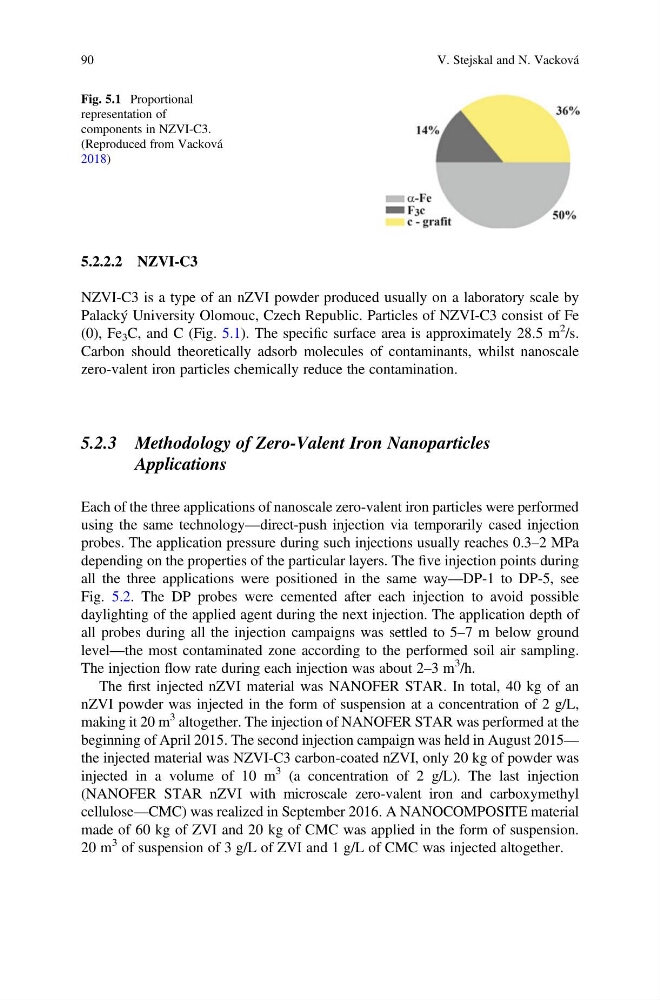
(0), Fe 3 C, and C (Fig. 5.1). The specific surface area is approximately 28.5 m
2 /s.
Carbon should theoretically adsorb molecules of contaminants, whilst nanoscale
zero-valent iron particles chemically reduce the contamination.
5.2.3 Methodology of Zero-Valent Iron Nanoparticles
Applications
Each of the three applications of nanoscale zero-valent iron particles were performed
using the same technology—direct-push injection via temporarily cased injection
probes. The application pressure during such injections usually reaches 0.3–2 MPa
depending on the properties of the particular layers. The five injection points during
all the three applications were positioned in the same way—DP-1 to DP-5, see
Fig. 5.2. The DP probes were cemented after each injection to avoid possible
daylighting of the applied agent during the next injection. The application depth of
all probes during all the injection campaigns was settled to 5–7 m below ground
level—the most contaminated zone according to the performed soil air sampling.
The injection flow rate during each injection was about 2–3 m
3
/h.
The first injected nZVI material was NANOFER STAR. In total, 40 kg of an
nZVI powder was injected in the form of suspension at a concentration of 2 g/L,
making it 20 m
3 altogether. The injection of NANOFER STAR was performed at the
beginning of April 2015. The second injection campaign was held in August 2015—
the injected material was NZVI-C3 carbon-coated nZVI, only 20 kg of powder was
injected in a volume of 10 m
3 (a concentration of 2 g/L). The last injection
(NANOFER STAR nZVI with microscale zero-valent iron and carboxymethyl
cellulose—CMC) was realized in September 2016. A NANOCOMPOSITE material
made of 60 kg of ZVI and 20 kg of CMC was applied in the form of suspension.
20 m
3 of suspension of 3 g/L of ZVI and 1 g/L of CMC was injected altogether.
Fig. 5.1 Proportional
representation of
components in NZVI-C3.
(Reproduced from Vacková
2018)
90
V. Stejskal and N. Vacková
NZVI-C3 is a type of an nZVI powder produced usually on a laboratory scale by
Palacký University Olomouc, Czech Republic. Particles of NZVI-C3 consist of Fe
(0), Fe 3 C, and C (Fig. 5.1). The specific surface area is approximately 28.5 m
2 /s.
Carbon should theoretically adsorb molecules of contaminants, whilst nanoscale
zero-valent iron particles chemically reduce the contamination.
5.2.3 Methodology of Zero-Valent Iron Nanoparticles
Applications
Each of the three applications of nanoscale zero-valent iron particles were performed
using the same technology—direct-push injection via temporarily cased injection
probes. The application pressure during such injections usually reaches 0.3–2 MPa
depending on the properties of the particular layers. The five injection points during
all the three applications were positioned in the same way—DP-1 to DP-5, see
Fig. 5.2. The DP probes were cemented after each injection to avoid possible
daylighting of the applied agent during the next injection. The application depth of
all probes during all the injection campaigns was settled to 5–7 m below ground
level—the most contaminated zone according to the performed soil air sampling.
The injection flow rate during each injection was about 2–3 m
3
/h.
The first injected nZVI material was NANOFER STAR. In total, 40 kg of an
nZVI powder was injected in the form of suspension at a concentration of 2 g/L,
making it 20 m
3 altogether. The injection of NANOFER STAR was performed at the
beginning of April 2015. The second injection campaign was held in August 2015—
the injected material was NZVI-C3 carbon-coated nZVI, only 20 kg of powder was
injected in a volume of 10 m
3 (a concentration of 2 g/L). The last injection
(NANOFER STAR nZVI with microscale zero-valent iron and carboxymethyl
cellulose—CMC) was realized in September 2016. A NANOCOMPOSITE material
made of 60 kg of ZVI and 20 kg of CMC was applied in the form of suspension.
20 m
3 of suspension of 3 g/L of ZVI and 1 g/L of CMC was injected altogether.
Fig. 5.1 Proportional
representation of
components in NZVI-C3.
(Reproduced from Vacková
2018)
90
V. Stejskal and N. Vacková