

Areas with lower permeability are filled with Quaternary fluvial clay and loam and
show a hydraulic conductivity around 10
À6 m/s (Kvapil et al. 2011).
The studied area is contaminated especially with trichloroethene (TCE) reaching
maximum molar concentrations of 400 μmol/L, i.e., 78 mg/L. Due to the TCE
decomposition to less chlorinated hydrocarbons, the studied area is subsequently
also contaminated with dichloroethene—DCE (500 μmol/L, i.e., 48 mg/L) and vinyl
chloride (VC) 200 μmol/L, i.e., 12.5 mg/L).
5.2.2 Methodology of Groundwater Monitoring
and Analytical Methods
All water samples were taken under dynamic conditions after stabilization of
oxidation–reduction potential (ORP) and pH. The groundwater was pumped out of
the wells by peristaltic pump M610 (Solinst, Canada). Reading of the ORP and pH
values was conducted at the end of every sampling using a WTW 3430 Multimeter
(WTW, Germany) and recalculated against a standard hydrogen electrode.
Concentration of chlorinated hydrocarbons was determined according to EPA
Method 8260B and concentrations of ethene and ethane as nontoxic products of
chlorinated hydrocarbons’ degradation were analyzed in accordance with the methodology described by Lewin et al. (1990).
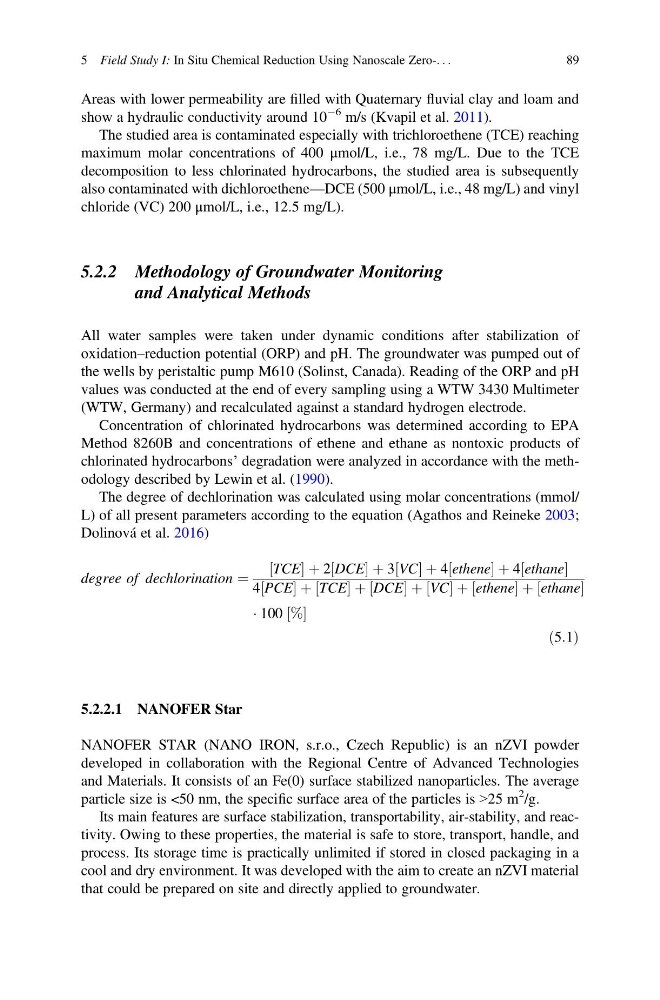
The degree of dechlorination was calculated using molar concentrations (mmol/
L) of all present parameters according to the equation (Agathos and Reineke 2003;
Dolinová et al. 2016)
degree of dechlorination ¼
TCE
½
þ2 DCE
½
þ3 VC
½ þ4 ethene
½
þ4 ethane
½
4 PCE
½
þ TCE
½
þ DCE
½
þ VC
½ þ ethene
½
þ ethane
½
Á 100 %
½
ð5:1Þ
5.2.2.1 NANOFER Star
NANOFER STAR (NANO IRON, s.r.o., Czech Republic) is an nZVI powder
developed in collaboration with the Regional Centre of Advanced Technologies
and Materials. It consists of an Fe(0) surface stabilized nanoparticles. The average
particle size is <50 nm, the specific surface area of the particles is ˃25 m
2 /g.
Its main features are surface stabilization, transportability, air-stability, and reactivity. Owing to these properties, the material is safe to store, transport, handle, and
process. Its storage time is practically unlimited if stored in closed packaging in a
cool and dry environment. It was developed with the aim to create an nZVI material
that could be prepared on site and directly applied to groundwater.
5 Field Study I: In Situ Chemical Reduction Using Nanoscale Zero-. . .
89
show a hydraulic conductivity around 10
À6 m/s (Kvapil et al. 2011).
The studied area is contaminated especially with trichloroethene (TCE) reaching
maximum molar concentrations of 400 μmol/L, i.e., 78 mg/L. Due to the TCE
decomposition to less chlorinated hydrocarbons, the studied area is subsequently
also contaminated with dichloroethene—DCE (500 μmol/L, i.e., 48 mg/L) and vinyl
chloride (VC) 200 μmol/L, i.e., 12.5 mg/L).
5.2.2 Methodology of Groundwater Monitoring
and Analytical Methods
All water samples were taken under dynamic conditions after stabilization of
oxidation–reduction potential (ORP) and pH. The groundwater was pumped out of
the wells by peristaltic pump M610 (Solinst, Canada). Reading of the ORP and pH
values was conducted at the end of every sampling using a WTW 3430 Multimeter
(WTW, Germany) and recalculated against a standard hydrogen electrode.
Concentration of chlorinated hydrocarbons was determined according to EPA
Method 8260B and concentrations of ethene and ethane as nontoxic products of
chlorinated hydrocarbons’ degradation were analyzed in accordance with the methodology described by Lewin et al. (1990).
The degree of dechlorination was calculated using molar concentrations (mmol/
L) of all present parameters according to the equation (Agathos and Reineke 2003;
Dolinová et al. 2016)
degree of dechlorination ¼
TCE
½
þ2 DCE
½
þ3 VC
½ þ4 ethene
½
þ4 ethane
½
4 PCE
½
þ TCE
½
þ DCE
½
þ VC
½ þ ethene
½
þ ethane
½
Á 100 %
½
ð5:1Þ
5.2.2.1 NANOFER Star
NANOFER STAR (NANO IRON, s.r.o., Czech Republic) is an nZVI powder
developed in collaboration with the Regional Centre of Advanced Technologies
and Materials. It consists of an Fe(0) surface stabilized nanoparticles. The average
particle size is <50 nm, the specific surface area of the particles is ˃25 m
2 /g.
Its main features are surface stabilization, transportability, air-stability, and reactivity. Owing to these properties, the material is safe to store, transport, handle, and
process. Its storage time is practically unlimited if stored in closed packaging in a
cool and dry environment. It was developed with the aim to create an nZVI material
that could be prepared on site and directly applied to groundwater.
5 Field Study I: In Situ Chemical Reduction Using Nanoscale Zero-. . .
89