

a mildly reducing environment approximately on the boundary between the stability
of Fe
2+ and Fe
3+ ions.
4.3.2 Field Application of the Combined Method
The field application of the combined method was performed at the Hořice site.
From a hydrogeological point of view, the Cenomanian aquifer is the most important
at the site. Its permeability is fissure-porous, with transmissivity of up to 10
À3 m
2
/s,
and the aquifer is artesian in part of its profile. The confining layer above the aquifer
is located about 20 m below the ground level. Another aquifer is Turonian, and has
fissure permeability with transmissivity of the order of 10
À5 m
2 /s. The aquifer is
recharged mainly from the overflow between the Turonian and the Cenomanian
aquifers. The upper aquifer is a Quaternary aquifer, which is bound to flooded sandygravel loams. The permeability is porous and very low, the transmissivity is in the
order of 10
À7 m
2 /s. ClE contamination is present in all three of the aquifers, the
highest being in the Quaternary.
The first remedial work took place in 2008 (month 0, M0) using nZVI (RNIP,
TODA, Japan) only. In total, 27 kg were applied to 11 wells in test polygon IS4. Due
to the very low hydraulic conductivity of the Quaternary sediments, uniform saturation was very unlikely and very heterogeneous nZVI concentration was observed.
The second application of nZVI was made in M12, again spatially, but this time
using the product NANOFER 25S (NANOIRON, Czech Republic).
The original contamination in well IS4 (M0) was composed predominantly of
DCE in the amount of 7,300 μg/L with a minor content of other chlorinated ethenes,
i.e., VC (800 μg/L), PCE (470 μg/L), and TCE (310 μg/L), so that the total
concentration of ClE was 8880 μg/L. During the two subsequent applications of
nZVI, there was a decrease in the concentrations of chlorinated hydrocarbons; but,
before the installation of the DC field (and before the third infiltration of nZVI,
M24), the total concentration of chlorinated hydrocarbons returned practically back
to the original value, due to the well-known rebound effect. The concentration of the
principal contaminant DCE was 7,040 μg/L, VC 2,330 μg/L, and there was a
negligible content of PCE (10 μg/L) and TCE (10 μg/L).
0
500
1000
1500
2000
2500
0
50
100
area (uV.s)
area (uV.s)
time (hours)
Ethene
R08 - anode
R08 - anode
R09 - cathode
0
200
400
600
800
1000
0
50
100
time (hours)
Ethane
R09 - cathode
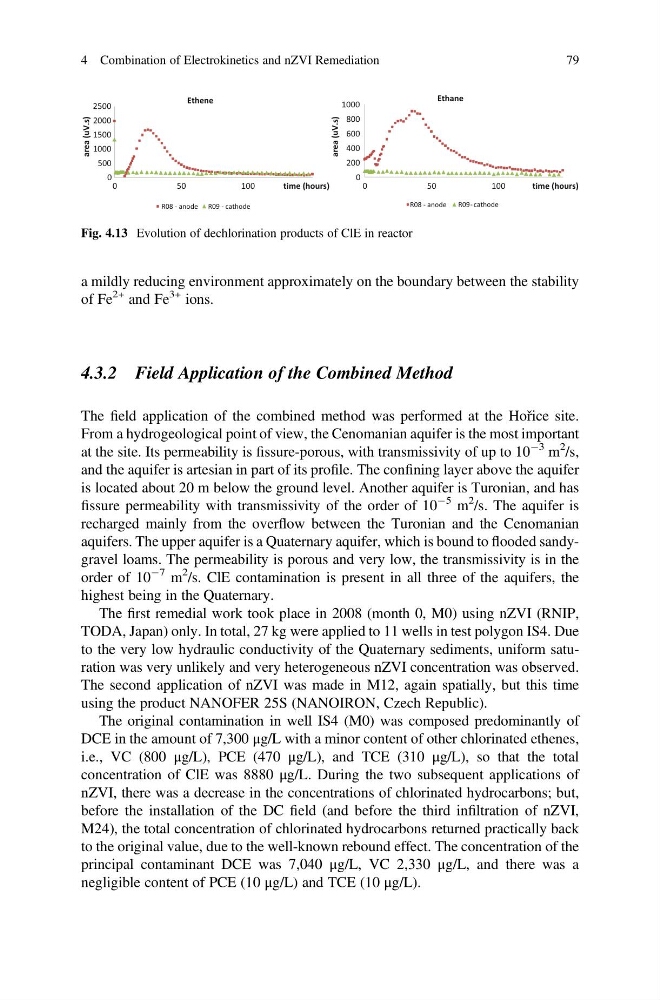
Fig. 4.13 Evolution of dechlorination products of ClE in reactor
4 Combination of Electrokinetics and nZVI Remediation
79
of Fe
2+ and Fe
3+ ions.
4.3.2 Field Application of the Combined Method
The field application of the combined method was performed at the Hořice site.
From a hydrogeological point of view, the Cenomanian aquifer is the most important
at the site. Its permeability is fissure-porous, with transmissivity of up to 10
À3 m
2
/s,
and the aquifer is artesian in part of its profile. The confining layer above the aquifer
is located about 20 m below the ground level. Another aquifer is Turonian, and has
fissure permeability with transmissivity of the order of 10
À5 m
2 /s. The aquifer is
recharged mainly from the overflow between the Turonian and the Cenomanian
aquifers. The upper aquifer is a Quaternary aquifer, which is bound to flooded sandygravel loams. The permeability is porous and very low, the transmissivity is in the
order of 10
À7 m
2 /s. ClE contamination is present in all three of the aquifers, the
highest being in the Quaternary.
The first remedial work took place in 2008 (month 0, M0) using nZVI (RNIP,
TODA, Japan) only. In total, 27 kg were applied to 11 wells in test polygon IS4. Due
to the very low hydraulic conductivity of the Quaternary sediments, uniform saturation was very unlikely and very heterogeneous nZVI concentration was observed.
The second application of nZVI was made in M12, again spatially, but this time
using the product NANOFER 25S (NANOIRON, Czech Republic).
The original contamination in well IS4 (M0) was composed predominantly of
DCE in the amount of 7,300 μg/L with a minor content of other chlorinated ethenes,
i.e., VC (800 μg/L), PCE (470 μg/L), and TCE (310 μg/L), so that the total
concentration of ClE was 8880 μg/L. During the two subsequent applications of
nZVI, there was a decrease in the concentrations of chlorinated hydrocarbons; but,
before the installation of the DC field (and before the third infiltration of nZVI,
M24), the total concentration of chlorinated hydrocarbons returned practically back
to the original value, due to the well-known rebound effect. The concentration of the
principal contaminant DCE was 7,040 μg/L, VC 2,330 μg/L, and there was a
negligible content of PCE (10 μg/L) and TCE (10 μg/L).
0
500
1000
1500
2000
2500
0
50
100
area (uV.s)
area (uV.s)
time (hours)
Ethene
R08 - anode
R08 - anode
R09 - cathode
0
200
400
600
800
1000
0
50
100
time (hours)
Ethane
R09 - cathode
Fig. 4.13 Evolution of dechlorination products of ClE in reactor
4 Combination of Electrokinetics and nZVI Remediation
79