

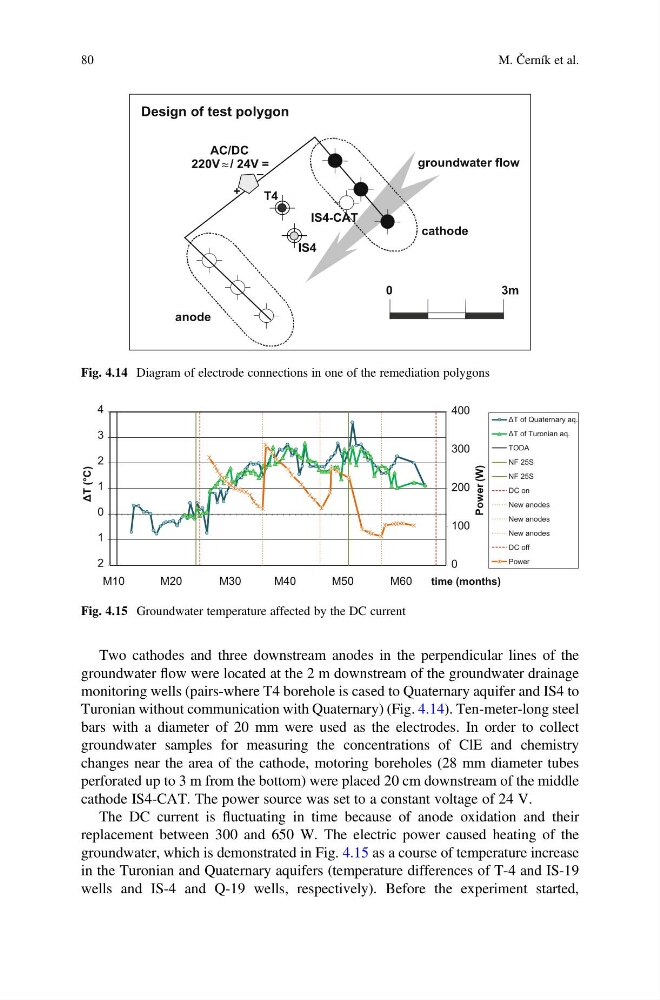
Two cathodes and three downstream anodes in the perpendicular lines of the
groundwater flow were located at the 2 m downstream of the groundwater drainage
monitoring wells (pairs-where T4 borehole is cased to Quaternary aquifer and IS4 to
Turonian without communication with Quaternary) (Fig. 4.14). Ten-meter-long steel
bars with a diameter of 20 mm were used as the electrodes. In order to collect
groundwater samples for measuring the concentrations of ClE and chemistry
changes near the area of the cathode, motoring boreholes (28 mm diameter tubes
perforated up to 3 m from the bottom) were placed 20 cm downstream of the middle
cathode IS4-CAT. The power source was set to a constant voltage of 24 V.
The DC current is fluctuating in time because of anode oxidation and their
replacement between 300 and 650 W. The electric power caused heating of the
groundwater, which is demonstrated in Fig. 4.15 as a course of temperature increase
in the Turonian and Quaternary aquifers (temperature differences of T-4 and IS-19
wells and IS-4 and Q-19 wells, respectively). Before the experiment started,
cathode
anode
AC/DC
220V / 24V =
T4
IS4
IS4-CAT
0
3m
groundwater flow
Design of test polygon
+
_
Fig. 4.14 Diagram of electrode connections in one of the remediation polygons
0
100
200
300
400
2
1
0
1
2
3
4
Power (W)
ȈT (°C)
ȈT of Quaternary aq.
ȈT of Turonian aq.
TODA
NF 25S
NF 25S
DC on
New anodes
New anodes
New anodes
DC off
Power
time (months)
M10
M20
M30
M40
M50
M60
Fig. 4.15 Groundwater temperature affected by the DC current
80
M. Černík et al.
groundwater flow were located at the 2 m downstream of the groundwater drainage
monitoring wells (pairs-where T4 borehole is cased to Quaternary aquifer and IS4 to
Turonian without communication with Quaternary) (Fig. 4.14). Ten-meter-long steel
bars with a diameter of 20 mm were used as the electrodes. In order to collect
groundwater samples for measuring the concentrations of ClE and chemistry
changes near the area of the cathode, motoring boreholes (28 mm diameter tubes
perforated up to 3 m from the bottom) were placed 20 cm downstream of the middle
cathode IS4-CAT. The power source was set to a constant voltage of 24 V.
The DC current is fluctuating in time because of anode oxidation and their
replacement between 300 and 650 W. The electric power caused heating of the
groundwater, which is demonstrated in Fig. 4.15 as a course of temperature increase
in the Turonian and Quaternary aquifers (temperature differences of T-4 and IS-19
wells and IS-4 and Q-19 wells, respectively). Before the experiment started,
cathode
anode
AC/DC
220V / 24V =
T4
IS4
IS4-CAT
0
3m
groundwater flow
Design of test polygon
+
_
Fig. 4.14 Diagram of electrode connections in one of the remediation polygons
0
100
200
300
400
2
1
0
1
2
3
4
Power (W)
ȈT (°C)
ȈT of Quaternary aq.
ȈT of Turonian aq.
TODA
NF 25S
NF 25S
DC on
New anodes
New anodes
New anodes
DC off
Power
time (months)
M10
M20
M30
M40
M50
M60
Fig. 4.15 Groundwater temperature affected by the DC current
80
M. Černík et al.