

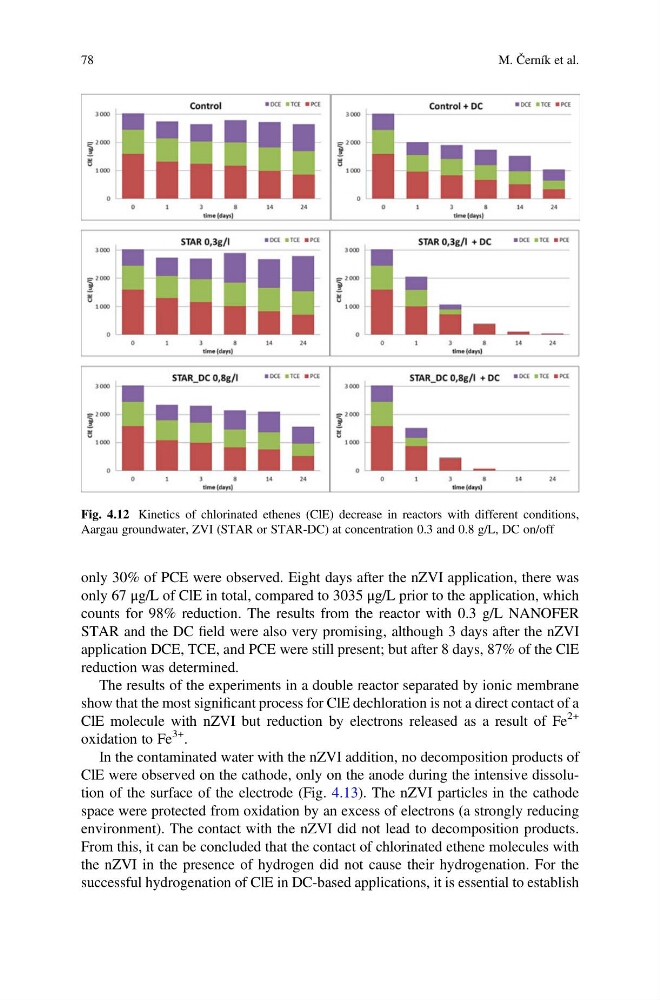
only 30% of PCE were observed. Eight days after the nZVI application, there was
only 67 μg/L of ClE in total, compared to 3035 μg/L prior to the application, which
counts for 98% reduction. The results from the reactor with 0.3 g/L NANOFER
STAR and the DC field were also very promising, although 3 days after the nZVI
application DCE, TCE, and PCE were still present; but after 8 days, 87% of the ClE
reduction was determined.
The results of the experiments in a double reactor separated by ionic membrane
show that the most significant process for ClE dechloration is not a direct contact of a
ClE molecule with nZVI but reduction by electrons released as a result of Fe
2+
oxidation to Fe
3+ .
In the contaminated water with the nZVI addition, no decomposition products of
ClE were observed on the cathode, only on the anode during the intensive dissolution of the surface of the electrode (Fig. 4.13). The nZVI particles in the cathode
space were protected from oxidation by an excess of electrons (a strongly reducing
environment). The contact with the nZVI did not lead to decomposition products.
From this, it can be concluded that the contact of chlorinated ethene molecules with
the nZVI in the presence of hydrogen did not cause their hydrogenation. For the
successful hydrogenation of ClE in DC-based applications, it is essential to establish
Fig. 4.12 Kinetics of chlorinated ethenes (ClE) decrease in reactors with different conditions,
Aargau groundwater, ZVI (STAR or STAR-DC) at concentration 0.3 and 0.8 g/L, DC on/off
78
M. Černík et al.
only 67 μg/L of ClE in total, compared to 3035 μg/L prior to the application, which
counts for 98% reduction. The results from the reactor with 0.3 g/L NANOFER
STAR and the DC field were also very promising, although 3 days after the nZVI
application DCE, TCE, and PCE were still present; but after 8 days, 87% of the ClE
reduction was determined.
The results of the experiments in a double reactor separated by ionic membrane
show that the most significant process for ClE dechloration is not a direct contact of a
ClE molecule with nZVI but reduction by electrons released as a result of Fe
2+
oxidation to Fe
3+ .
In the contaminated water with the nZVI addition, no decomposition products of
ClE were observed on the cathode, only on the anode during the intensive dissolution of the surface of the electrode (Fig. 4.13). The nZVI particles in the cathode
space were protected from oxidation by an excess of electrons (a strongly reducing
environment). The contact with the nZVI did not lead to decomposition products.
From this, it can be concluded that the contact of chlorinated ethene molecules with
the nZVI in the presence of hydrogen did not cause their hydrogenation. For the
successful hydrogenation of ClE in DC-based applications, it is essential to establish
Fig. 4.12 Kinetics of chlorinated ethenes (ClE) decrease in reactors with different conditions,
Aargau groundwater, ZVI (STAR or STAR-DC) at concentration 0.3 and 0.8 g/L, DC on/off
78
M. Černík et al.