

intensity of carbon nanomaterials is quenched interaction with plasmonic
nanoparticles. Here, the fluorescence of GO after interaction with Au
3+ is quenched
due to fluorescence resonance energy transfer (FRET) mechanism. The intensity of
quenched fluorescence intensity can be restored by addition of Pb
2+ . The added ions
accelerate the rate of leaching of Au nanoparticles on the decorated graphene
surface. Thus, this is an on-off-on type fluorescence sensing strategy for Pb
2 ions
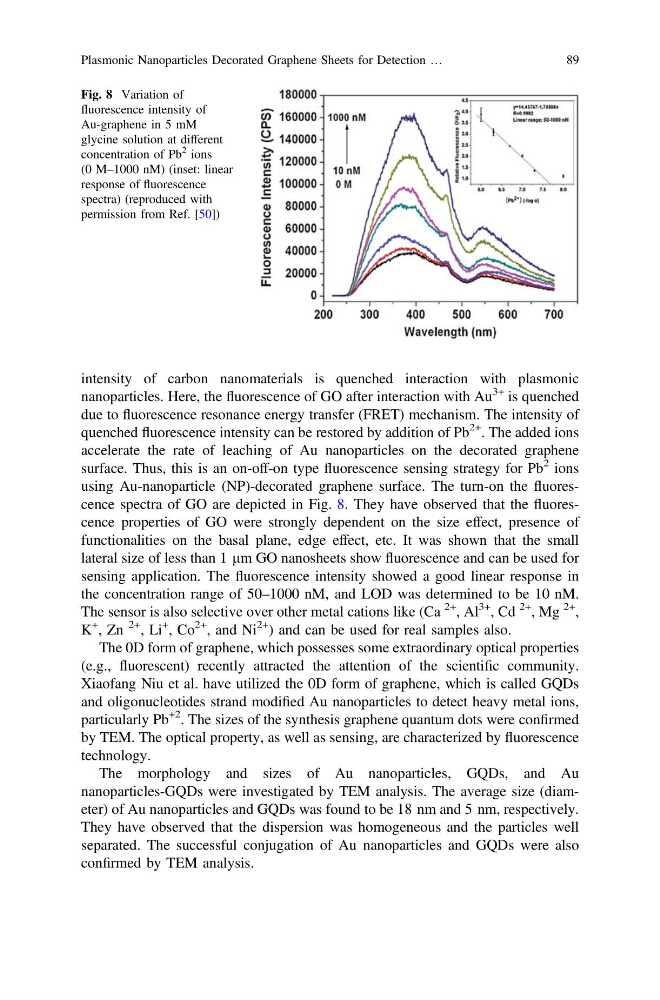
using Au-nanoparticle (NP)-decorated graphene surface. The turn-on the fluorescence spectra of GO are depicted in Fig. 8. They have observed that the fluorescence properties of GO were strongly dependent on the size effect, presence of
functionalities on the basal plane, edge effect, etc. It was shown that the small
lateral size of less than 1 lm GO nanosheets show fluorescence and can be used for
sensing application. The fluorescence intensity showed a good linear response in
the concentration range of 50–1000 nM, and LOD was determined to be 10 nM.
The sensor is also selective over other metal cations like (Ca
2+ , Al
3+ , Cd
2+ , Mg
2+ ,
K
+
, Zn
2+ , Li
+
, Co
2+ , and Ni
2+ ) and can be used for real samples also.
The 0D form of graphene, which possesses some extraordinary optical properties
(e.g., fluorescent) recently attracted the attention of the scientific community.
Xiaofang Niu et al. have utilized the 0D form of graphene, which is called GQDs
and oligonucleotides strand modified Au nanoparticles to detect heavy metal ions,
particularly Pb
+2 . The sizes of the synthesis graphene quantum dots were confirmed
by TEM. The optical property, as well as sensing, are characterized by fluorescence
technology.
The morphology and sizes of Au nanoparticles, GQDs, and Au
nanoparticles-GQDs were investigated by TEM analysis. The average size (diameter) of Au nanoparticles and GQDs was found to be 18 nm and 5 nm, respectively.
They have observed that the dispersion was homogeneous and the particles well
separated. The successful conjugation of Au nanoparticles and GQDs were also
confirmed by TEM analysis.
Fig. 8 Variation of
fluorescence intensity of
Au-graphene in 5 mM
glycine solution at different
concentration of Pb
2 ions
(0 M–1000 nM) (inset: linear
response of fluorescence
spectra) (reproduced with
permission from Ref. [50])
Plasmonic Nanoparticles Decorated Graphene Sheets for Detection …
89
nanoparticles. Here, the fluorescence of GO after interaction with Au
3+ is quenched
due to fluorescence resonance energy transfer (FRET) mechanism. The intensity of
quenched fluorescence intensity can be restored by addition of Pb
2+ . The added ions
accelerate the rate of leaching of Au nanoparticles on the decorated graphene
surface. Thus, this is an on-off-on type fluorescence sensing strategy for Pb
2 ions
using Au-nanoparticle (NP)-decorated graphene surface. The turn-on the fluorescence spectra of GO are depicted in Fig. 8. They have observed that the fluorescence properties of GO were strongly dependent on the size effect, presence of
functionalities on the basal plane, edge effect, etc. It was shown that the small
lateral size of less than 1 lm GO nanosheets show fluorescence and can be used for
sensing application. The fluorescence intensity showed a good linear response in
the concentration range of 50–1000 nM, and LOD was determined to be 10 nM.
The sensor is also selective over other metal cations like (Ca
2+ , Al
3+ , Cd
2+ , Mg
2+ ,
K
+
, Zn
2+ , Li
+
, Co
2+ , and Ni
2+ ) and can be used for real samples also.
The 0D form of graphene, which possesses some extraordinary optical properties
(e.g., fluorescent) recently attracted the attention of the scientific community.
Xiaofang Niu et al. have utilized the 0D form of graphene, which is called GQDs
and oligonucleotides strand modified Au nanoparticles to detect heavy metal ions,
particularly Pb
+2 . The sizes of the synthesis graphene quantum dots were confirmed
by TEM. The optical property, as well as sensing, are characterized by fluorescence
technology.
The morphology and sizes of Au nanoparticles, GQDs, and Au
nanoparticles-GQDs were investigated by TEM analysis. The average size (diameter) of Au nanoparticles and GQDs was found to be 18 nm and 5 nm, respectively.
They have observed that the dispersion was homogeneous and the particles well
separated. The successful conjugation of Au nanoparticles and GQDs were also
confirmed by TEM analysis.
Fig. 8 Variation of
fluorescence intensity of
Au-graphene in 5 mM
glycine solution at different
concentration of Pb
2 ions
(0 M–1000 nM) (inset: linear
response of fluorescence
spectra) (reproduced with
permission from Ref. [50])
Plasmonic Nanoparticles Decorated Graphene Sheets for Detection …
89