

With taking advantages of PL (fluorescence) property of these graphene-based
nanomaterials, these plasmonic nanomaterials decorated graphene/GQDs are used
as a fluorescence sensing platform for water pollutant like anions, cations, heavy
metal ions, dye, pesticide, etc. Due to their transparency and atomically thin nature,
both pristine graphene and their functionalized analogs are reported as excellent
substrates for plasmonic nanoparticles decoration. This strategy helps to construct
plasmon-based sensors (biological and chemical) as well as transparent flexible
electronics device. There are several reports for graphene-based fluorescence sensor
for water pollutants.
Among the heavy metal ions, Au
3+ or its salts are already reported as toxic to
humans beings as well as environment. The ions may cause a serious threat and risk
to the kidneys, nervous system, liver, heart, cell toxicity in living organisms. The
permissible limit of Au
3+ reported as 200 lM, so there is a need for a developed
new method for the detection of gold ion also necessary.
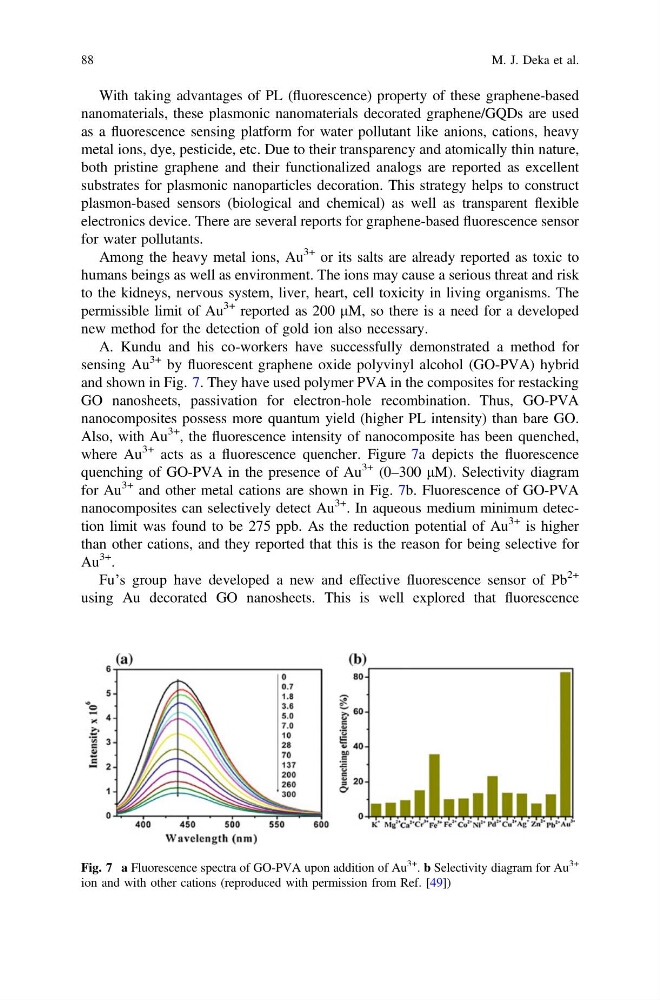
A. Kundu and his co-workers have successfully demonstrated a method for
sensing Au
3+ by fluorescent graphene oxide polyvinyl alcohol (GO-PVA) hybrid
and shown in Fig. 7. They have used polymer PVA in the composites for restacking
GO nanosheets, passivation for electron-hole recombination. Thus, GO-PVA
nanocomposites possess more quantum yield (higher PL intensity) than bare GO.
Also, with Au
3+ , the fluorescence intensity of nanocomposite has been quenched,
where Au
3+ acts as a fluorescence quencher. Figure 7a depicts the fluorescence
quenching of GO-PVA in the presence of Au
3+ (0–300 lM). Selectivity diagram
for Au
3+ and other metal cations are shown in Fig. 7b. Fluorescence of GO-PVA
nanocomposites can selectively detect Au
3+ . In aqueous medium minimum detection limit was found to be 275 ppb. As the reduction potential of Au
3+ is higher
than other cations, and they reported that this is the reason for being selective for
Au
3+ .
Fu’s group have developed a new and effective fluorescence sensor of Pb
2+
using Au decorated GO nanosheets. This is well explored that fluorescence
Fig. 7 a Fluorescence spectra of GO-PVA upon addition of Au
3+ . b Selectivity diagram for Au
3+
ion and with other cations (reproduced with permission from Ref. [49])
88
M. J. Deka et al.
nanomaterials, these plasmonic nanomaterials decorated graphene/GQDs are used
as a fluorescence sensing platform for water pollutant like anions, cations, heavy
metal ions, dye, pesticide, etc. Due to their transparency and atomically thin nature,
both pristine graphene and their functionalized analogs are reported as excellent
substrates for plasmonic nanoparticles decoration. This strategy helps to construct
plasmon-based sensors (biological and chemical) as well as transparent flexible
electronics device. There are several reports for graphene-based fluorescence sensor
for water pollutants.
Among the heavy metal ions, Au
3+ or its salts are already reported as toxic to
humans beings as well as environment. The ions may cause a serious threat and risk
to the kidneys, nervous system, liver, heart, cell toxicity in living organisms. The
permissible limit of Au
3+ reported as 200 lM, so there is a need for a developed
new method for the detection of gold ion also necessary.
A. Kundu and his co-workers have successfully demonstrated a method for
sensing Au
3+ by fluorescent graphene oxide polyvinyl alcohol (GO-PVA) hybrid
and shown in Fig. 7. They have used polymer PVA in the composites for restacking
GO nanosheets, passivation for electron-hole recombination. Thus, GO-PVA
nanocomposites possess more quantum yield (higher PL intensity) than bare GO.
Also, with Au
3+ , the fluorescence intensity of nanocomposite has been quenched,
where Au
3+ acts as a fluorescence quencher. Figure 7a depicts the fluorescence
quenching of GO-PVA in the presence of Au
3+ (0–300 lM). Selectivity diagram
for Au
3+ and other metal cations are shown in Fig. 7b. Fluorescence of GO-PVA
nanocomposites can selectively detect Au
3+ . In aqueous medium minimum detection limit was found to be 275 ppb. As the reduction potential of Au
3+ is higher
than other cations, and they reported that this is the reason for being selective for
Au
3+ .
Fu’s group have developed a new and effective fluorescence sensor of Pb
2+
using Au decorated GO nanosheets. This is well explored that fluorescence
Fig. 7 a Fluorescence spectra of GO-PVA upon addition of Au
3+ . b Selectivity diagram for Au
3+
ion and with other cations (reproduced with permission from Ref. [49])
88
M. J. Deka et al.