

Excitation dependant PL of graphene-based nanomaterials
GQDs and other derivatives of GO mainly possess excitation-dependent photoluminescence, and this is one of the most important properties of carbon-based
nanomaterials. There are many debates on the origin of this property and yet not
been well established. On the contrary, despite having considerable differences in
shape, surface, functionalities, and sizes, all the carbon nanomaterials exhibit
excitation dependant PL. Interestingly, some exceptions are also reported where
there exists excitation independent PL behavior [41, 42].
The mechanism of excitation dependent or independent PL properties depends
on some factors like size effect, quantum confinement effect, giant red-edge effect,
edge effect, carbonization degree, surface traps, etc. [43, 44].
Z. X. Gan and his co-worker’s studied the details of photoluminescence
(PL) and photoluminescence excitation (PLE) spectra of rGO. The
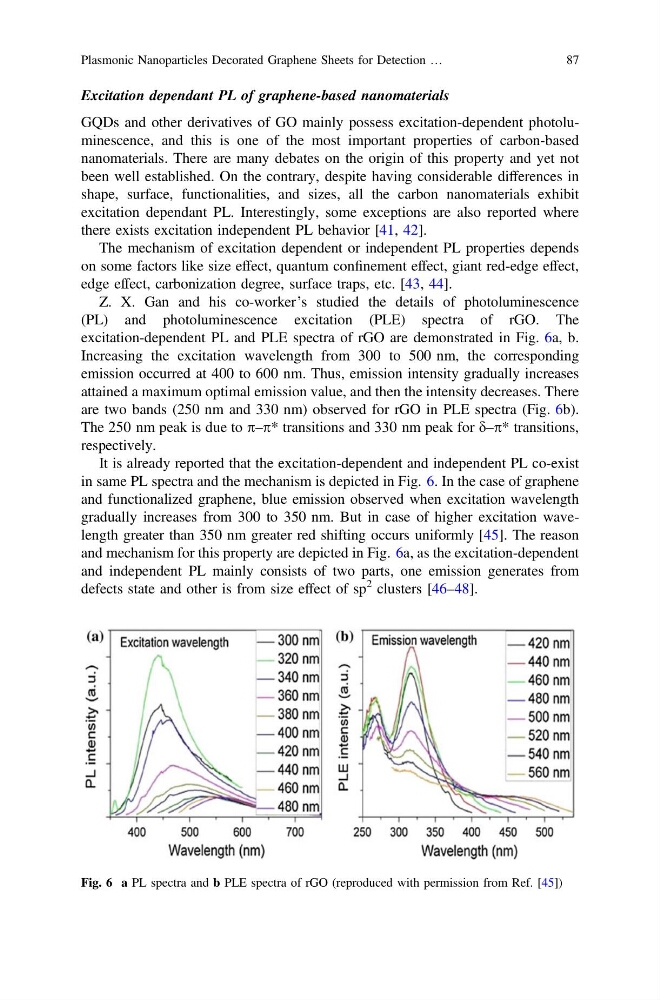
excitation-dependent PL and PLE spectra of rGO are demonstrated in Fig. 6a, b.
Increasing the excitation wavelength from 300 to 500 nm, the corresponding
emission occurred at 400 to 600 nm. Thus, emission intensity gradually increases
attained a maximum optimal emission value, and then the intensity decreases. There
are two bands (250 nm and 330 nm) observed for rGO in PLE spectra (Fig. 6b).
The 250 nm peak is due to p–p* transitions and 330 nm peak for d–p* transitions,
respectively.
It is already reported that the excitation-dependent and independent PL co-exist
in same PL spectra and the mechanism is depicted in Fig. 6. In the case of graphene
and functionalized graphene, blue emission observed when excitation wavelength
gradually increases from 300 to 350 nm. But in case of higher excitation wavelength greater than 350 nm greater red shifting occurs uniformly [45]. The reason
and mechanism for this property are depicted in Fig. 6a, as the excitation-dependent
and independent PL mainly consists of two parts, one emission generates from
defects state and other is from size effect of sp
2 clusters [46–48].
Fig. 6 a PL spectra and b PLE spectra of rGO (reproduced with permission from Ref. [45])
Plasmonic Nanoparticles Decorated Graphene Sheets for Detection …
87
GQDs and other derivatives of GO mainly possess excitation-dependent photoluminescence, and this is one of the most important properties of carbon-based
nanomaterials. There are many debates on the origin of this property and yet not
been well established. On the contrary, despite having considerable differences in
shape, surface, functionalities, and sizes, all the carbon nanomaterials exhibit
excitation dependant PL. Interestingly, some exceptions are also reported where
there exists excitation independent PL behavior [41, 42].
The mechanism of excitation dependent or independent PL properties depends
on some factors like size effect, quantum confinement effect, giant red-edge effect,
edge effect, carbonization degree, surface traps, etc. [43, 44].
Z. X. Gan and his co-worker’s studied the details of photoluminescence
(PL) and photoluminescence excitation (PLE) spectra of rGO. The
excitation-dependent PL and PLE spectra of rGO are demonstrated in Fig. 6a, b.
Increasing the excitation wavelength from 300 to 500 nm, the corresponding
emission occurred at 400 to 600 nm. Thus, emission intensity gradually increases
attained a maximum optimal emission value, and then the intensity decreases. There
are two bands (250 nm and 330 nm) observed for rGO in PLE spectra (Fig. 6b).
The 250 nm peak is due to p–p* transitions and 330 nm peak for d–p* transitions,
respectively.
It is already reported that the excitation-dependent and independent PL co-exist
in same PL spectra and the mechanism is depicted in Fig. 6. In the case of graphene
and functionalized graphene, blue emission observed when excitation wavelength
gradually increases from 300 to 350 nm. But in case of higher excitation wavelength greater than 350 nm greater red shifting occurs uniformly [45]. The reason
and mechanism for this property are depicted in Fig. 6a, as the excitation-dependent
and independent PL mainly consists of two parts, one emission generates from
defects state and other is from size effect of sp
2 clusters [46–48].
Fig. 6 a PL spectra and b PLE spectra of rGO (reproduced with permission from Ref. [45])
Plasmonic Nanoparticles Decorated Graphene Sheets for Detection …
87