

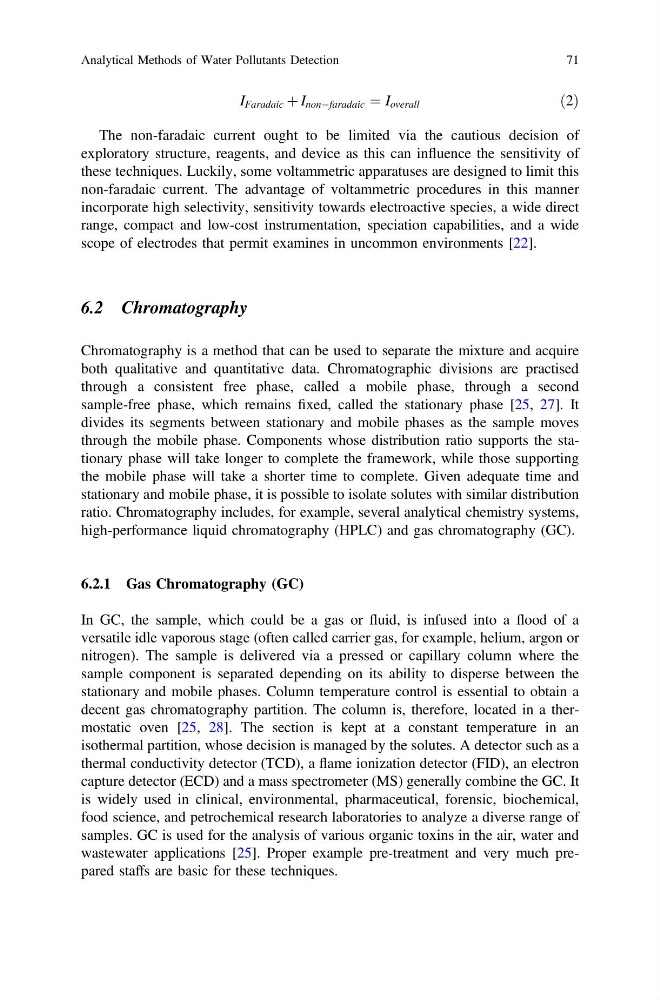
I Faradaic þ I nonÀfaradaic ¼ I overall
ð2Þ
The non-faradaic current ought to be limited via the cautious decision of
exploratory structure, reagents, and device as this can influence the sensitivity of
these techniques. Luckily, some voltammetric apparatuses are designed to limit this
non-faradaic current. The advantage of voltammetric procedures in this manner
incorporate high selectivity, sensitivity towards electroactive species, a wide direct
range, compact and low-cost instrumentation, speciation capabilities, and a wide
scope of electrodes that permit examines in uncommon environments [22].
6.2 Chromatography
Chromatography is a method that can be used to separate the mixture and acquire
both qualitative and quantitative data. Chromatographic divisions are practised
through a consistent free phase, called a mobile phase, through a second
sample-free phase, which remains fixed, called the stationary phase [25, 27]. It
divides its segments between stationary and mobile phases as the sample moves
through the mobile phase. Components whose distribution ratio supports the stationary phase will take longer to complete the framework, while those supporting
the mobile phase will take a shorter time to complete. Given adequate time and
stationary and mobile phase, it is possible to isolate solutes with similar distribution
ratio. Chromatography includes, for example, several analytical chemistry systems,
high-performance liquid chromatography (HPLC) and gas chromatography (GC).
6.2.1 Gas Chromatography (GC)
In GC, the sample, which could be a gas or fluid, is infused into a flood of a
versatile idle vaporous stage (often called carrier gas, for example, helium, argon or
nitrogen). The sample is delivered via a pressed or capillary column where the
sample component is separated depending on its ability to disperse between the
stationary and mobile phases. Column temperature control is essential to obtain a
decent gas chromatography partition. The column is, therefore, located in a thermostatic oven [25, 28]. The section is kept at a constant temperature in an
isothermal partition, whose decision is managed by the solutes. A detector such as a
thermal conductivity detector (TCD), a flame ionization detector (FID), an electron
capture detector (ECD) and a mass spectrometer (MS) generally combine the GC. It
is widely used in clinical, environmental, pharmaceutical, forensic, biochemical,
food science, and petrochemical research laboratories to analyze a diverse range of
samples. GC is used for the analysis of various organic toxins in the air, water and
wastewater applications [25]. Proper example pre-treatment and very much prepared staffs are basic for these techniques.
Analytical Methods of Water Pollutants Detection
71
ð2Þ
The non-faradaic current ought to be limited via the cautious decision of
exploratory structure, reagents, and device as this can influence the sensitivity of
these techniques. Luckily, some voltammetric apparatuses are designed to limit this
non-faradaic current. The advantage of voltammetric procedures in this manner
incorporate high selectivity, sensitivity towards electroactive species, a wide direct
range, compact and low-cost instrumentation, speciation capabilities, and a wide
scope of electrodes that permit examines in uncommon environments [22].
6.2 Chromatography
Chromatography is a method that can be used to separate the mixture and acquire
both qualitative and quantitative data. Chromatographic divisions are practised
through a consistent free phase, called a mobile phase, through a second
sample-free phase, which remains fixed, called the stationary phase [25, 27]. It
divides its segments between stationary and mobile phases as the sample moves
through the mobile phase. Components whose distribution ratio supports the stationary phase will take longer to complete the framework, while those supporting
the mobile phase will take a shorter time to complete. Given adequate time and
stationary and mobile phase, it is possible to isolate solutes with similar distribution
ratio. Chromatography includes, for example, several analytical chemistry systems,
high-performance liquid chromatography (HPLC) and gas chromatography (GC).
6.2.1 Gas Chromatography (GC)
In GC, the sample, which could be a gas or fluid, is infused into a flood of a
versatile idle vaporous stage (often called carrier gas, for example, helium, argon or
nitrogen). The sample is delivered via a pressed or capillary column where the
sample component is separated depending on its ability to disperse between the
stationary and mobile phases. Column temperature control is essential to obtain a
decent gas chromatography partition. The column is, therefore, located in a thermostatic oven [25, 28]. The section is kept at a constant temperature in an
isothermal partition, whose decision is managed by the solutes. A detector such as a
thermal conductivity detector (TCD), a flame ionization detector (FID), an electron
capture detector (ECD) and a mass spectrometer (MS) generally combine the GC. It
is widely used in clinical, environmental, pharmaceutical, forensic, biochemical,
food science, and petrochemical research laboratories to analyze a diverse range of
samples. GC is used for the analysis of various organic toxins in the air, water and
wastewater applications [25]. Proper example pre-treatment and very much prepared staffs are basic for these techniques.
Analytical Methods of Water Pollutants Detection
71