

electrochemical changes happen is known as the working terminal (WE) [22, 26].
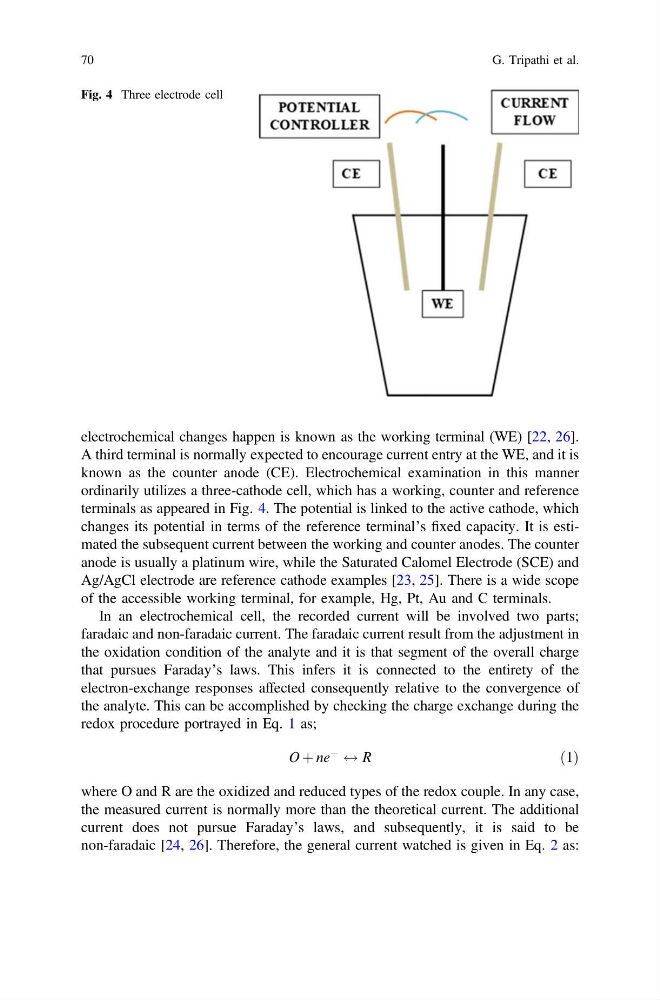
A third terminal is normally expected to encourage current entry at the WE, and it is
known as the counter anode (CE). Electrochemical examination in this manner
ordinarily utilizes a three-cathode cell, which has a working, counter and reference
terminals as appeared in Fig. 4. The potential is linked to the active cathode, which
changes its potential in terms of the reference terminal’s fixed capacity. It is estimated the subsequent current between the working and counter anodes. The counter
anode is usually a platinum wire, while the Saturated Calomel Electrode (SCE) and
Ag/AgCl electrode are reference cathode examples [23, 25]. There is a wide scope
of the accessible working terminal, for example, Hg, Pt, Au and C terminals.
In an electrochemical cell, the recorded current will be involved two parts;
faradaic and non-faradaic current. The faradaic current result from the adjustment in
the oxidation condition of the analyte and it is that segment of the overall charge
that pursues Faraday’s laws. This infers it is connected to the entirety of the
electron-exchange responses affected consequently relative to the convergence of
the analyte. This can be accomplished by checking the charge exchange during the
redox procedure portrayed in Eq. 1 as;
O þ ne
À
$ R
ð1Þ
where O and R are the oxidized and reduced types of the redox couple. In any case,
the measured current is normally more than the theoretical current. The additional
current does not pursue Faraday’s laws, and subsequently, it is said to be
non-faradaic [24, 26]. Therefore, the general current watched is given in Eq. 2 as:
Fig. 4 Three electrode cell
70
G. Tripathi et al.
A third terminal is normally expected to encourage current entry at the WE, and it is
known as the counter anode (CE). Electrochemical examination in this manner
ordinarily utilizes a three-cathode cell, which has a working, counter and reference
terminals as appeared in Fig. 4. The potential is linked to the active cathode, which
changes its potential in terms of the reference terminal’s fixed capacity. It is estimated the subsequent current between the working and counter anodes. The counter
anode is usually a platinum wire, while the Saturated Calomel Electrode (SCE) and
Ag/AgCl electrode are reference cathode examples [23, 25]. There is a wide scope
of the accessible working terminal, for example, Hg, Pt, Au and C terminals.
In an electrochemical cell, the recorded current will be involved two parts;
faradaic and non-faradaic current. The faradaic current result from the adjustment in
the oxidation condition of the analyte and it is that segment of the overall charge
that pursues Faraday’s laws. This infers it is connected to the entirety of the
electron-exchange responses affected consequently relative to the convergence of
the analyte. This can be accomplished by checking the charge exchange during the
redox procedure portrayed in Eq. 1 as;
O þ ne
À
$ R
ð1Þ
where O and R are the oxidized and reduced types of the redox couple. In any case,
the measured current is normally more than the theoretical current. The additional
current does not pursue Faraday’s laws, and subsequently, it is said to be
non-faradaic [24, 26]. Therefore, the general current watched is given in Eq. 2 as:
Fig. 4 Three electrode cell
70
G. Tripathi et al.