

Biosensors’. Renneberg et al. reviewed the foundation laid by Clark and other
workers in the area of biosensors [2]. Some of the major milestones in the process
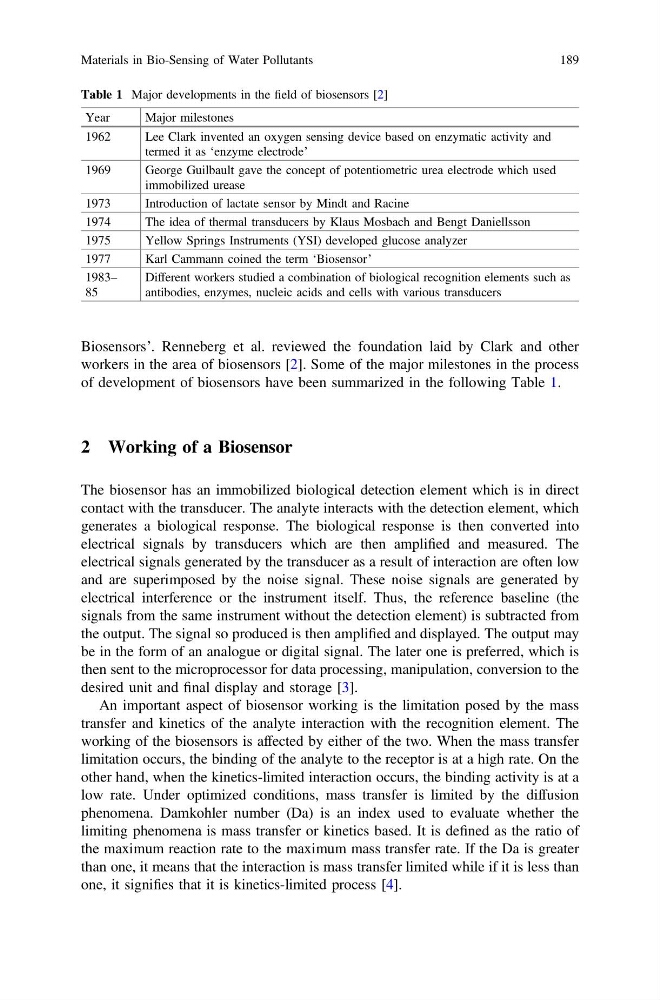
of development of biosensors have been summarized in the following Table 1.
2 Working of a Biosensor
The biosensor has an immobilized biological detection element which is in direct
contact with the transducer. The analyte interacts with the detection element, which
generates a biological response. The biological response is then converted into
electrical signals by transducers which are then amplified and measured. The
electrical signals generated by the transducer as a result of interaction are often low
and are superimposed by the noise signal. These noise signals are generated by
electrical interference or the instrument itself. Thus, the reference baseline (the
signals from the same instrument without the detection element) is subtracted from
the output. The signal so produced is then amplified and displayed. The output may
be in the form of an analogue or digital signal. The later one is preferred, which is
then sent to the microprocessor for data processing, manipulation, conversion to the
desired unit and final display and storage [3].
An important aspect of biosensor working is the limitation posed by the mass
transfer and kinetics of the analyte interaction with the recognition element. The
working of the biosensors is affected by either of the two. When the mass transfer
limitation occurs, the binding of the analyte to the receptor is at a high rate. On the
other hand, when the kinetics-limited interaction occurs, the binding activity is at a
low rate. Under optimized conditions, mass transfer is limited by the diffusion
phenomena. Damkohler number (Da) is an index used to evaluate whether the
limiting phenomena is mass transfer or kinetics based. It is defined as the ratio of
the maximum reaction rate to the maximum mass transfer rate. If the Da is greater
than one, it means that the interaction is mass transfer limited while if it is less than
one, it signifies that it is kinetics-limited process [4].
Table 1 Major developments in the field of biosensors [2]
Year
Major milestones
1962
Lee Clark invented an oxygen sensing device based on enzymatic activity and
termed it as ‘enzyme electrode’
1969
George Guilbault gave the concept of potentiometric urea electrode which used
immobilized urease
1973
Introduction of lactate sensor by Mindt and Racine
1974
The idea of thermal transducers by Klaus Mosbach and Bengt Daniellsson
1975
Yellow Springs Instruments (YSI) developed glucose analyzer
1977
Karl Cammann coined the term ‘Biosensor’
1983–
85
Different workers studied a combination of biological recognition elements such as
antibodies, enzymes, nucleic acids and cells with various transducers
Materials in Bio-Sensing of Water Pollutants
189
workers in the area of biosensors [2]. Some of the major milestones in the process
of development of biosensors have been summarized in the following Table 1.
2 Working of a Biosensor
The biosensor has an immobilized biological detection element which is in direct
contact with the transducer. The analyte interacts with the detection element, which
generates a biological response. The biological response is then converted into
electrical signals by transducers which are then amplified and measured. The
electrical signals generated by the transducer as a result of interaction are often low
and are superimposed by the noise signal. These noise signals are generated by
electrical interference or the instrument itself. Thus, the reference baseline (the
signals from the same instrument without the detection element) is subtracted from
the output. The signal so produced is then amplified and displayed. The output may
be in the form of an analogue or digital signal. The later one is preferred, which is
then sent to the microprocessor for data processing, manipulation, conversion to the
desired unit and final display and storage [3].
An important aspect of biosensor working is the limitation posed by the mass
transfer and kinetics of the analyte interaction with the recognition element. The
working of the biosensors is affected by either of the two. When the mass transfer
limitation occurs, the binding of the analyte to the receptor is at a high rate. On the
other hand, when the kinetics-limited interaction occurs, the binding activity is at a
low rate. Under optimized conditions, mass transfer is limited by the diffusion
phenomena. Damkohler number (Da) is an index used to evaluate whether the
limiting phenomena is mass transfer or kinetics based. It is defined as the ratio of
the maximum reaction rate to the maximum mass transfer rate. If the Da is greater
than one, it means that the interaction is mass transfer limited while if it is less than
one, it signifies that it is kinetics-limited process [4].
Table 1 Major developments in the field of biosensors [2]
Year
Major milestones
1962
Lee Clark invented an oxygen sensing device based on enzymatic activity and
termed it as ‘enzyme electrode’
1969
George Guilbault gave the concept of potentiometric urea electrode which used
immobilized urease
1973
Introduction of lactate sensor by Mindt and Racine
1974
The idea of thermal transducers by Klaus Mosbach and Bengt Daniellsson
1975
Yellow Springs Instruments (YSI) developed glucose analyzer
1977
Karl Cammann coined the term ‘Biosensor’
1983–
85
Different workers studied a combination of biological recognition elements such as
antibodies, enzymes, nucleic acids and cells with various transducers
Materials in Bio-Sensing of Water Pollutants
189