

3 Types of Biosensors
Thevenot et al. described the classification of biosensors as recommended by the
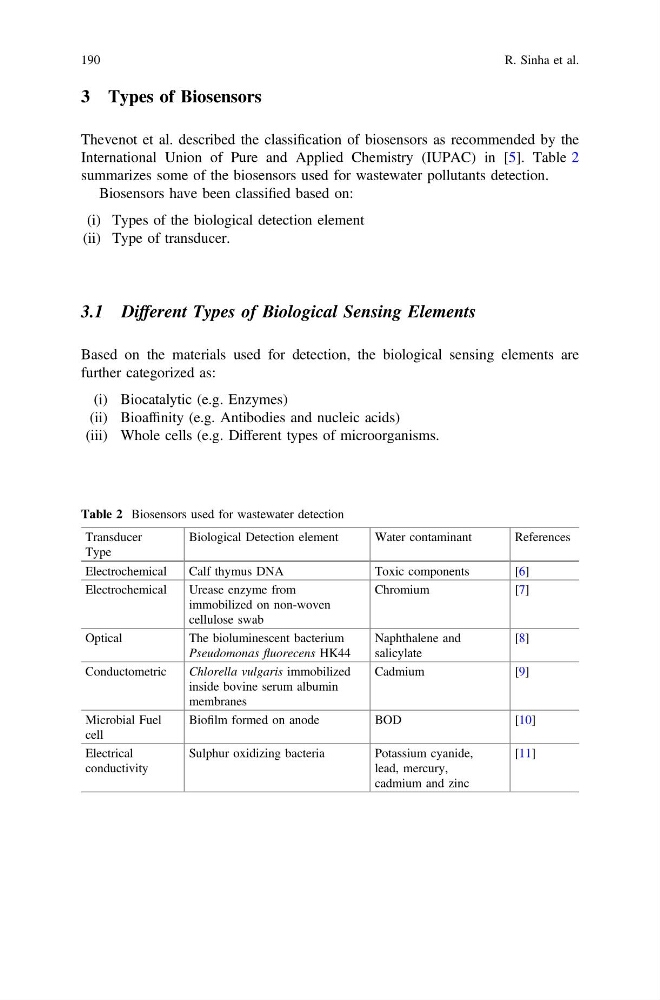
International Union of Pure and Applied Chemistry (IUPAC) in [5]. Table 2
summarizes some of the biosensors used for wastewater pollutants detection.
Biosensors have been classified based on:
(i) Types of the biological detection element
(ii) Type of transducer.
3.1 Different Types of Biological Sensing Elements
Based on the materials used for detection, the biological sensing elements are
further categorized as:
(i) Biocatalytic (e.g. Enzymes)
(ii) Bioaffinity (e.g. Antibodies and nucleic acids)
(iii) Whole cells (e.g. Different types of microorganisms.
Table 2 Biosensors used for wastewater detection
Transducer
Type
Biological Detection element
Water contaminant
References
Electrochemical
Calf thymus DNA
Toxic components
[6]
Electrochemical
Urease enzyme from
immobilized on non-woven
cellulose swab
Chromium
[7]
Optical
The bioluminescent bacterium
Pseudomonas fluorecens HK44
Naphthalene and
salicylate
[8]
Conductometric
Chlorella vulgaris immobilized
inside bovine serum albumin
membranes
Cadmium
[9]
Microbial Fuel
cell
Biofilm formed on anode
BOD
[10]
Electrical
conductivity
Sulphur oxidizing bacteria
Potassium cyanide,
lead, mercury,
cadmium and zinc
[11]
190
R. Sinha et al.
Thevenot et al. described the classification of biosensors as recommended by the
International Union of Pure and Applied Chemistry (IUPAC) in [5]. Table 2
summarizes some of the biosensors used for wastewater pollutants detection.
Biosensors have been classified based on:
(i) Types of the biological detection element
(ii) Type of transducer.
3.1 Different Types of Biological Sensing Elements
Based on the materials used for detection, the biological sensing elements are
further categorized as:
(i) Biocatalytic (e.g. Enzymes)
(ii) Bioaffinity (e.g. Antibodies and nucleic acids)
(iii) Whole cells (e.g. Different types of microorganisms.
Table 2 Biosensors used for wastewater detection
Transducer
Type
Biological Detection element
Water contaminant
References
Electrochemical
Calf thymus DNA
Toxic components
[6]
Electrochemical
Urease enzyme from
immobilized on non-woven
cellulose swab
Chromium
[7]
Optical
The bioluminescent bacterium
Pseudomonas fluorecens HK44
Naphthalene and
salicylate
[8]
Conductometric
Chlorella vulgaris immobilized
inside bovine serum albumin
membranes
Cadmium
[9]
Microbial Fuel
cell
Biofilm formed on anode
BOD
[10]
Electrical
conductivity
Sulphur oxidizing bacteria
Potassium cyanide,
lead, mercury,
cadmium and zinc
[11]
190
R. Sinha et al.