

1 Introduction
The rise in pollutants in the water bodies poses health risks as well as other
environmental problems which have become a global concern. This calls for simple, sensitive and efficient methods for detection of different types of pollutants
present in water so that the remediation process becomes effective. Conventional
methods of pollutants detection are less effective than biosensors in the detection of
toxic components of wastewater due to their slow response, complex methodology
and high cost. Thus, biosensors were conceptualized for real-time detection of
analyte even at small concentrations. The application of biosensors in wastewater
analysis and the materials used for their construction are discussed in this chapter.
Cammann coined the term biosensor [1]. The IUPAC committee defined biosensor
as “A biosensor is a self-contained integrated device, which is capable of providing
specific quantitative or semi-quantitative analytical information using a biological
recognition element (biochemical receptor), which is retained in direct spatial
contact with a transduction element.” [2]. Construction of biosensors requires a
multi-disciplinary knowledge as the detection element is a biological material by
which chemical conversion occurs, which is transduced with the help of an electronic component.
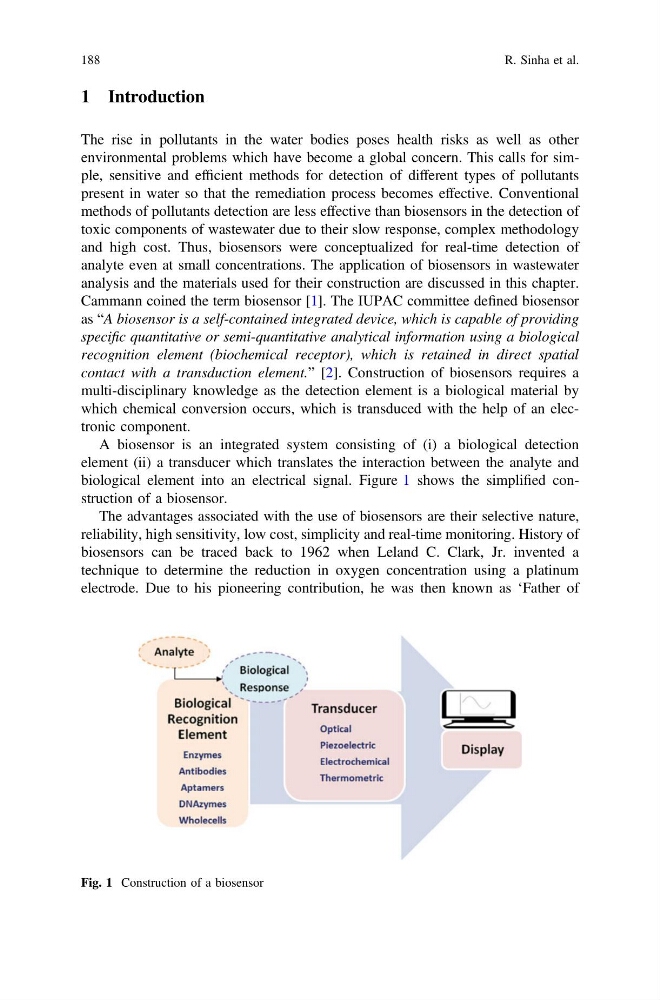
A biosensor is an integrated system consisting of (i) a biological detection
element (ii) a transducer which translates the interaction between the analyte and
biological element into an electrical signal. Figure 1 shows the simplified construction of a biosensor.
The advantages associated with the use of biosensors are their selective nature,
reliability, high sensitivity, low cost, simplicity and real-time monitoring. History of
biosensors can be traced back to 1962 when Leland C. Clark, Jr. invented a
technique to determine the reduction in oxygen concentration using a platinum
electrode. Due to his pioneering contribution, he was then known as ‘Father of
Fig. 1 Construction of a biosensor
188
R. Sinha et al.
The rise in pollutants in the water bodies poses health risks as well as other
environmental problems which have become a global concern. This calls for simple, sensitive and efficient methods for detection of different types of pollutants
present in water so that the remediation process becomes effective. Conventional
methods of pollutants detection are less effective than biosensors in the detection of
toxic components of wastewater due to their slow response, complex methodology
and high cost. Thus, biosensors were conceptualized for real-time detection of
analyte even at small concentrations. The application of biosensors in wastewater
analysis and the materials used for their construction are discussed in this chapter.
Cammann coined the term biosensor [1]. The IUPAC committee defined biosensor
as “A biosensor is a self-contained integrated device, which is capable of providing
specific quantitative or semi-quantitative analytical information using a biological
recognition element (biochemical receptor), which is retained in direct spatial
contact with a transduction element.” [2]. Construction of biosensors requires a
multi-disciplinary knowledge as the detection element is a biological material by
which chemical conversion occurs, which is transduced with the help of an electronic component.
A biosensor is an integrated system consisting of (i) a biological detection
element (ii) a transducer which translates the interaction between the analyte and
biological element into an electrical signal. Figure 1 shows the simplified construction of a biosensor.
The advantages associated with the use of biosensors are their selective nature,
reliability, high sensitivity, low cost, simplicity and real-time monitoring. History of
biosensors can be traced back to 1962 when Leland C. Clark, Jr. invented a
technique to determine the reduction in oxygen concentration using a platinum
electrode. Due to his pioneering contribution, he was then known as ‘Father of
Fig. 1 Construction of a biosensor
188
R. Sinha et al.