

4 Future Scope
The scope of fluorescent chemosensors for continuous water quality monitoring is
expanding with the dramatic advances in the development of affordable and portable monitoring tools. In this context, paper based test strips in combination with
microfluidics are promising for fabricating affordable and disposable analytical
devices. The current challenges in addressing the development of portable
fluorimeters for real time water quality monitoring could be potentially met by
integrating the paper based sensors and the innovative advancements in wireless
communication. Micro-paper based analytical devices (µPADs) integrated with
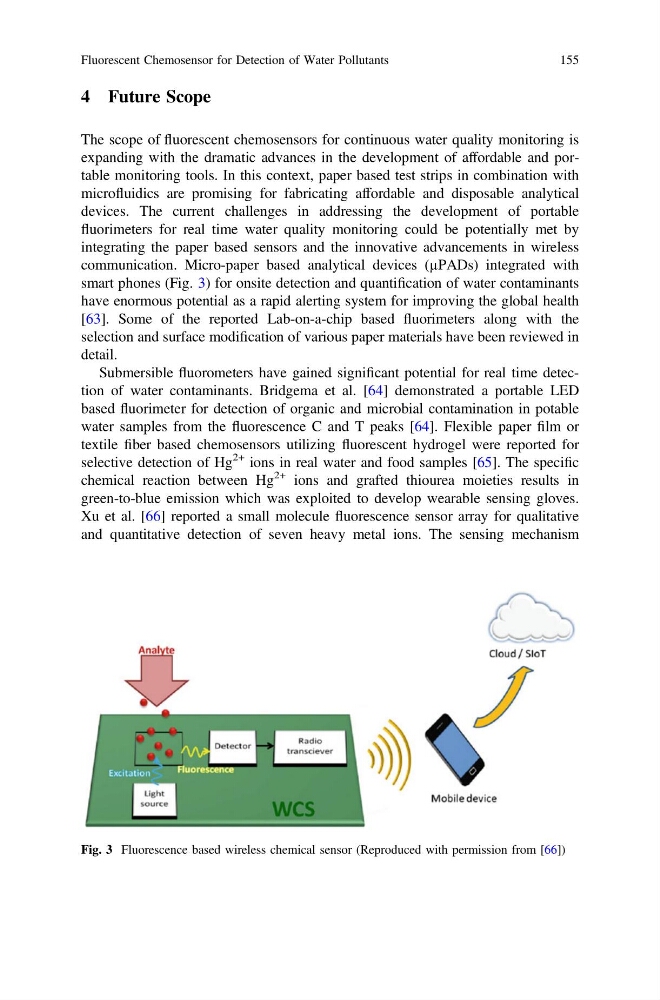
smart phones (Fig. 3) for onsite detection and quantification of water contaminants
have enormous potential as a rapid alerting system for improving the global health
[63]. Some of the reported Lab-on-a-chip based fluorimeters along with the
selection and surface modification of various paper materials have been reviewed in
detail.
Submersible fluorometers have gained significant potential for real time detection of water contaminants. Bridgema et al. [64] demonstrated a portable LED
based fluorimeter for detection of organic and microbial contamination in potable
water samples from the fluorescence C and T peaks [64]. Flexible paper film or
textile fiber based chemosensors utilizing fluorescent hydrogel were reported for
selective detection of Hg
2+ ions in real water and food samples [65]. The specific
chemical reaction between Hg
2+ ions and grafted thiourea moieties results in
green-to-blue emission which was exploited to develop wearable sensing gloves.
Xu et al. [66] reported a small molecule fluorescence sensor array for qualitative
and quantitative detection of seven heavy metal ions. The sensing mechanism
Fig. 3 Fluorescence based wireless chemical sensor (Reproduced with permission from [66])
Fluorescent Chemosensor for Detection of Water Pollutants
155
The scope of fluorescent chemosensors for continuous water quality monitoring is
expanding with the dramatic advances in the development of affordable and portable monitoring tools. In this context, paper based test strips in combination with
microfluidics are promising for fabricating affordable and disposable analytical
devices. The current challenges in addressing the development of portable
fluorimeters for real time water quality monitoring could be potentially met by
integrating the paper based sensors and the innovative advancements in wireless
communication. Micro-paper based analytical devices (µPADs) integrated with
smart phones (Fig. 3) for onsite detection and quantification of water contaminants
have enormous potential as a rapid alerting system for improving the global health
[63]. Some of the reported Lab-on-a-chip based fluorimeters along with the
selection and surface modification of various paper materials have been reviewed in
detail.
Submersible fluorometers have gained significant potential for real time detection of water contaminants. Bridgema et al. [64] demonstrated a portable LED
based fluorimeter for detection of organic and microbial contamination in potable
water samples from the fluorescence C and T peaks [64]. Flexible paper film or
textile fiber based chemosensors utilizing fluorescent hydrogel were reported for
selective detection of Hg
2+ ions in real water and food samples [65]. The specific
chemical reaction between Hg
2+ ions and grafted thiourea moieties results in
green-to-blue emission which was exploited to develop wearable sensing gloves.
Xu et al. [66] reported a small molecule fluorescence sensor array for qualitative
and quantitative detection of seven heavy metal ions. The sensing mechanism
Fig. 3 Fluorescence based wireless chemical sensor (Reproduced with permission from [66])
Fluorescent Chemosensor for Detection of Water Pollutants
155