

Fluorescence chemosensors for detection of anions, pesticides, heavy metal ions and
explosives using organic dyes, inorganic metal complexes have been extensively
reviewed [45–50]. However, recent advances on the exploitation of fluorescent
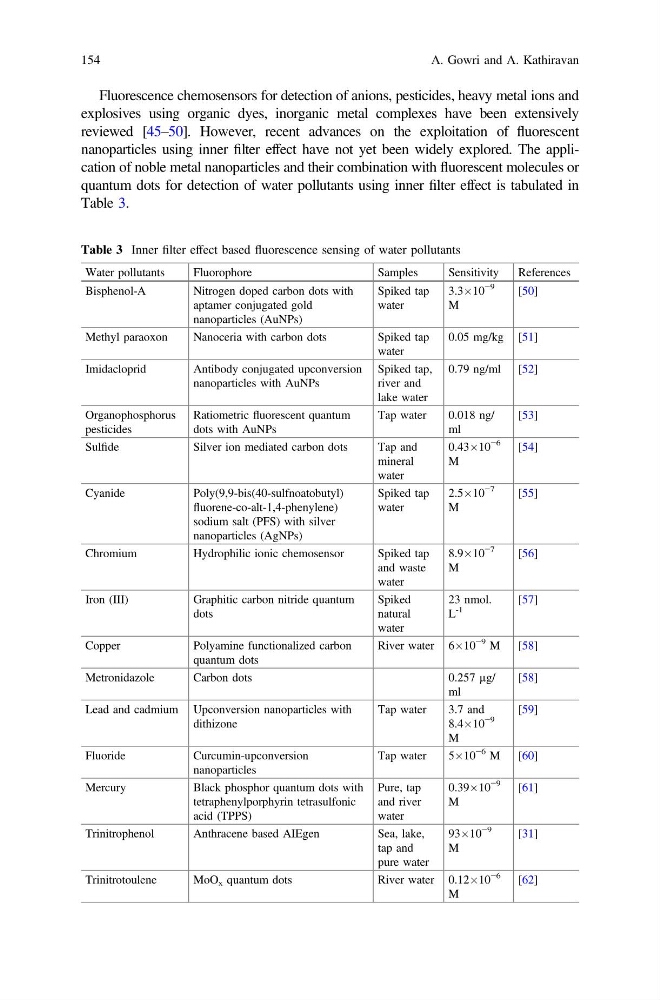
nanoparticles using inner filter effect have not yet been widely explored. The application of noble metal nanoparticles and their combination with fluorescent molecules or
quantum dots for detection of water pollutants using inner filter effect is tabulated in
Table 3.
Table 3 Inner filter effect based fluorescence sensing of water pollutants
Water pollutants
Fluorophore
Samples
Sensitivity
References
Bisphenol-A
Nitrogen doped carbon dots with
aptamer conjugated gold
nanoparticles (AuNPs)
Spiked tap
water
3.3Â10
−9
M
[50]
Methyl paraoxon
Nanoceria with carbon dots
Spiked tap
water
0.05 mg/kg [51]
Imidacloprid
Antibody conjugated upconversion
nanoparticles with AuNPs
Spiked tap,
river and
lake water
0.79 ng/ml [52]
Organophosphorus
pesticides
Ratiometric fluorescent quantum
dots with AuNPs
Tap water
0.018 ng/
ml
[53]
Sulfide
Silver ion mediated carbon dots
Tap and
mineral
water
0.43Â10
−6
M
[54]
Cyanide
Poly(9,9-bis(40-sulfnoatobutyl)
fluorene-co-alt-1,4-phenylene)
sodium salt (PFS) with silver
nanoparticles (AgNPs)
Spiked tap
water
2.5Â10
−7
M
[55]
Chromium
Hydrophilic ionic chemosensor
Spiked tap
and waste
water
8.9Â10
−7
M
[56]
Iron (III)
Graphitic carbon nitride quantum
dots
Spiked
natural
water
23 nmol.
L
-1
[57]
Copper
Polyamine functionalized carbon
quantum dots
River water 6Â10
−9 M [58]
Metronidazole
Carbon dots
0.257 µg/
ml
[58]
Lead and cadmium Upconversion nanoparticles with
dithizone
Tap water
3.7 and
8.4Â10
−9
M
[59]
Fluoride
Curcumin-upconversion
nanoparticles
Tap water
5Â10
−6 M [60]
Mercury
Black phosphor quantum dots with
tetraphenylporphyrin tetrasulfonic
acid (TPPS)
Pure, tap
and river
water
0.39Â10
−9
M
[61]
Trinitrophenol
Anthracene based AIEgen
Sea, lake,
tap and
pure water
93Â10
−9
M
[31]
Trinitrotoulene
MoO x quantum dots
River water 0.12Â10
−6
M
[62]
154
A. Gowri and A. Kathiravan
explosives using organic dyes, inorganic metal complexes have been extensively
reviewed [45–50]. However, recent advances on the exploitation of fluorescent
nanoparticles using inner filter effect have not yet been widely explored. The application of noble metal nanoparticles and their combination with fluorescent molecules or
quantum dots for detection of water pollutants using inner filter effect is tabulated in
Table 3.
Table 3 Inner filter effect based fluorescence sensing of water pollutants
Water pollutants
Fluorophore
Samples
Sensitivity
References
Bisphenol-A
Nitrogen doped carbon dots with
aptamer conjugated gold
nanoparticles (AuNPs)
Spiked tap
water
3.3Â10
−9
M
[50]
Methyl paraoxon
Nanoceria with carbon dots
Spiked tap
water
0.05 mg/kg [51]
Imidacloprid
Antibody conjugated upconversion
nanoparticles with AuNPs
Spiked tap,
river and
lake water
0.79 ng/ml [52]
Organophosphorus
pesticides
Ratiometric fluorescent quantum
dots with AuNPs
Tap water
0.018 ng/
ml
[53]
Sulfide
Silver ion mediated carbon dots
Tap and
mineral
water
0.43Â10
−6
M
[54]
Cyanide
Poly(9,9-bis(40-sulfnoatobutyl)
fluorene-co-alt-1,4-phenylene)
sodium salt (PFS) with silver
nanoparticles (AgNPs)
Spiked tap
water
2.5Â10
−7
M
[55]
Chromium
Hydrophilic ionic chemosensor
Spiked tap
and waste
water
8.9Â10
−7
M
[56]
Iron (III)
Graphitic carbon nitride quantum
dots
Spiked
natural
water
23 nmol.
L
-1
[57]
Copper
Polyamine functionalized carbon
quantum dots
River water 6Â10
−9 M [58]
Metronidazole
Carbon dots
0.257 µg/
ml
[58]
Lead and cadmium Upconversion nanoparticles with
dithizone
Tap water
3.7 and
8.4Â10
−9
M
[59]
Fluoride
Curcumin-upconversion
nanoparticles
Tap water
5Â10
−6 M [60]
Mercury
Black phosphor quantum dots with
tetraphenylporphyrin tetrasulfonic
acid (TPPS)
Pure, tap
and river
water
0.39Â10
−9
M
[61]
Trinitrophenol
Anthracene based AIEgen
Sea, lake,
tap and
pure water
93Â10
−9
M
[31]
Trinitrotoulene
MoO x quantum dots
River water 0.12Â10
−6
M
[62]
154
A. Gowri and A. Kathiravan