

chemosensors [28–30]. The above mentioned mechanisms require interaction
between the fluorophore and absorber (analyte). Moreover, those mechanisms
involve no overlap between the absorption spectrum of analyte and the emission
spectrum of the fluorophore with alterations in the fluorescence lifetime upon
interaction with the analyte.
2.2 Inner Filter Effect (IFE)
On the contrary, fluorescence sensing mechanism based on inner filter effect
(IFE) does not require any interaction which led to minimal intervention during
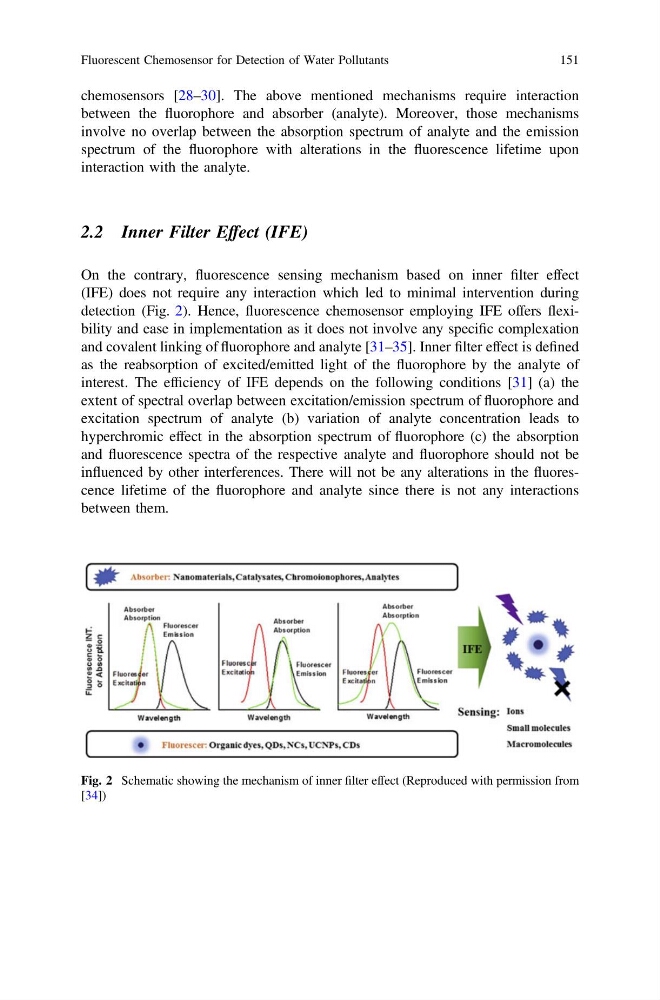
detection (Fig. 2). Hence, fluorescence chemosensor employing IFE offers flexibility and ease in implementation as it does not involve any specific complexation
and covalent linking of fluorophore and analyte [31–35]. Inner filter effect is defined
as the reabsorption of excited/emitted light of the fluorophore by the analyte of
interest. The efficiency of IFE depends on the following conditions [31] (a) the
extent of spectral overlap between excitation/emission spectrum of fluorophore and
excitation spectrum of analyte (b) variation of analyte concentration leads to
hyperchromic effect in the absorption spectrum of fluorophore (c) the absorption
and fluorescence spectra of the respective analyte and fluorophore should not be
influenced by other interferences. There will not be any alterations in the fluorescence lifetime of the fluorophore and analyte since there is not any interactions
between them.
Fig. 2 Schematic showing the mechanism of inner filter effect (Reproduced with permission from
[34])
Fluorescent Chemosensor for Detection of Water Pollutants
151
between the fluorophore and absorber (analyte). Moreover, those mechanisms
involve no overlap between the absorption spectrum of analyte and the emission
spectrum of the fluorophore with alterations in the fluorescence lifetime upon
interaction with the analyte.
2.2 Inner Filter Effect (IFE)
On the contrary, fluorescence sensing mechanism based on inner filter effect
(IFE) does not require any interaction which led to minimal intervention during
detection (Fig. 2). Hence, fluorescence chemosensor employing IFE offers flexibility and ease in implementation as it does not involve any specific complexation
and covalent linking of fluorophore and analyte [31–35]. Inner filter effect is defined
as the reabsorption of excited/emitted light of the fluorophore by the analyte of
interest. The efficiency of IFE depends on the following conditions [31] (a) the
extent of spectral overlap between excitation/emission spectrum of fluorophore and
excitation spectrum of analyte (b) variation of analyte concentration leads to
hyperchromic effect in the absorption spectrum of fluorophore (c) the absorption
and fluorescence spectra of the respective analyte and fluorophore should not be
influenced by other interferences. There will not be any alterations in the fluorescence lifetime of the fluorophore and analyte since there is not any interactions
between them.
Fig. 2 Schematic showing the mechanism of inner filter effect (Reproduced with permission from
[34])
Fluorescent Chemosensor for Detection of Water Pollutants
151