

3 Fluorophores Reported for Detection of Water
Pollutants
There are various fluorophores reported in literature including organic dyes, inorganic complexes, metal organic frameworks, quantum dots and noble metal nanoclusters [36–40]. However, the main challenge in the design of IFE based sensing
lies in selection of the fluorophore-absorber combination with complete spectral
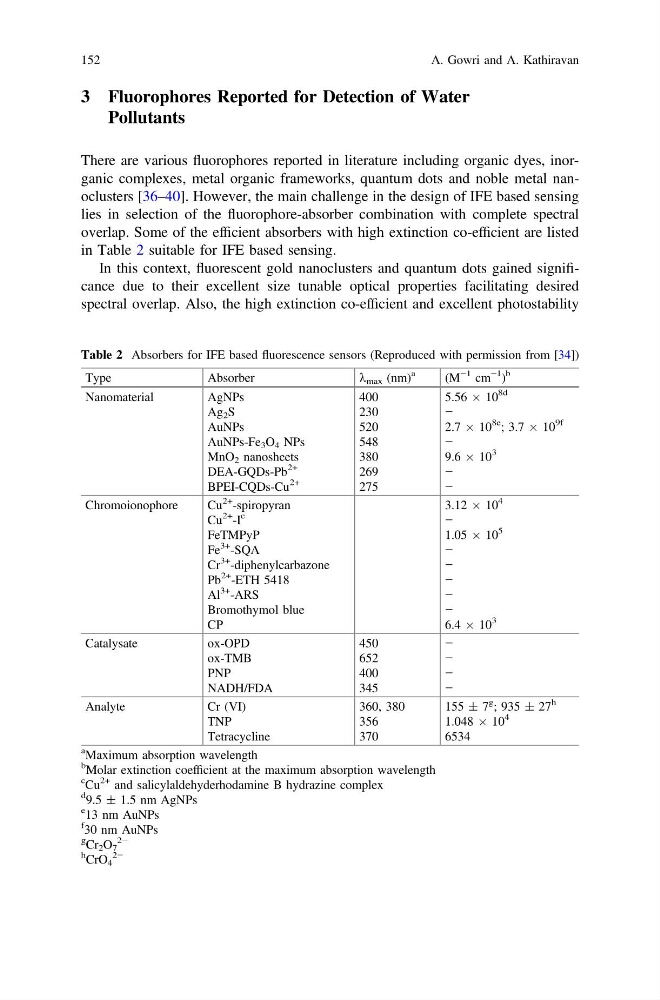
overlap. Some of the efficient absorbers with high extinction co-efficient are listed
in Table 2 suitable for IFE based sensing.
In this context, fluorescent gold nanoclusters and quantum dots gained significance due to their excellent size tunable optical properties facilitating desired
spectral overlap. Also, the high extinction co-efficient and excellent photostability
Table 2 Absorbers for IFE based fluorescence sensors (Reproduced with permission from [34])
Type
Absorber
k max (nm)
a
(M
−1 cm
−1
)
b
Nanomaterial
AgNPs
Ag 2 S
AuNPs
AuNPs-Fe 3 O 4 NPs
MnO 2 nanosheets
DEA-GQDs-Pb
2+
BPEI-CQDs-Cu
2+
400
230
520
548
380
269
275
5.56 Â 10
8d
−
2.7 Â 10
8e ; 3.7 Â 10
9f
−
9.6 Â 10
3
−
−
Chromoionophore
Cu
2+ -spiropyran
Cu
2+ -I
c
FeTMPyP
Fe
3+ -SQA
Cr
3+ -diphenylcarbazone
Pb
2+ -ETH 5418
Al
3+ -ARS
Bromothymol blue
CP
3.12 Â 10
4
−
1.05 Â 10
5
−
−
−
−
−
6.4 Â 10
3
Catalysate
ox-OPD
ox-TMB
PNP
NADH/FDA
450
652
400
345
−
−
−
−
Analyte
Cr (VI)
TNP
Tetracycline
360, 380
356
370
155 ± 7
g
; 935 ± 27
h
1.048 Â 10
4
6534
a Maximum absorption wavelength
b
Molar extinction coefficient at the maximum absorption wavelength
c Cu
2+ and salicylaldehyderhodamine B hydrazine complex
d
9.5 ± 1.5 nm AgNPs
e 13 nm AuNPs
f
30 nm AuNPs
g
Cr 2 O 7
2−
h
CrO 4
2−
152
A. Gowri and A. Kathiravan
Pollutants
There are various fluorophores reported in literature including organic dyes, inorganic complexes, metal organic frameworks, quantum dots and noble metal nanoclusters [36–40]. However, the main challenge in the design of IFE based sensing
lies in selection of the fluorophore-absorber combination with complete spectral
overlap. Some of the efficient absorbers with high extinction co-efficient are listed
in Table 2 suitable for IFE based sensing.
In this context, fluorescent gold nanoclusters and quantum dots gained significance due to their excellent size tunable optical properties facilitating desired
spectral overlap. Also, the high extinction co-efficient and excellent photostability
Table 2 Absorbers for IFE based fluorescence sensors (Reproduced with permission from [34])
Type
Absorber
k max (nm)
a
(M
−1 cm
−1
)
b
Nanomaterial
AgNPs
Ag 2 S
AuNPs
AuNPs-Fe 3 O 4 NPs
MnO 2 nanosheets
DEA-GQDs-Pb
2+
BPEI-CQDs-Cu
2+
400
230
520
548
380
269
275
5.56 Â 10
8d
−
2.7 Â 10
8e ; 3.7 Â 10
9f
−
9.6 Â 10
3
−
−
Chromoionophore
Cu
2+ -spiropyran
Cu
2+ -I
c
FeTMPyP
Fe
3+ -SQA
Cr
3+ -diphenylcarbazone
Pb
2+ -ETH 5418
Al
3+ -ARS
Bromothymol blue
CP
3.12 Â 10
4
−
1.05 Â 10
5
−
−
−
−
−
6.4 Â 10
3
Catalysate
ox-OPD
ox-TMB
PNP
NADH/FDA
450
652
400
345
−
−
−
−
Analyte
Cr (VI)
TNP
Tetracycline
360, 380
356
370
155 ± 7
g
; 935 ± 27
h
1.048 Â 10
4
6534
a Maximum absorption wavelength
b
Molar extinction coefficient at the maximum absorption wavelength
c Cu
2+ and salicylaldehyderhodamine B hydrazine complex
d
9.5 ± 1.5 nm AgNPs
e 13 nm AuNPs
f
30 nm AuNPs
g
Cr 2 O 7
2−
h
CrO 4
2−
152
A. Gowri and A. Kathiravan