

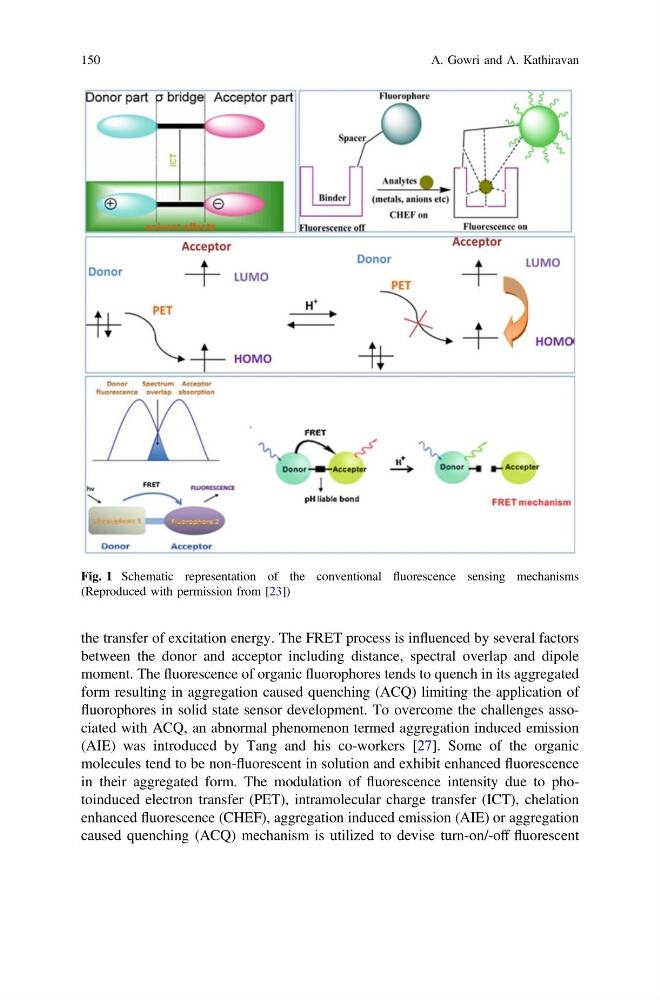
the transfer of excitation energy. The FRET process is influenced by several factors
between the donor and acceptor including distance, spectral overlap and dipole
moment. The fluorescence of organic fluorophores tends to quench in its aggregated
form resulting in aggregation caused quenching (ACQ) limiting the application of
fluorophores in solid state sensor development. To overcome the challenges associated with ACQ, an abnormal phenomenon termed aggregation induced emission
(AIE) was introduced by Tang and his co-workers [27]. Some of the organic
molecules tend to be non-fluorescent in solution and exhibit enhanced fluorescence
in their aggregated form. The modulation of fluorescence intensity due to photoinduced electron transfer (PET), intramolecular charge transfer (ICT), chelation
enhanced fluorescence (CHEF), aggregation induced emission (AIE) or aggregation
caused quenching (ACQ) mechanism is utilized to devise turn-on/-off fluorescent
Fig. 1 Schematic representation of the conventional fluorescence sensing mechanisms
(Reproduced with permission from [23])
150
A. Gowri and A. Kathiravan
between the donor and acceptor including distance, spectral overlap and dipole
moment. The fluorescence of organic fluorophores tends to quench in its aggregated
form resulting in aggregation caused quenching (ACQ) limiting the application of
fluorophores in solid state sensor development. To overcome the challenges associated with ACQ, an abnormal phenomenon termed aggregation induced emission
(AIE) was introduced by Tang and his co-workers [27]. Some of the organic
molecules tend to be non-fluorescent in solution and exhibit enhanced fluorescence
in their aggregated form. The modulation of fluorescence intensity due to photoinduced electron transfer (PET), intramolecular charge transfer (ICT), chelation
enhanced fluorescence (CHEF), aggregation induced emission (AIE) or aggregation
caused quenching (ACQ) mechanism is utilized to devise turn-on/-off fluorescent
Fig. 1 Schematic representation of the conventional fluorescence sensing mechanisms
(Reproduced with permission from [23])
150
A. Gowri and A. Kathiravan