

Cd
2+ , Zn
2+ and I
− ions. Similarly, Zhang and his co-workers have developed Au/
graphene nanocomposite sensor for the selective electrochemical detection Hg
2+ ion
[70]. They have observed a very low LOD of 0.001 aM in the linear range of 1.0
aM–100 nM.
Yang et al. and his co-workers have contrived a plasmonic Au nanoparticles
deposited functionalized graphene and carbon nanotube (CNT) based composite
materials for the electrochemical detection of various water pollutants [71]. They
have observed a low LOD of 4.17, 1.00, 7.80, and 23.5 lM, for the detection of
hydroquinone, catechol, resorcinol and nitrite ions. The electrochemical sensor
based Au nanoparticles/rGO/CNT nanocomposite was established by Wang et al.
for the detection of harmful phenolic compound bisphenol A [72]. They have
obtained LOD of 800 pM in the linear range of 1.5–1490 nM for the electrochemical detection bisphenol A. The highly selective activity of Au nanoparticles/
rGO/CNT was observed towards the detection of bisphenol A in presence of various interference molecules and ions like phenol, p-nitrophenol, pyrocatechol,
2,4-dinitrophenol, hydroquinone and Na
+
, K
+
, Cl
− and Ca
2+ . Ma et al. have also
been utilized Au nanoparticles-polyaniline-graphene nanocomposites (Au
nanoparticles/PAN/graphene) based electrochemical sensor for the selective
detection of NO 2
− ion with a low LOD of 10 nM [73].
Ikhsan and his co-workers have decorated plasmonic Ag nanoparticles on rGO
sheets for sensitive as well as selective electrochemical detection of 4-nitrophenol
(4-NP) [74]. Since nitrophenols are commonly used in the manufacture of dyes,
pharmaceuticals, and pesticides, these are highly toxic, inhibitory, and anthropogenic compounds [75]. They have also chosen a SWASV detection method for
the sensitive electrochemical detection of 4-NP. The electrochemical detection of
4-NP was thoroughly investigated by the modified Au/rGO electrode prepared with
2, 6, 10, and 15 h reaction times. The Au/rGO/GCE electrode displayed that, the
current response is an increase in the 4-NP reduction process at different concentration of 4-NP ranging from 10 nM to 10 lM (Fig. 13a). Owing to the high
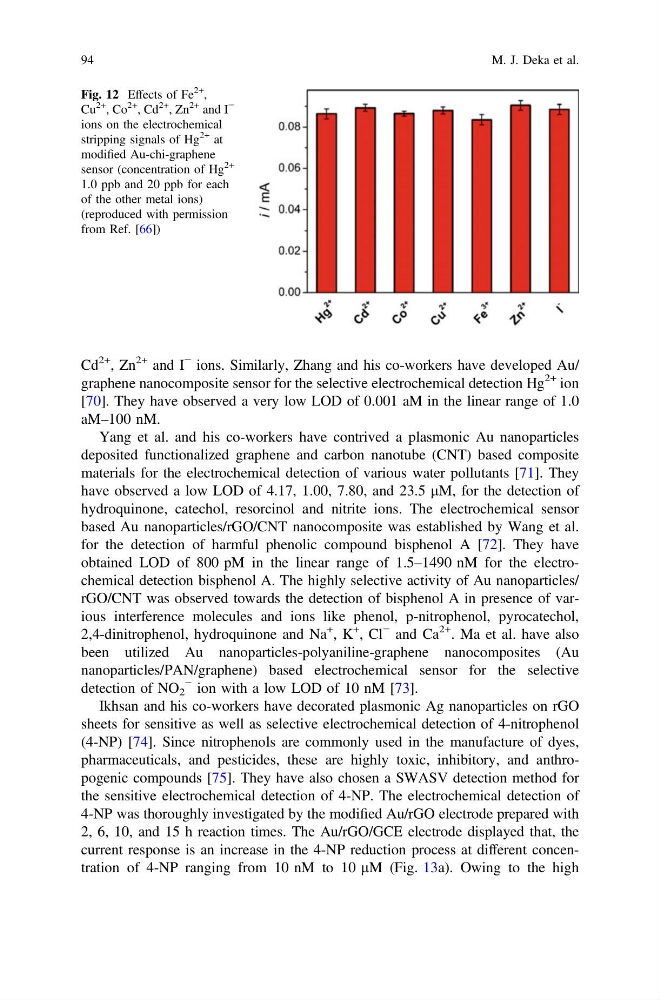
Fig. 12 Effects of Fe
2+ ,
Cu
2+ , Co
2+ , Cd
2+ , Zn
2+ and I
−
ions on the electrochemical
stripping signals of Hg
2+ at
modified Au-chi-graphene
sensor (concentration of Hg
2+
1.0 ppb and 20 ppb for each
of the other metal ions)
(reproduced with permission
from Ref. [66])
94
M. J. Deka et al.
2+ , Zn
2+ and I
− ions. Similarly, Zhang and his co-workers have developed Au/
graphene nanocomposite sensor for the selective electrochemical detection Hg
2+ ion
[70]. They have observed a very low LOD of 0.001 aM in the linear range of 1.0
aM–100 nM.
Yang et al. and his co-workers have contrived a plasmonic Au nanoparticles
deposited functionalized graphene and carbon nanotube (CNT) based composite
materials for the electrochemical detection of various water pollutants [71]. They
have observed a low LOD of 4.17, 1.00, 7.80, and 23.5 lM, for the detection of
hydroquinone, catechol, resorcinol and nitrite ions. The electrochemical sensor
based Au nanoparticles/rGO/CNT nanocomposite was established by Wang et al.
for the detection of harmful phenolic compound bisphenol A [72]. They have
obtained LOD of 800 pM in the linear range of 1.5–1490 nM for the electrochemical detection bisphenol A. The highly selective activity of Au nanoparticles/
rGO/CNT was observed towards the detection of bisphenol A in presence of various interference molecules and ions like phenol, p-nitrophenol, pyrocatechol,
2,4-dinitrophenol, hydroquinone and Na
+
, K
+
, Cl
− and Ca
2+ . Ma et al. have also
been utilized Au nanoparticles-polyaniline-graphene nanocomposites (Au
nanoparticles/PAN/graphene) based electrochemical sensor for the selective
detection of NO 2
− ion with a low LOD of 10 nM [73].
Ikhsan and his co-workers have decorated plasmonic Ag nanoparticles on rGO
sheets for sensitive as well as selective electrochemical detection of 4-nitrophenol
(4-NP) [74]. Since nitrophenols are commonly used in the manufacture of dyes,
pharmaceuticals, and pesticides, these are highly toxic, inhibitory, and anthropogenic compounds [75]. They have also chosen a SWASV detection method for
the sensitive electrochemical detection of 4-NP. The electrochemical detection of
4-NP was thoroughly investigated by the modified Au/rGO electrode prepared with
2, 6, 10, and 15 h reaction times. The Au/rGO/GCE electrode displayed that, the
current response is an increase in the 4-NP reduction process at different concentration of 4-NP ranging from 10 nM to 10 lM (Fig. 13a). Owing to the high
Fig. 12 Effects of Fe
2+ ,
Cu
2+ , Co
2+ , Cd
2+ , Zn
2+ and I
−
ions on the electrochemical
stripping signals of Hg
2+ at
modified Au-chi-graphene
sensor (concentration of Hg
2+
1.0 ppb and 20 ppb for each
of the other metal ions)
(reproduced with permission
from Ref. [66])
94
M. J. Deka et al.