

Gong et al. synthesized monodispersed Au nanoparticles on graphene for the
electrochemical detection of Hg (II) ion. The Au nanoparticles decorated graphene
(Au nanoparticles-chi-graphene) could greatly enhance the electron transfer process
between electrode and Hg
2+ , which exhibited excellent performance for the
detection of Hg
2+ ion [66]. They have used three electrode systems such as glassy
carbon electrode (working electrode), calomel electrode (reference electrode), and
auxiliary electrode (platinum wire). Square wave anodic stripping voltammetry
(SWASV) was utilized for the continuous determination of Hg
2+ ions. SWASV
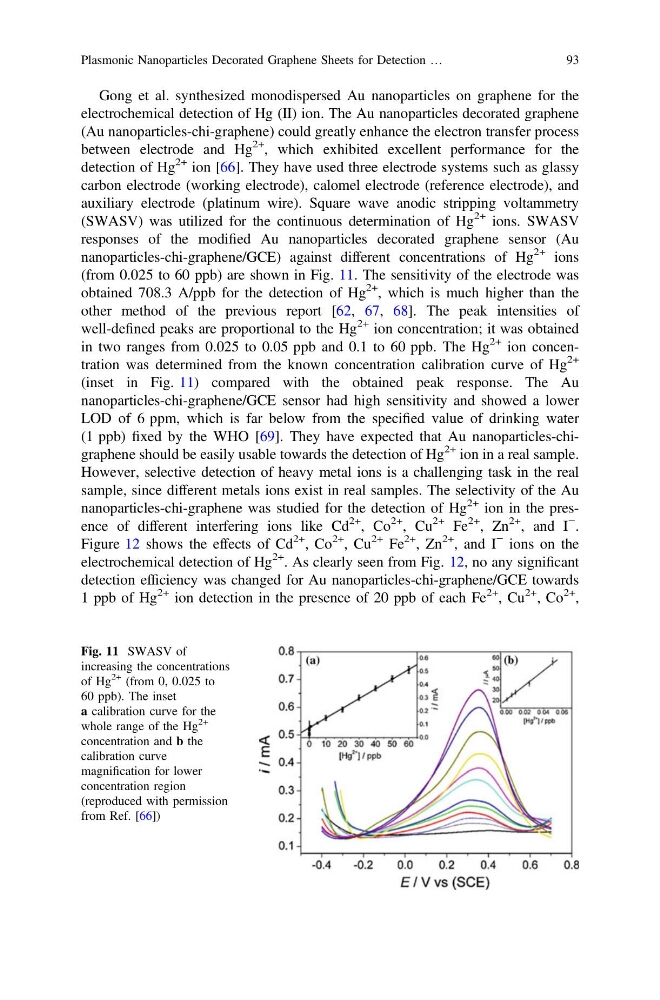
responses of the modified Au nanoparticles decorated graphene sensor (Au
nanoparticles-chi-graphene/GCE) against different concentrations of Hg
2+ ions
(from 0.025 to 60 ppb) are shown in Fig. 11. The sensitivity of the electrode was
obtained 708.3 A/ppb for the detection of Hg
2+ , which is much higher than the
other method of the previous report [62, 67, 68]. The peak intensities of
well-defined peaks are proportional to the Hg
2+ ion concentration; it was obtained
in two ranges from 0.025 to 0.05 ppb and 0.1 to 60 ppb. The Hg
2+ ion concentration was determined from the known concentration calibration curve of Hg
2+
(inset in Fig. 11) compared with the obtained peak response. The Au
nanoparticles-chi-graphene/GCE sensor had high sensitivity and showed a lower
LOD of 6 ppm, which is far below from the specified value of drinking water
(1 ppb) fixed by the WHO [69]. They have expected that Au nanoparticles-chigraphene should be easily usable towards the detection of Hg
2+ ion in a real sample.
However, selective detection of heavy metal ions is a challenging task in the real
sample, since different metals ions exist in real samples. The selectivity of the Au
nanoparticles-chi-graphene was studied for the detection of Hg
2+ ion in the presence of different interfering ions like Cd
2+ , Co
2+ , Cu
2+ Fe
2+ , Zn
2+ , and I
− .
Figure 12 shows the effects of Cd
2+ , Co
2+ , Cu
2+ Fe
2+ , Zn
2+ , and I
− ions on the
electrochemical detection of Hg
2+ . As clearly seen from Fig. 12, no any significant
detection efficiency was changed for Au nanoparticles-chi-graphene/GCE towards
1 ppb of Hg
2+ ion detection in the presence of 20 ppb of each Fe
2+ , Cu
2+ , Co
2+ ,
Fig. 11 SWASV of
increasing the concentrations
of Hg
2+ (from 0, 0.025 to
60 ppb). The inset
a calibration curve for the
whole range of the Hg
2+
concentration and b the
calibration curve
magnification for lower
concentration region
(reproduced with permission
from Ref. [66])
Plasmonic Nanoparticles Decorated Graphene Sheets for Detection …
93
electrochemical detection of Hg (II) ion. The Au nanoparticles decorated graphene
(Au nanoparticles-chi-graphene) could greatly enhance the electron transfer process
between electrode and Hg
2+ , which exhibited excellent performance for the
detection of Hg
2+ ion [66]. They have used three electrode systems such as glassy
carbon electrode (working electrode), calomel electrode (reference electrode), and
auxiliary electrode (platinum wire). Square wave anodic stripping voltammetry
(SWASV) was utilized for the continuous determination of Hg
2+ ions. SWASV
responses of the modified Au nanoparticles decorated graphene sensor (Au
nanoparticles-chi-graphene/GCE) against different concentrations of Hg
2+ ions
(from 0.025 to 60 ppb) are shown in Fig. 11. The sensitivity of the electrode was
obtained 708.3 A/ppb for the detection of Hg
2+ , which is much higher than the
other method of the previous report [62, 67, 68]. The peak intensities of
well-defined peaks are proportional to the Hg
2+ ion concentration; it was obtained
in two ranges from 0.025 to 0.05 ppb and 0.1 to 60 ppb. The Hg
2+ ion concentration was determined from the known concentration calibration curve of Hg
2+
(inset in Fig. 11) compared with the obtained peak response. The Au
nanoparticles-chi-graphene/GCE sensor had high sensitivity and showed a lower
LOD of 6 ppm, which is far below from the specified value of drinking water
(1 ppb) fixed by the WHO [69]. They have expected that Au nanoparticles-chigraphene should be easily usable towards the detection of Hg
2+ ion in a real sample.
However, selective detection of heavy metal ions is a challenging task in the real
sample, since different metals ions exist in real samples. The selectivity of the Au
nanoparticles-chi-graphene was studied for the detection of Hg
2+ ion in the presence of different interfering ions like Cd
2+ , Co
2+ , Cu
2+ Fe
2+ , Zn
2+ , and I
− .
Figure 12 shows the effects of Cd
2+ , Co
2+ , Cu
2+ Fe
2+ , Zn
2+ , and I
− ions on the
electrochemical detection of Hg
2+ . As clearly seen from Fig. 12, no any significant
detection efficiency was changed for Au nanoparticles-chi-graphene/GCE towards
1 ppb of Hg
2+ ion detection in the presence of 20 ppb of each Fe
2+ , Cu
2+ , Co
2+ ,
Fig. 11 SWASV of
increasing the concentrations
of Hg
2+ (from 0, 0.025 to
60 ppb). The inset
a calibration curve for the
whole range of the Hg
2+
concentration and b the
calibration curve
magnification for lower
concentration region
(reproduced with permission
from Ref. [66])
Plasmonic Nanoparticles Decorated Graphene Sheets for Detection …
93